
What is rounding to the nearest ten?
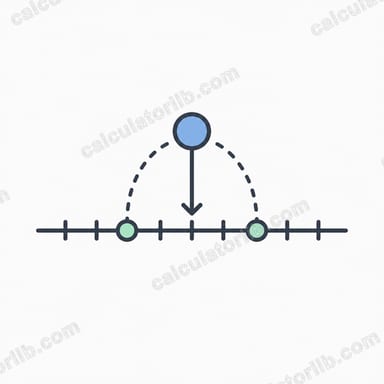
Rounding to the nearest ten replaces a number with the closest multiple of 10 — for example, 0, 10, 20, 30, and so on. It is one of the most common forms of rounding, used to simplify numbers, make quick mental estimates, and present tidy figures. This calculator does it instantly for any whole number or decimal.
How to use this calculator
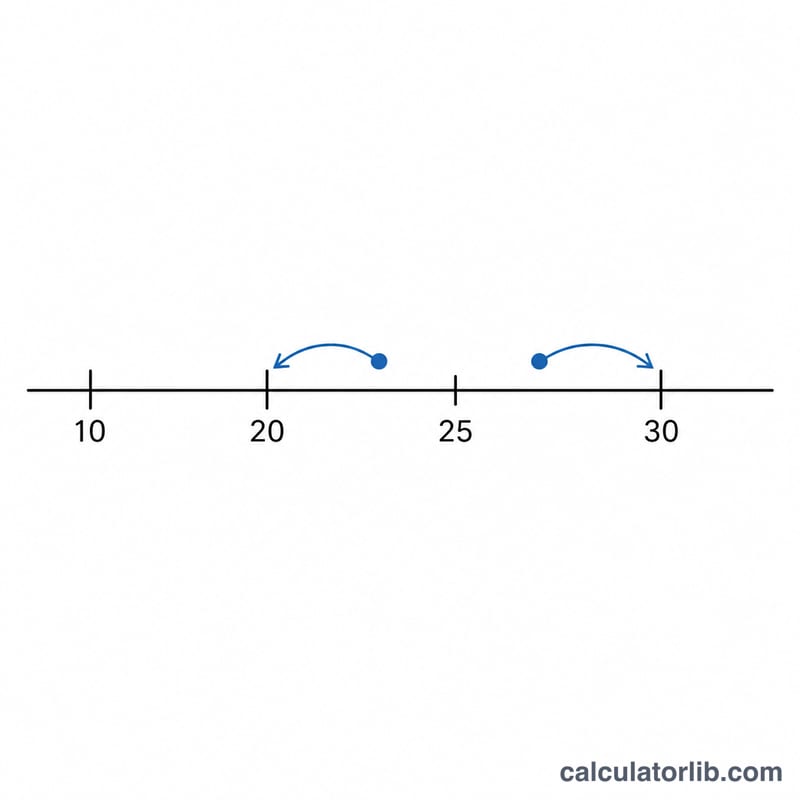
Type any number into the input box and the calculator returns its value rounded to the nearest ten. It works for positive numbers, negative numbers, and decimals alike. The result is always a multiple of 10 that sits closest to your original value.
The formula explained
The rule is $$\text{Rounded} = \left\lfloor \frac{\text{Number}}{10} \right\rceil \times 10$$ First you divide the number by 10, then round that result to the nearest whole number (digits 0–4 round down, 5–9 round up), and finally multiply by 10 to scale back up. The decisive digit is the ones place: if it is 5 or more you round up, otherwise you round down.
Worked example
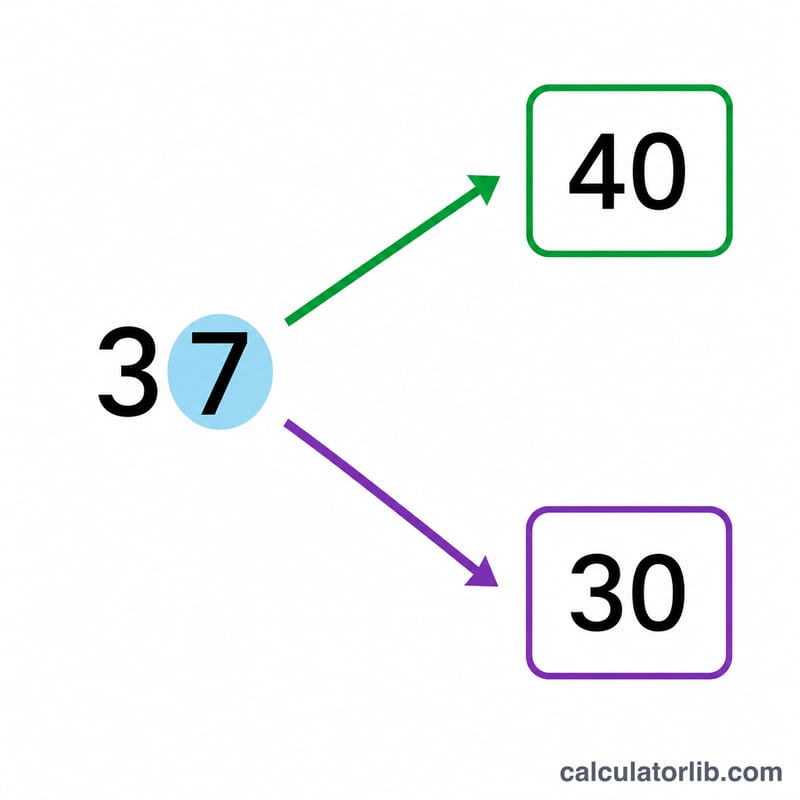
Take 47. Divide by 10 to get 4.7, round to 5, then multiply by 10 to get 50. Because the ones digit (7) is 5 or greater, 47 rounds up to 50. By contrast, 43 has a ones digit of 3, so it rounds down to 40.
$$\text{Rounded} = \left\lfloor \frac{47}{10} \right\rceil \times 10 = \lfloor 4.7 \rceil \times 10 = 5 \times 10 = 50$$
FAQ
What about a number ending in 5, like 25? Using standard "round half up" rules, 25 rounds to 30.
Does it work with decimals? Yes. For example, 12.4 rounds to 10 and 16.8 rounds to 20.
How are negative numbers handled? They round to the nearest ten as well; for instance, -47 rounds to -50 and -43 rounds to -40.