
What this calculator does
This tool computes the gravitational pull and the tidal (differential) force that the Moon and the Sun exert on the Earth, expressed per unit mass (N/kg, equivalent to m/s^2). It also reports the Moon's tidal force at perigee (closest approach) and gives each tidal force as a ratio relative to that perigee value. It is a pure-physics tool based on Newtonian gravity and the standard tidal-force approximation, so it applies identically everywhere on Earth.
How to use it
Enter the Moon's mass and mean distance, the Moon's orbital eccentricity, and the Sun's mass and mean distance. Masses are in kilograms; distances are in kilometres (converted internally to metres). The gravitational constant \(G = 6.67430 \times 10^{-11}\ \text{m}^3\,\text{kg}^{-1}\,\text{s}^{-2}\) and the mean Earth radius \(R = 6.371 \times 10^{6}\ \text{m}\) are fixed constants and are not editable.
The formulas explained
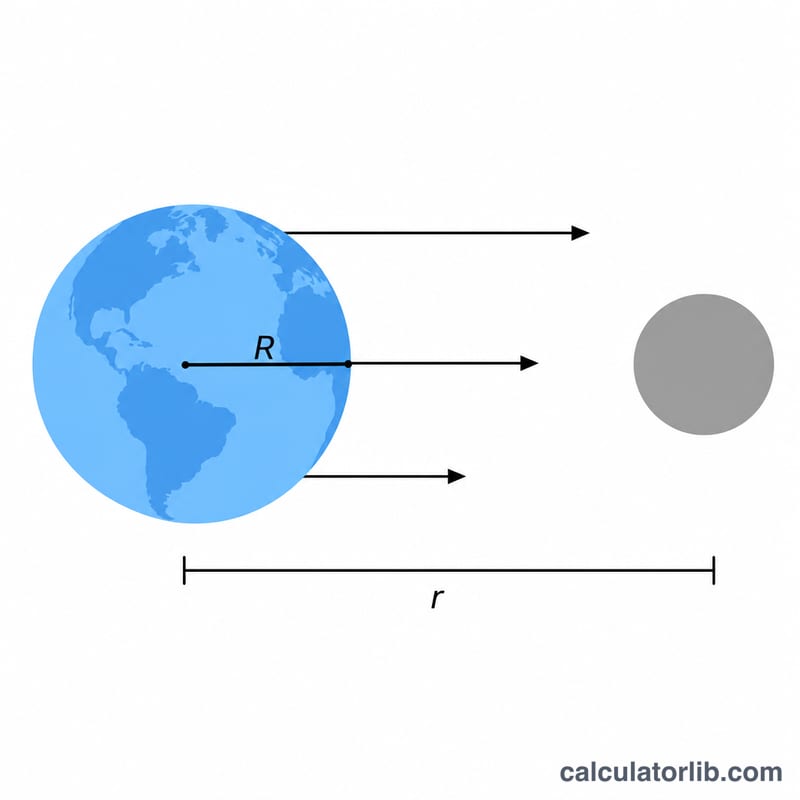
The gravitational acceleration of a body of mass \(M\) at distance \(r\) from Earth's center is
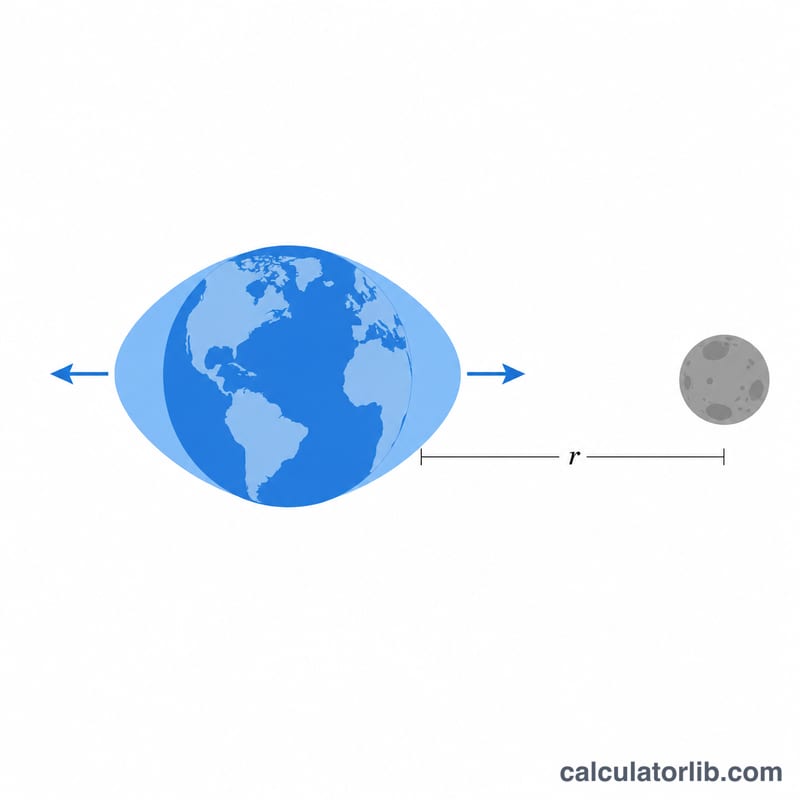
$$g = \frac{G \cdot M}{r^{2}}$$The tidal force is the difference in that pull across the Earth's radius \(R\): to leading order it equals
$$F_{\text{tidal}} = \frac{2 \cdot G \cdot M \cdot R}{r^{3}}$$Because the tidal term falls off as \(1/r^{3}\) rather than \(1/r^{2}\), the nearby Moon can dominate the distant, far more massive Sun. The Moon's perigee distance follows from the semi-major axis \(a\) and eccentricity \(e\) as \(r_p = a(1 - e)\).
Worked example (defaults)
With \(M_{\text{moon}} = 7.347673 \times 10^{22}\ \text{kg}\) at \(r = 384{,}399\ \text{km}\), the mean Moon tidal force is about \(1.10 \times 10^{-6}\ \text{N/kg}\). The Sun (\(1.9891 \times 10^{30}\ \text{kg}\) at 1 AU) gives about \(5.05 \times 10^{-7}\ \text{N/kg}\). At perigee,
$$r_p = 384{,}399 \times (1 - 0.0549) = 363{,}295\ \text{km}$$raising the Moon's tidal force to about \(1.30 \times 10^{-6}\ \text{N/kg}\). The ratios become \(\text{Moon(mean)}/\text{Moon(perigee)} = 0.844\) and \(\text{Sun}/\text{Moon(perigee)} = 0.388\).
FAQ
Why is the Sun's tidal force smaller than the Moon's? Although the Sun is vastly more massive, tidal force scales as \(1/r^{3}\), and the Sun is roughly 390 times farther away. The Sun's tide-raising effect is only about 40-46% of the Moon's.
What does "per unit mass" mean? The results are accelerations (N/kg = m/s^2). To get the force on a specific object, multiply by its mass in kg.
Why are my numbers slightly different from textbooks? The exact value depends on the chosen \(G\) and Earth radius \(R\), and on whether higher-order tidal terms are included. This tool uses the leading-order approximation, valid because \(R\) is far smaller than \(r\).