
What Are Compatible Numbers?
Compatible numbers are values that have been rounded to nearby, convenient figures so an arithmetic problem becomes easy to do in your head. Instead of multiplying \(247 \times 18\), you might use \(200 \times 20 = 4{,}000\) to get a quick ballpark answer. This calculator rounds each operand to its leading place value, performs your chosen operation, and shows how close the estimate is to the exact result.
How to Use It
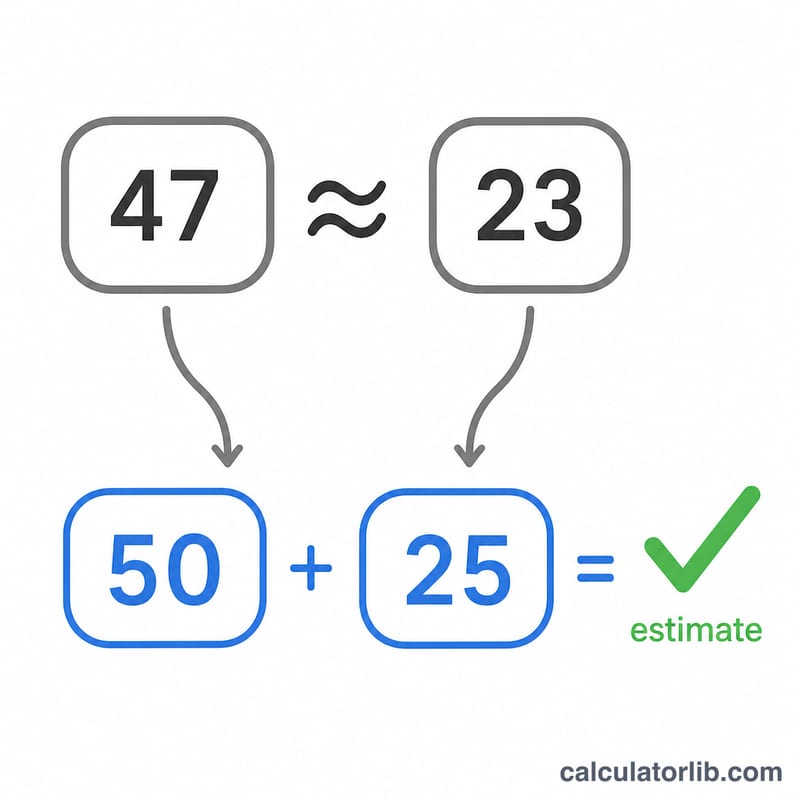
Enter your first and second numbers, pick an operation (add, subtract, multiply or divide), and submit. The tool rounds each number to the nearest "nice" magnitude (tens, hundreds, thousands, etc.), computes the estimate, and reports the exact answer alongside the absolute and percent error so you can judge the estimate's quality.
The Formula
Each operand a is rounded using its order of magnitude: find the power of ten just below \(|a|\), then round a to the nearest multiple of that power. For example, 247 rounds to 200 (nearest hundred) and 18 rounds to 20 (nearest ten). The estimate is simply round(a) □ round(b), where □ is your operation.
$$\text{Estimate} = R_1 \times R_2 \qquad R_i = \text{round}\!\left(\frac{x_i}{10^{\lfloor \log_{10}|x_i| \rfloor}}\right)\cdot 10^{\lfloor \log_{10}|x_i| \rfloor}$$Worked Example
For \(247 \times 18\): round \(247 \to 200\) and \(18 \to 20\).
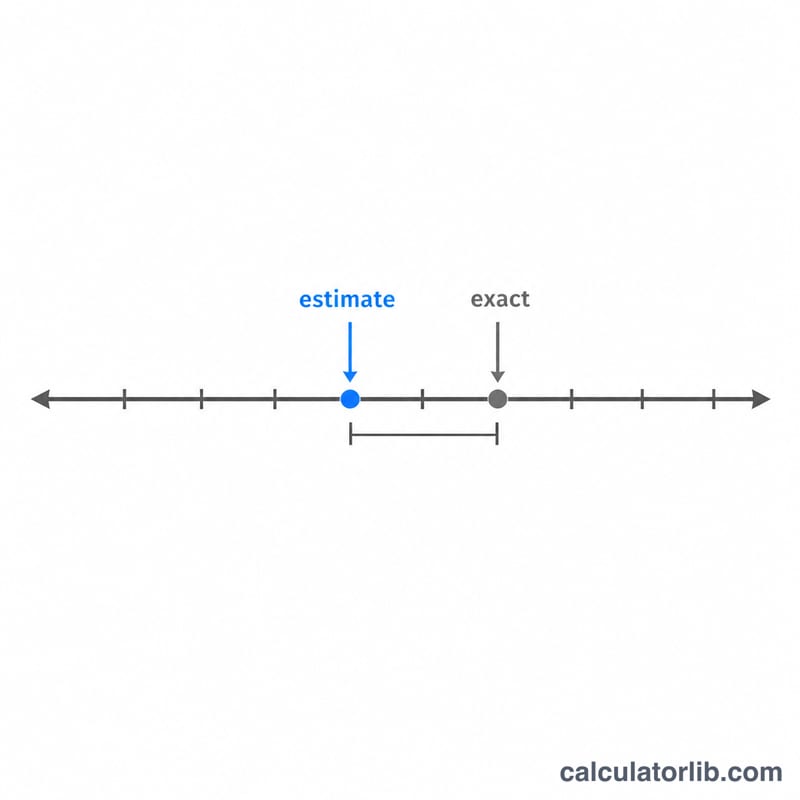
$$\text{Estimate} = 200 \times 20 = 4{,}000$$The exact product is \(4{,}446\), so the absolute error is \(-446\) and the percent error is about \(10\%\). A handy estimate confirms the real answer is in the right ballpark.
FAQ
Why use compatible numbers? They let you estimate quickly and sanity-check a calculator or written answer for big mistakes.
Are estimates always accurate? No — they trade precision for speed. The percent error here tells you how rough the estimate is.
Does it work for decimals? Yes. Any number is rounded to its leading place value, including values below one.