
What Is the Distributive Property?
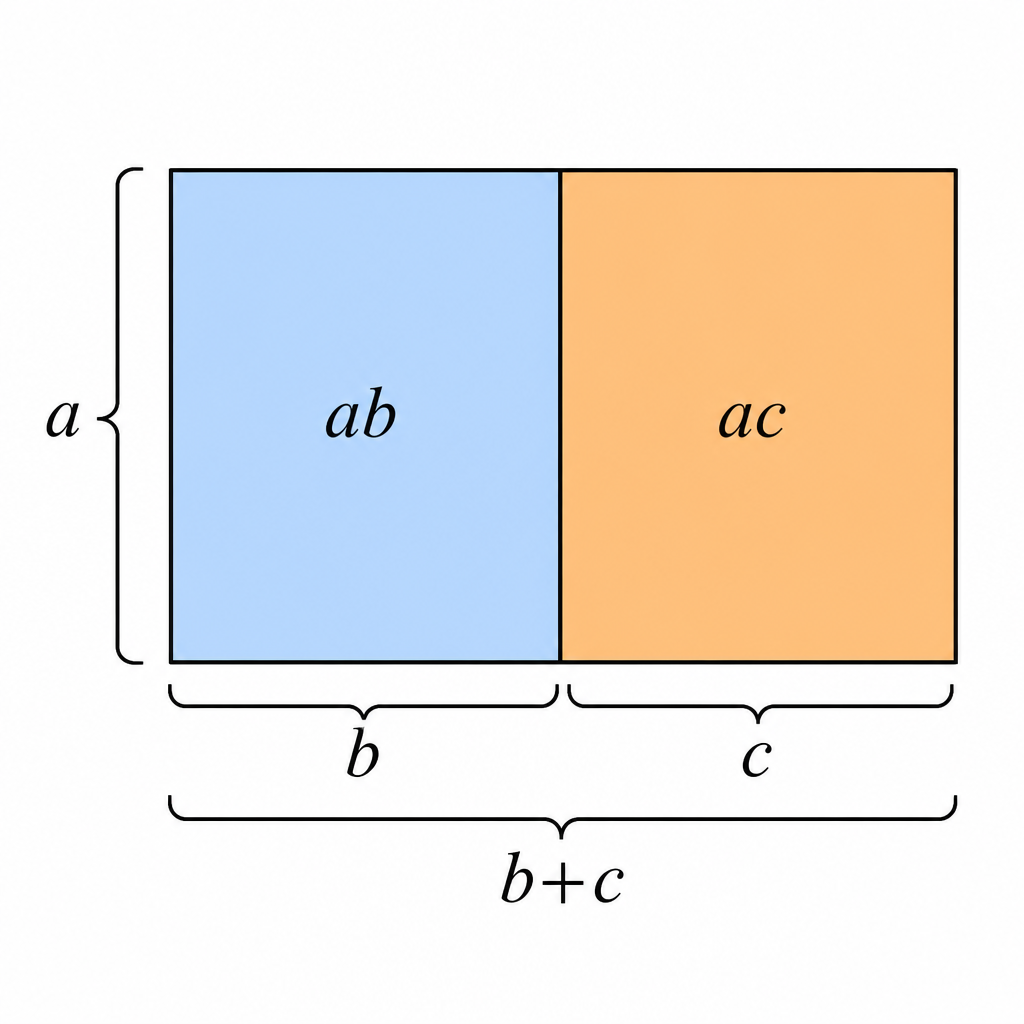
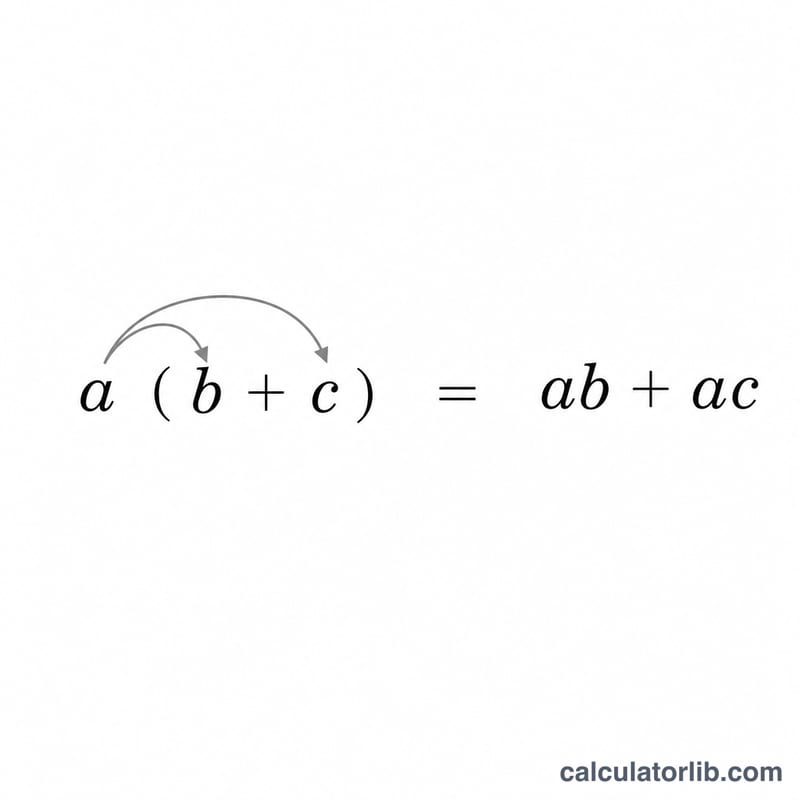
The distributive property is a fundamental rule of arithmetic and algebra stating that multiplying a single value by a sum is the same as multiplying that value by each term separately and then adding the products. In symbols: \(a(b + c) = ab + ac\). This calculator expands the expression and shows each step so you can see exactly how the result is built.
How to Use This Calculator
Enter the outside multiplier a, then the two terms inside the parentheses, b and c. The calculator computes the inner sum (b + c), the individual products (a × b and a × c), and the final total. All three inputs accept decimals and negative numbers.
The Formula Explained
The distributive property lets you "distribute" the factor across addition. Instead of adding first, you can multiply each term by a and add afterward — both paths give the same answer. This is the backbone of expanding brackets, factoring, and mental-math shortcuts like \(6 \times 23 = 6(20 + 3) = 120 + 18 = 138\).
Worked Example
Suppose a = 3, b = 4, c = 5. First find b + c = 9, so $$a(b + c) = 3 \times 9 = 27.$$ Distributing: \(ab = 3 \times 4 = 12\) and \(ac = 3 \times 5 = 15\), then \(ab + ac = 12 + 15 = 27\). Both methods agree — the result is 27.
FAQ
Does it work with negatives? Yes. For example, \(2(-3 + 5) = 2(2) = 4\), matching \((2 \times -3) + (2 \times 5) = -6 + 10 = 4\).
Can a, b, or c be decimals? Yes, any real numbers are accepted.
What about subtraction? \(a(b - c)\) is the same as \(a(b + (-c))\); just enter c as a negative number.