
What the Secant Calculator Does
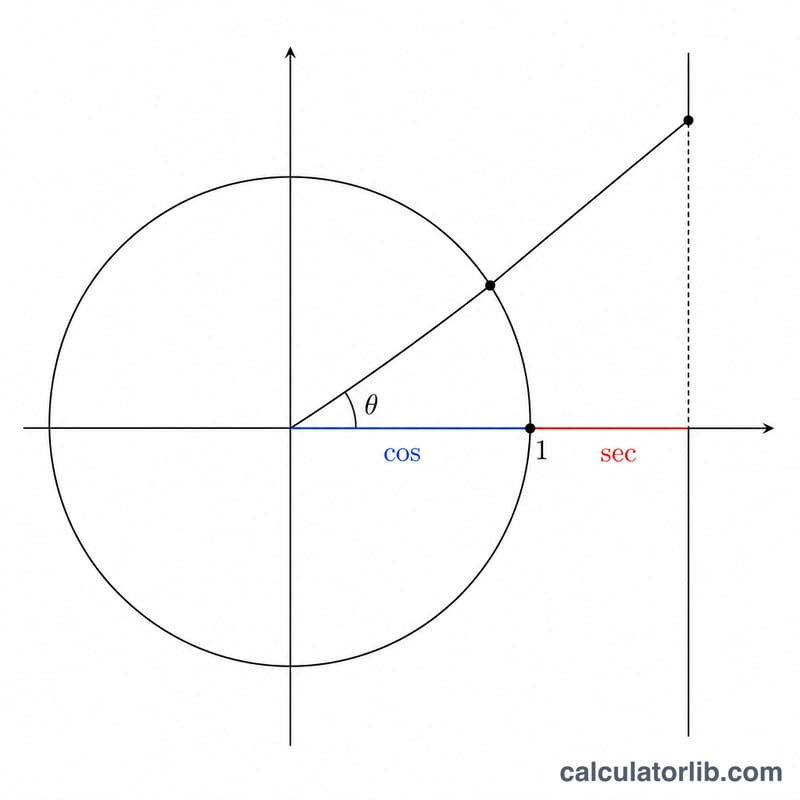
This Secant Calculator takes a single angle, measured in degrees, and returns its secant — written as sec(θ). Secant is one of the six core trigonometric functions and is defined as the reciprocal of cosine. Because most everyday angles (30°, 45°, 60°, 90°) are quoted in degrees rather than radians, the tool also converts your angle to radians so you can see exactly what value is being fed into the cosine function.
How to Use It
- Type your angle into the Angle (in degrees) field — for example, 60.
- The calculator converts the degrees to radians.
- It then computes the cosine and takes its reciprocal to give sec(θ).
- You see the secant value plus the equivalent angle in radians.
The Formula Explained
The calculator uses:
$$\sec(\theta) = \frac{1}{\cos\left(\frac{\pi}{180} \cdot \theta\right)}$$
The factor \(\pi/180\) converts degrees to radians, because trigonometric functions in mathematics and in code operate on radians. Once the cosine of that radian value is found, the calculator divides 1 by it. In short, secant tells you how the reciprocal of cosine behaves as the angle changes.
Worked Example
Suppose you enter 60 degrees:
- Convert to radians: \(60 \times (\pi/180) \approx 1.0472\) rad.
- \(\cos(1.0472) = 0.5\).
- $$\sec(60°) = \frac{1}{0.5} = 2$$
So the calculator displays a secant of 2 and a radian value of about 1.0472 — matching the known textbook result.
Frequently Asked Questions
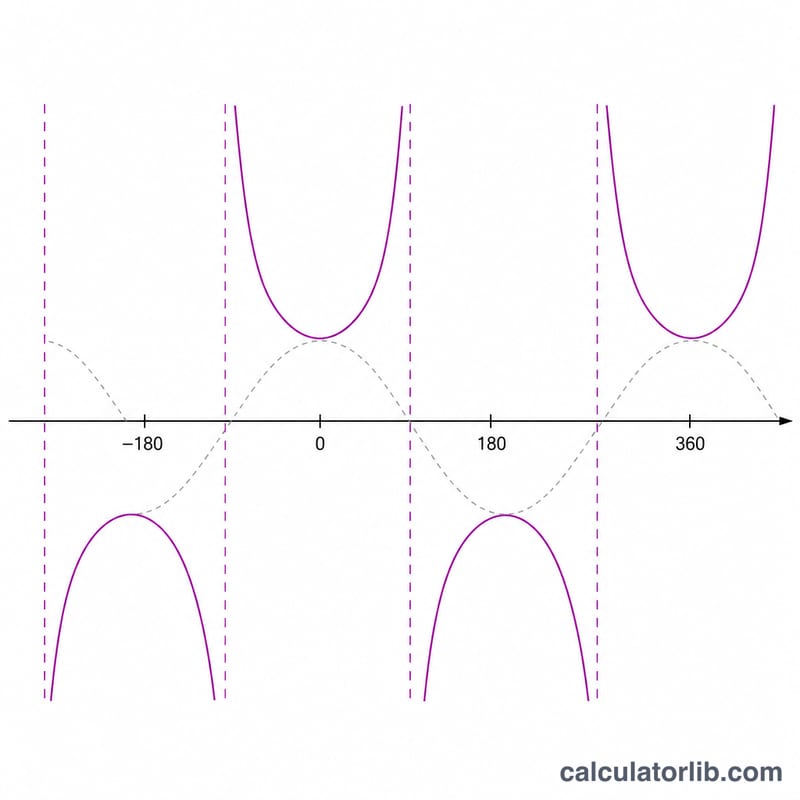
Why does the calculator show an extremely large or undefined-looking result at 90°? Because cos(90°) = 0, and dividing 1 by 0 is mathematically undefined. Secant has vertical asymptotes at 90°, 270°, and every 180° from there, so values near those angles shoot toward infinity.
Can I enter negative angles or values over 360°? Yes. The cosine function is periodic and defined for all real angles, so negative and large inputs work fine — for instance, sec(-60°) also equals 2, since cosine is an even function.
What's the difference between secant and cosine? Secant is simply the reciprocal of cosine: \(\sec(\theta) = 1/\cos(\theta)\). When cosine is small, secant is large, and vice versa. The minimum absolute value of secant is 1, occurring where cosine equals ±1 (at 0°, 180°, etc.).