
What Is Average Atomic Mass?
The average atomic mass (also called atomic weight) of an element is the weighted mean of the masses of all its naturally occurring isotopes. Because isotopes of the same element differ in the number of neutrons, they have different masses. The value reported on the periodic table reflects how much of each isotope exists in nature, weighted by its relative abundance.
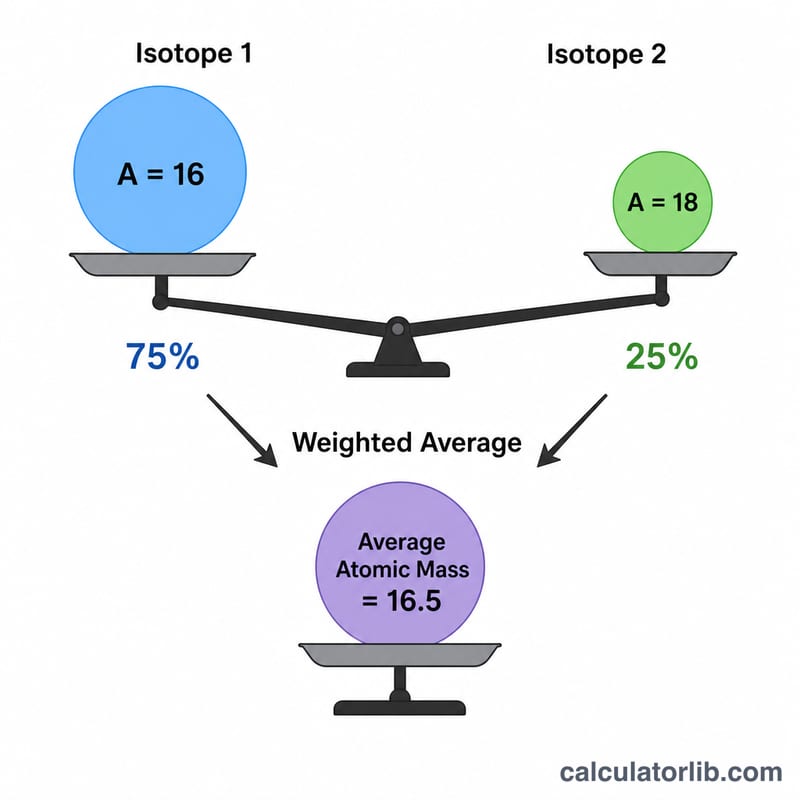
How to Use This Calculator
Enter the mass (in atomic mass units, amu) and the percent natural abundance for each isotope of the element. You can enter up to three isotopes; leave unused rows blank. The abundances should add up to roughly 100%. Click calculate to get the element's average atomic mass.
The Formula Explained
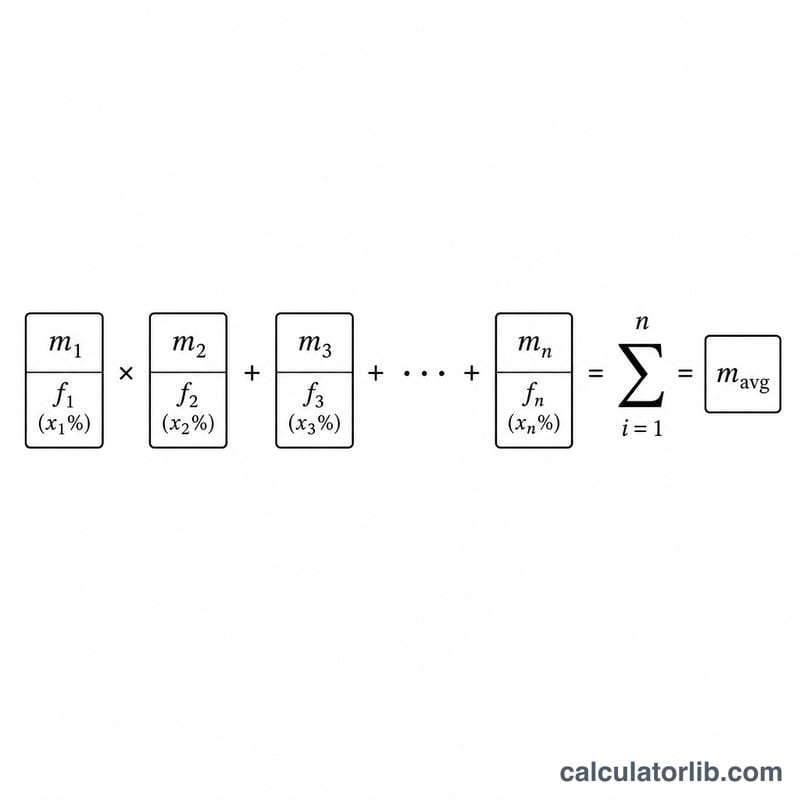
The average atomic mass is calculated as:
$$\text{Average Atomic Mass} = \sum (\text{Isotope Mass} \times \text{Fractional Abundance})$$
Here, the fractional abundance is the percent abundance divided by 100. So for each isotope you multiply its mass by its decimal abundance, then add all the products together. This gives a single weighted average that represents the element as it occurs naturally.
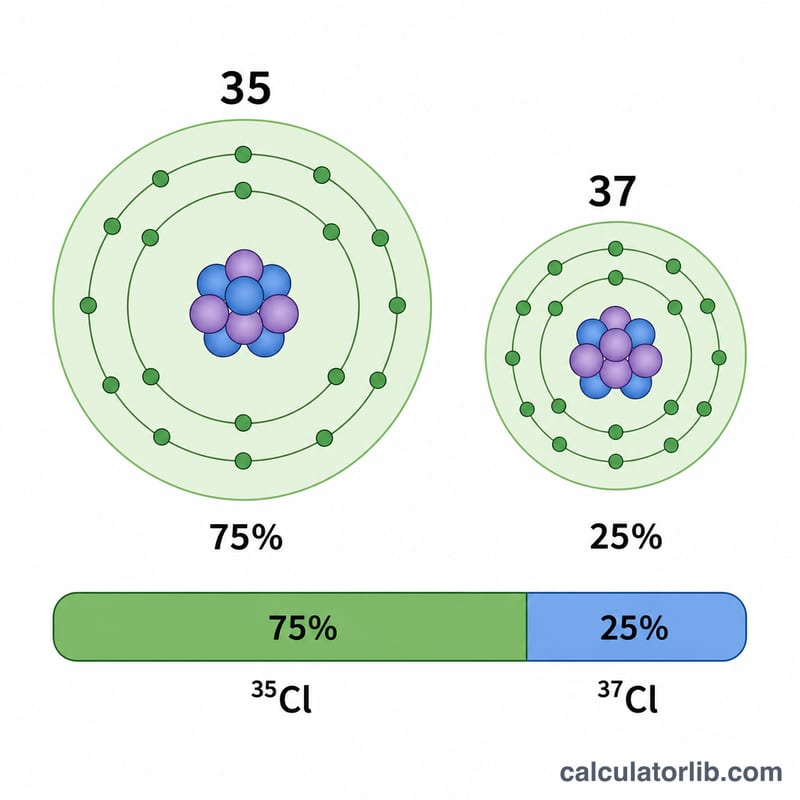
Worked Example: Chlorine
Chlorine has two stable isotopes. Chlorine-35 has a mass of 34.96885 amu with 75.77% abundance, and chlorine-37 has a mass of 36.96590 amu with 24.23% abundance.
$$(34.96885 \times 0.7577) + (36.96590 \times 0.2423) = 26.4959 + 8.9568 = 35.4527 \text{ amu}$$
This matches the value of about 35.45 amu shown for chlorine on the periodic table.
Isotope Masses and Natural Abundances of Common Elements
The values below are the standard isotopic masses (in unified atomic mass units, u) and the representative natural percent abundances published by IUPAC/CIAAW. Abundances vary slightly between terrestrial samples, so the figures shown are widely used representative values. Each element's stable isotopes are listed; abundances for an element's isotopes sum to 100%.
| Element | Isotope | Isotopic mass (u) | Abundance (%) |
|---|---|---|---|
| Hydrogen | ¹H | 1.007825 | 99.9885 |
| ²H (D) | 2.014102 | 0.0115 | |
| Boron | ¹⁰B | 10.012937 | 19.9 |
| ¹¹B | 11.009305 | 80.1 | |
| Carbon | ¹²C | 12.000000 | 98.93 |
| ¹³C | 13.003355 | 1.07 | |
| Magnesium | ²⁴Mg | 23.985042 | 78.99 |
| ²⁵Mg | 24.985837 | 10.00 | |
| ²⁶Mg | 25.982593 | 11.01 | |
| Silicon | ²⁸Si | 27.976927 | 92.23 |
| ²⁹Si | 28.976495 | 4.68 | |
| ³⁰Si | 29.973770 | 3.09 | |
| Chlorine | ³⁵Cl | 34.968853 | 75.76 |
| ³⁷Cl | 36.965903 | 24.24 | |
| Copper | ⁶³Cu | 62.929598 | 69.15 |
| ⁶⁵Cu | 64.927790 | 30.85 | |
| Bromine | ⁷⁹Br | 78.918338 | 50.69 |
| ⁸¹Br | 80.916290 | 49.31 |
Key Terms and Definitions
- Isotope
- Atoms of the same element (same number of protons) that differ in their number of neutrons, and therefore in mass. For example, ³⁵Cl and ³⁷Cl are both chlorine.
- Mass number (A)
- The total count of protons plus neutrons in a nucleus, written as the superscript in a nuclide symbol (e.g. the 12 in ¹²C). It is a whole number and labels the isotope.
- Atomic mass unit (amu, u, or Dalton)
- The standard unit for atomic-scale masses, defined as exactly 1/12 the mass of a neutral ¹²C atom. 1 u ≈ 1.66054 × 10⁻²⁴ g. The symbols amu, u, and Da (Dalton) all refer to the same unit.
- Isotopic mass
- The actual measured mass of a single isotope expressed in u. It is close to, but not exactly equal to, the mass number because of nuclear binding energy and the proton/neutron mass difference (e.g. ¹¹B has an isotopic mass of 11.0093 u).
- Percent abundance
- The fraction of an element's atoms that are a given isotope, expressed as a percentage (0–100%). The abundances of all of an element's isotopes add up to 100%.
- Fractional abundance
- The same quantity written as a decimal fraction (0–1) instead of a percentage — simply the percent abundance divided by 100. Using fractional abundances lets you take the weighted sum directly without dividing by 100.
- Average atomic mass (atomic weight)
- The abundance-weighted mean of the isotopic masses of an element, in u. This is the value printed on the periodic table and used as the molar mass (g/mol) in mole calculations. It is computed as \(\bar{M} = \sum (\text{isotopic mass} \times \text{fractional abundance})\).
FAQ
Why isn't the average a whole number? Because it is a weighted average of isotopes with different abundances, the result is rarely a clean integer.
Do abundances have to total 100%? Yes — natural abundances of all isotopes of an element should sum to 100%. Small rounding differences are fine.
What units does the result use? Atomic mass units (amu), also written as u or Daltons.