
What this calculator does
This tool estimates how many bricks you need to build a flat, rectangular wall. It works by comparing the total area of the wall to the visible face area of a single brick, then adding a waste allowance to cover cuts, breakages and irregularities. It is a universal geometric estimate and works with any brick size in any country.
How to use it
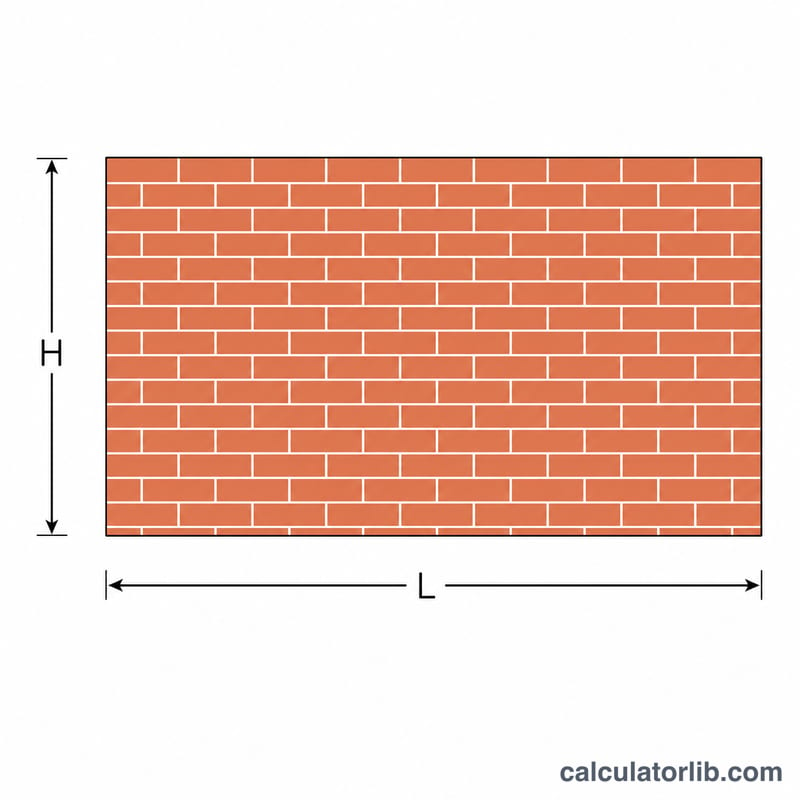
Enter the wall length and height in metres. Enter the brick face dimensions in millimetres — for a standard UK metric brick this is 215 mm long by 65 mm high. Add a waste allowance (5–10% is typical) and read off the total bricks needed. The result also shows the count before waste and the underlying areas.
The formula explained
First the wall area is \(L \times H\). The brick face area is \((l_{b}/1000) \times (h_{b}/1000)\) to convert millimetres into square metres. Dividing wall area by brick face area gives the raw number of bricks, which is rounded up because you cannot buy a fraction of a brick. Finally the result is multiplied by \((1 + \text{waste\%})\) and rounded up again.
$$N = \left\lceil \left\lceil \dfrac{A_{w}}{A_{b}} \right\rceil \cdot \left(1 + \dfrac{\text{Waste (\%)}}{100}\right) \right\rceil$$ $$\text{where}\quad \left\{ \begin{aligned} A_{w} &= \text{Wall Length (m)} \times \text{Wall Height (m)} \\ A_{b} &= \dfrac{\text{Brick Length (mm)}}{1000} \times \dfrac{\text{Brick Height (mm)}}{1000} \end{aligned} \right.$$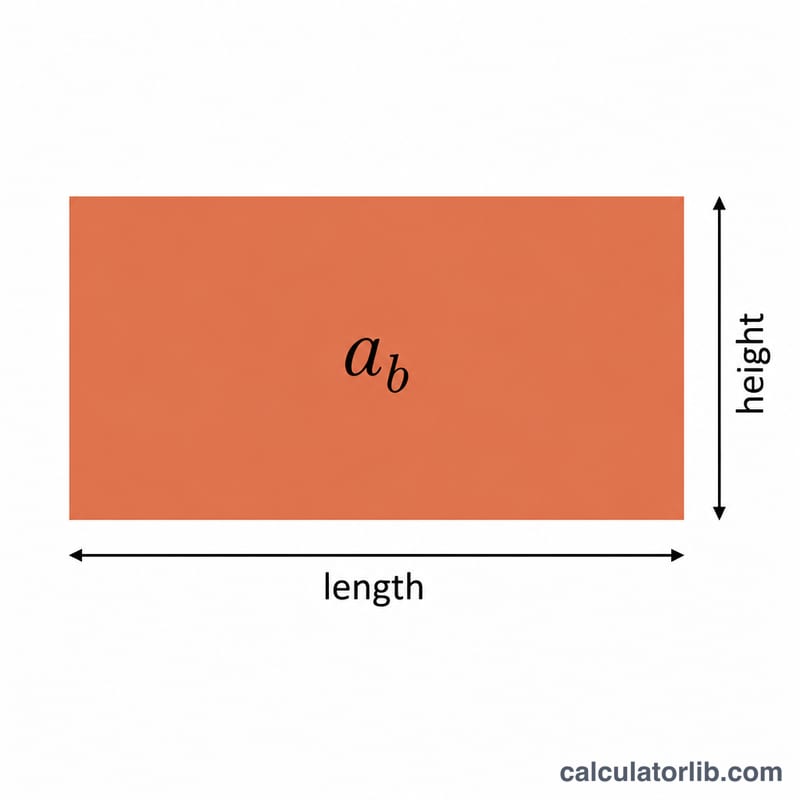
Worked example
A wall 5 m long and 2.5 m high has an area of 12.5 m². A 215 × 65 mm brick face is
$$0.215 \times 0.065 = 0.013975 \ \text{m}^2$$That gives
$$12.5 \div 0.013975 \approx 894.4$$rounded up to 895 bricks. With a 5% waste allowance:
$$895 \times 1.05 = 939.75$$rounded up to 940 bricks.
FAQ
Does this include mortar joints? The brick face dimensions you enter should already reflect the bedded size if you want joints included; otherwise add a few percent extra via the waste field.
Why round up twice? Bricks are whole units, so both the raw count and the waste-adjusted count are rounded up to be safe.
Can I use inches? Convert your brick size to millimetres first (1 inch = 25.4 mm) and the wall to metres.