
What Is the Fundamental Counting Principle?
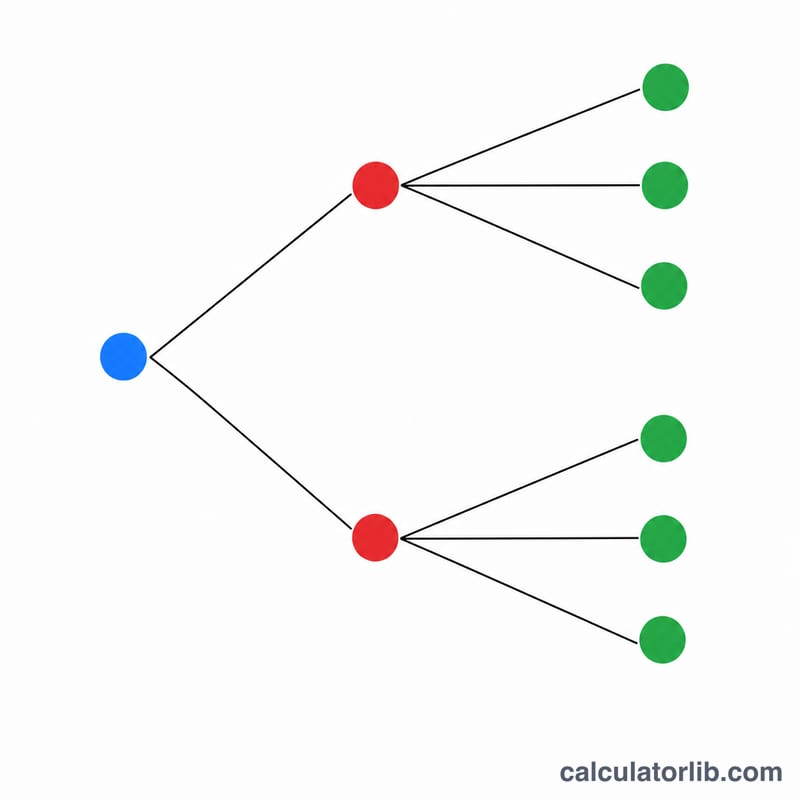
The fundamental counting principle is a core rule in combinatorics. It states that if one event can occur in n₁ ways, a second independent event in n₂ ways, and so on through k events, then the total number of ways all events can occur together is the product \(n_1 \times n_2 \times \cdots \times n_k\). This calculator multiplies the choices you enter for each stage to give the total number of possible outcomes.
How to Use This Calculator
Enter the number of options available at each stage of your process, separated by commas. For example, if you are picking an outfit with 4 shirts, 3 pairs of pants, and 2 pairs of shoes, type 4, 3, 2. The calculator multiplies them and returns the total number of distinct combinations.
The Formula Explained
Each comma-separated value represents an independent decision point. Because the choices are independent, every option in one stage can be paired with every option in another, so the counts multiply rather than add.
$$\text{Total} = n_1 \times n_2 \times \cdots \times n_k$$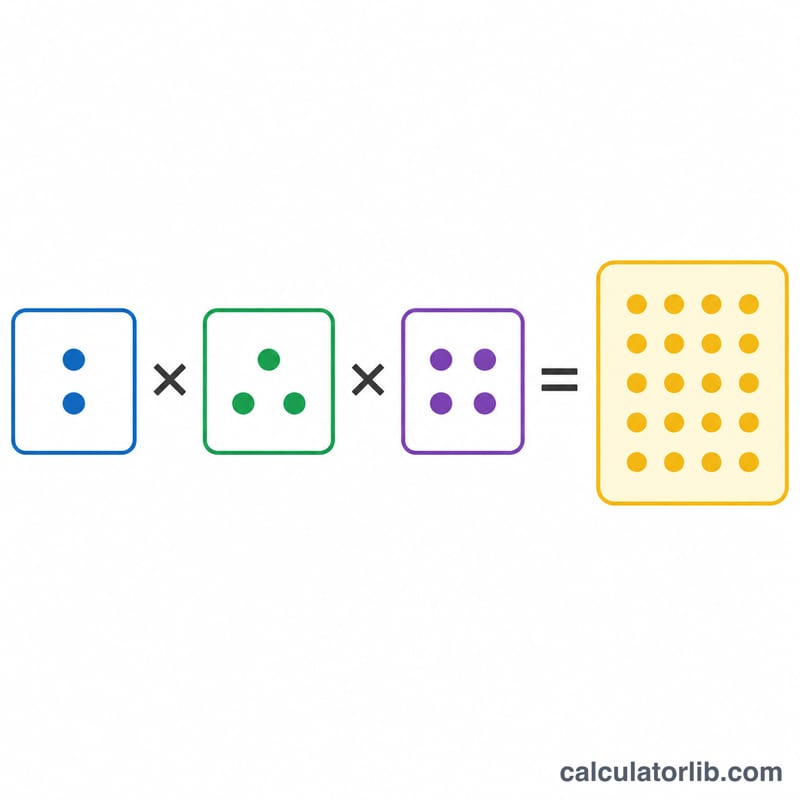
Worked Example
Suppose a restaurant offers 3 appetizers, 5 main courses, and 4 desserts. The number of possible three-course meals is
$$3 \times 5 \times 4 = 60$$There are 60 different ways to build a meal.
FAQ
When does the counting principle apply? It applies when the choices at each stage are independent — the option chosen at one stage does not change the number of options at another.
Can stages have different counts? Yes. Each stage can have any positive number of choices; the principle simply multiplies them.
What if order or repetition matters? The basic principle assumes each stage is a separate, repeatable choice. For permutations or combinations without repetition, use a dedicated permutation or combination calculator.