
What is skin depth?
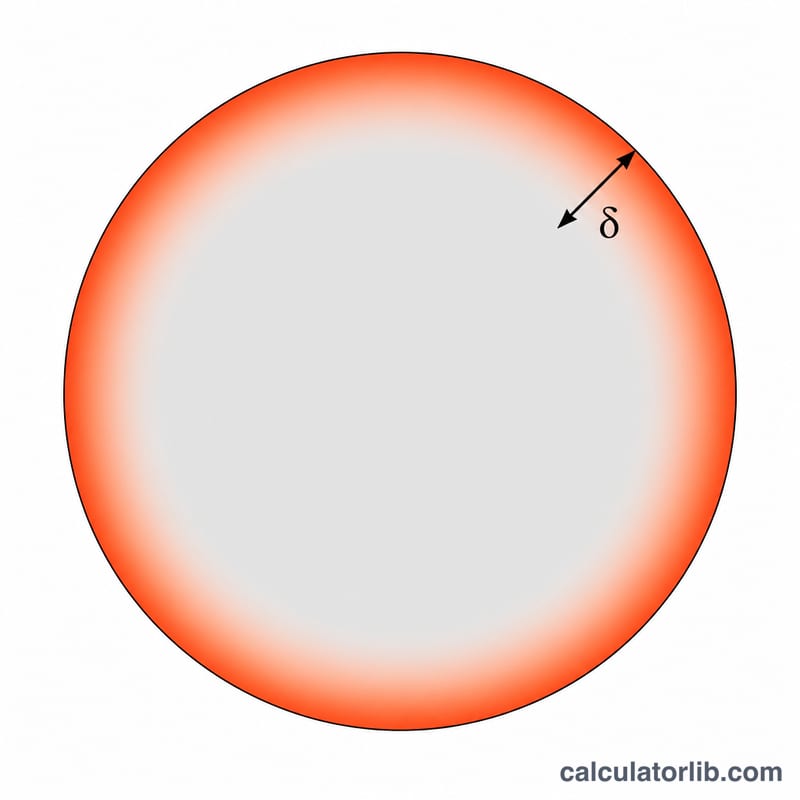
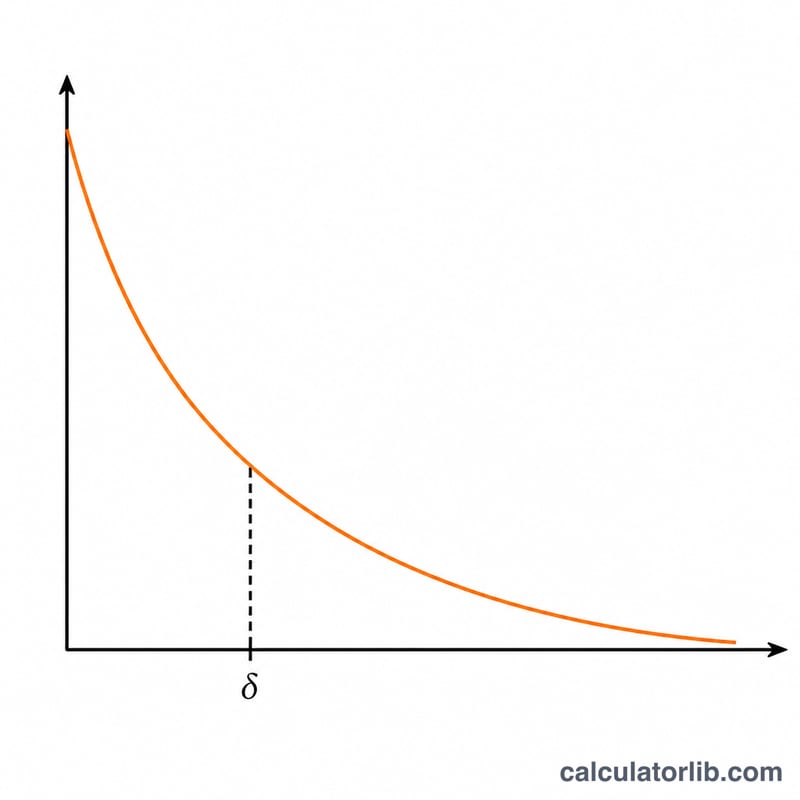
Skin depth (\(\delta\)) describes how deeply an alternating current penetrates into a conductor. Because of the skin effect, AC current concentrates near the conductor's surface, with current density falling off exponentially with depth. The skin depth is the distance at which the current density has dropped to about 37% (\(1/e\)) of its surface value. This calculator works for any conductor and any frequency — it is a universal physics tool.
How to use this calculator
Enter the operating frequency in hertz, the conductor's conductivity \(\sigma\) in siemens per meter, and its relative permeability \(\mu_r\). For most non-magnetic metals such as copper, aluminum and gold, \(\mu_r \approx 1\). For ferromagnetic materials like iron or steel, \(\mu_r\) can be in the hundreds or thousands. The result is reported in micrometers, millimeters and meters, plus the resistivity \(\rho = 1/\sigma\).
The formula explained
The skin depth is $$\delta = \dfrac{1}{\sqrt{\pi \, f \cdot \mu \cdot \sigma}},$$ which is mathematically equivalent to \(\delta = \sqrt{2\rho / (\omega \cdot \mu)}\) where \(\omega = 2\pi f\) and \(\rho = 1/\sigma\). Here \(\mu = \mu_0 \cdot \mu_r\) and \(\mu_0 = 4\pi\times10^{-7}\ \text{H/m}\) is the permeability of free space. Higher frequency, conductivity or permeability all reduce the skin depth.
Worked example
For copper at 1 MHz with \(\sigma = 5.96\times10^{7}\ \text{S/m}\) and \(\mu_r = 1\): \(\mu = 4\pi\times10^{-7} \approx 1.2566\times10^{-6}\ \text{H/m}\). Then $$\pi \cdot f \cdot \mu \cdot \sigma = 3.1416 \times 10^{6} \times 1.2566\times10^{-6} \times 5.96\times10^{7} \approx 2.3527\times10^{8}.$$ $$\delta = \frac{1}{\sqrt{2.3527\times10^{8}}} \approx 6.519\times10^{-5}\ \text{m} = 65.19\ \mu\text{m}.$$
FAQ
Why does current avoid the center of a wire? Eddy currents induced by the changing magnetic field oppose the flow in the core, pushing current outward toward the surface.
Does skin depth increase or decrease with frequency? It decreases as frequency rises — at very high frequencies current flows in an extremely thin surface layer, which is why high-frequency conductors are often silver-plated or hollow.
What conductivity should I use for copper? Annealed copper is about \(5.8\text{–}5.96\times10^{7}\ \text{S/m}\) at room temperature; this example uses \(5.96\times10^{7}\ \text{S/m}\).