

What This Calculator Does
This tool applies to United States employers and estimates the total cost of employing a worker — not just their salary, but the employer-side payroll taxes layered on top. It uses 2024-era default rates: Social Security 6.2%, Medicare 1.45%, FUTA 0.6% (after the standard state credit) on the first $7,000 of wages, and an editable SUTA (state unemployment) rate. State rates and wage bases vary widely, so adjust the SUTA fields to match your state and experience rating.
How to Use It
Enter the employee's annual gross wage. The default federal rates are pre-filled; override any of them if your situation differs. FUTA and SUTA are capped at their respective wage bases because unemployment taxes apply only to the first portion of wages. Click calculate to see each tax component and the grand total.
The Formula Explained
The employer cost equals the wage plus FICA (Social Security + Medicare, both at the employer's matching rate), plus FUTA and SUTA. FICA applies to the full wage in this simplified model, while FUTA and SUTA apply only up to their wage bases: \(\min(\text{wage}, \text{base}) \times \text{rate}\). Note this is the employer's share only — employees pay a separate matching FICA amount withheld from their paycheck.
$$\begin{gathered} \text{Total Cost} = W + \left( S + M + F + U \right) \\[1.5em] \text{where}\quad \left\{ \begin{aligned} W &= \text{Wage} \\ S &= W \times \dfrac{\text{SS Rate (\%)}}{100} \\ M &= W \times \dfrac{\text{Medicare Rate (\%)}}{100} \\ F &= \min\!\left(W,\ \text{FUTA Base}\right) \times \dfrac{\text{FUTA Rate (\%)}}{100} \\ U &= \min\!\left(W,\ \text{SUTA Base}\right) \times \dfrac{\text{SUTA Rate (\%)}}{100} \end{aligned} \right. \end{gathered}$$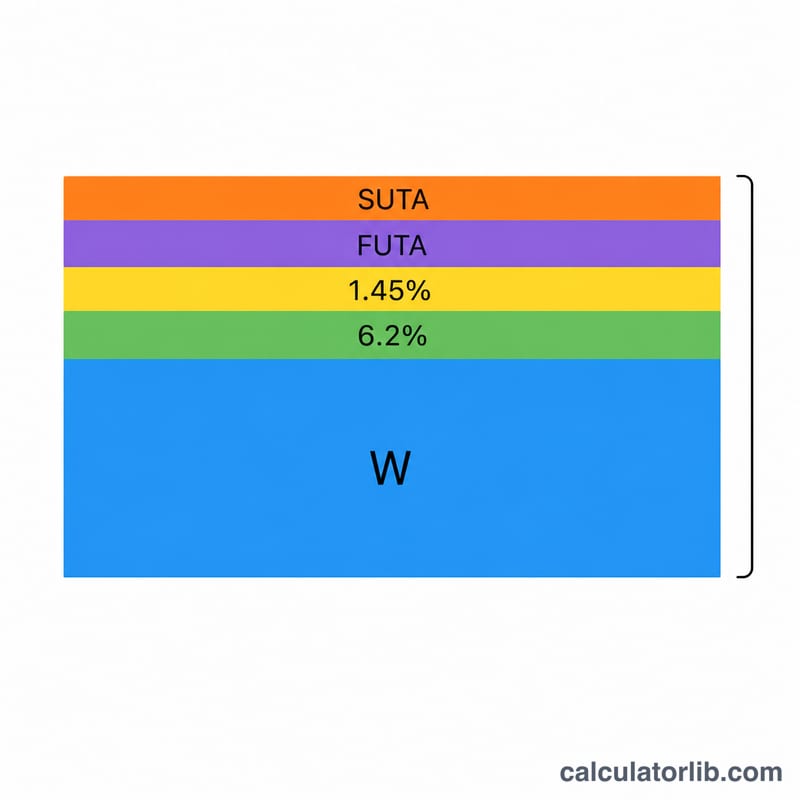
Worked Example
For a $50,000 salary with default rates: Social Security = 50,000 × 6.2% = $3,100; Medicare = 50,000 × 1.45% = $725; FUTA = 7,000 × 0.6% = $42; SUTA = 7,000 × 2.7% = $189. Total payroll tax = $4,056, so the total employer cost is $54,056.
$$\text{Social Security} = 50{,}000 \times 6.2\% = \$3{,}100$$$$\text{Medicare} = 50{,}000 \times 1.45\% = \$725$$$$\text{FUTA} = 7{,}000 \times 0.6\% = \$42$$$$\text{SUTA} = 7{,}000 \times 2.7\% = \$189$$$$\text{Total payroll tax} = \$4{,}056 \quad\Rightarrow\quad \text{Total employer cost} = \$54{,}056$$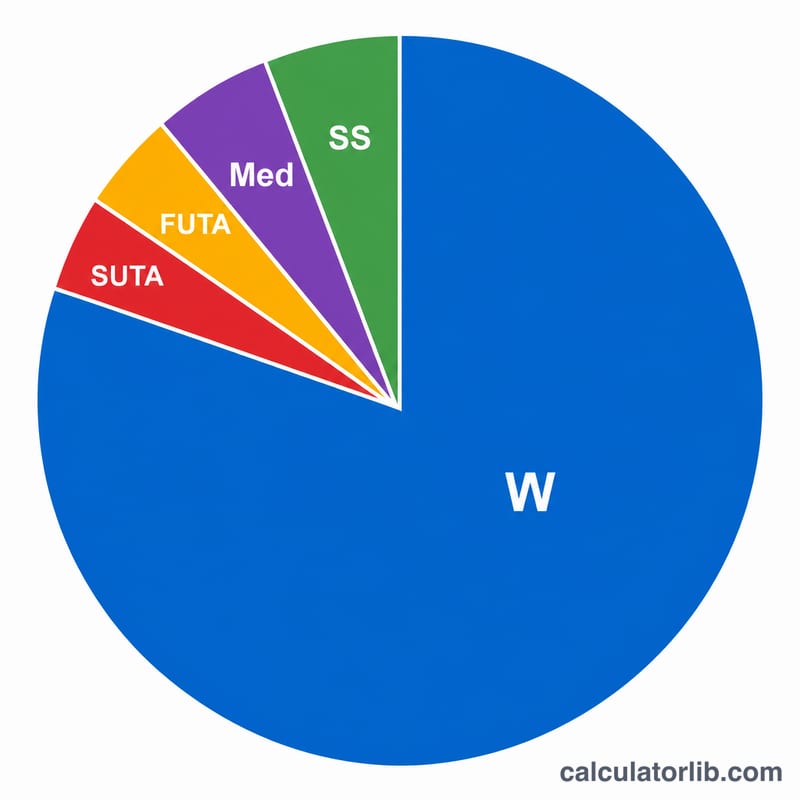
FAQ
Why are FUTA and SUTA so small? They apply only to the first few thousand dollars of wages (the wage base), so for any full-time salary they hit a fixed cap.
Does this include benefits or workers' comp? No — it covers statutory payroll taxes only. Health insurance, retirement match and workers' compensation add further to true cost.
What about the additional Medicare tax? The 0.9% additional Medicare tax is employee-paid only and is not an employer cost, so it is excluded here.