
What Is a Pension Calculator?
A pension calculator estimates the retirement income you can expect from a defined-benefit (DB) pension plan. These plans pay a guaranteed income based on a formula that uses your length of service, your salary, and a fixed accrual rate set by your scheme. This tool works for any plan that follows the standard DB formula, regardless of country, but you should always confirm the exact terms with your own plan administrator.
How to Use It
Enter three values: your years of service (how long you have been or will be a member of the plan), your final average salary (the average pensionable pay used by your scheme — often the average of your last few years), and your plan's accrual rate as a percentage. Typical accrual rates are between 1% and 2.5% per year of service. The calculator returns your estimated annual and monthly pension.
The Formula Explained
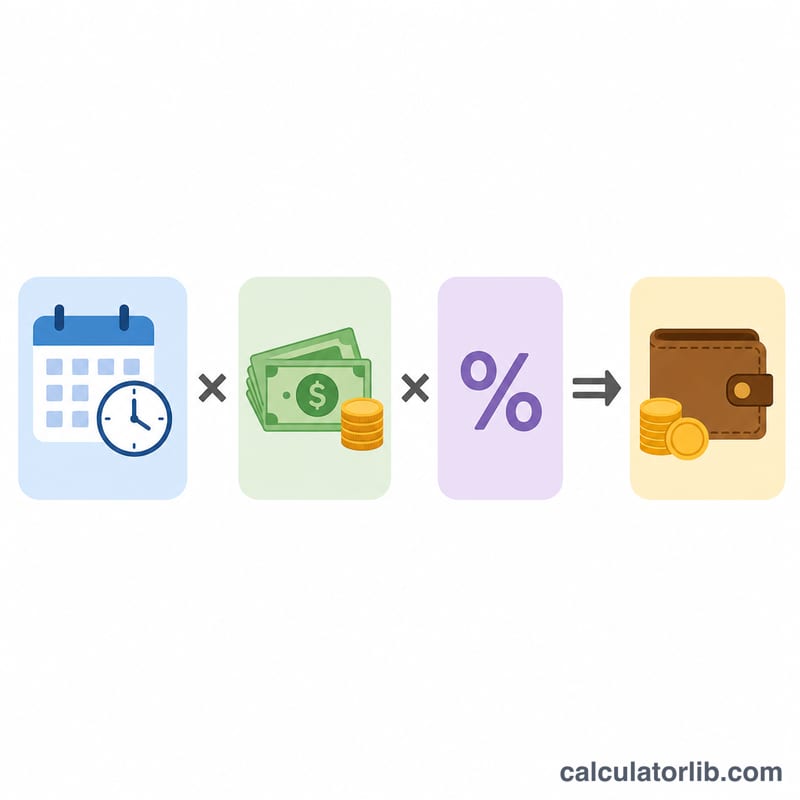
The core calculation is:
$$\text{Annual Pension} = \text{Years of Service} \times \text{Final Average Salary} \times \left(\frac{\text{Accrual Rate}}{100}\right)$$
The accrual rate (also called the multiplier) is the fraction of salary you earn for each year of service. A 1/60th scheme corresponds to roughly \(1.67\%\), while a 1/80th scheme is \(1.25\%\).
Worked Example
Suppose you have 30 years of service, a final average salary of $60,000, and a 2% accrual rate. Your annual pension is $$30 \times \$60{,}000 \times 0.02 = \$36{,}000 \text{ per year},$$ or $3,000 per month.
Pension Estimates Across Different Scenarios
Each figure below is calculated as \(\text{Years} \times \text{Final Average Salary} \times \frac{\text{Rate}}{100}\), and the monthly figure is the annual figure divided by 12. All amounts are gross: they are before tax, before any inflation adjustment, and before any early-retirement reduction.
| Years of service | Final average salary | Accrual rate | Annual gross pension | Monthly gross pension |
|---|---|---|---|---|
| 20 | $60,000 | 1.67% | $20,040 | $1,670 |
| 30 | $60,000 | 1.67% | $30,060 | $2,505 |
| 40 | $60,000 | 1.67% | $40,080 | $3,340 |
| 20 | $60,000 | 2% | $24,000 | $2,000 |
| 30 | $60,000 | 2% | $36,000 | $3,000 |
| 40 | $60,000 | 2% | $48,000 | $4,000 |
| 30 | $85,000 | 1.67% | $42,585 | $3,548.75 |
| 30 | $85,000 | 2% | $51,000 | $4,250 |
Example of the arithmetic: for 30 years at $60,000 and 1.67%, \(30 \times 60{,}000 \times \frac{1.67}{100} = 1{,}800{,}000 \times 0.0167 = 30{,}060\) per year, or \(30{,}060 \div 12 = 2{,}505\) per month.
Moving from 1.67% to 2% raises the pension by about 20% for the same service and salary, and a higher final average salary scales the result proportionally. Actual plans may apply caps, minimums, or different rules, so these figures are illustrative only.
Common Accrual Rates and Fractions
Some plans state the accrual rate as a fraction of salary per year of service (for example 1/60) rather than as a percentage. The table converts common fractions and shows the annual pension per $10,000 of final average salary after 30 years of service, calculated with the exact fraction (\(30 \times 10{,}000 \times \text{rate}\)).
| Fraction | Percentage per year | Annual pension per $10,000 of final average salary (30 years) |
|---|---|---|
| 1/80 | 1.25% | $3,750.00 |
| 1/70 | ≈ 1.43% | $4,285.71 |
| 1/60 | ≈ 1.67% | $5,000.00 |
| 1/50 | 2% | $6,000.00 |
| 1/45 | ≈ 2.22% | $6,666.67 |
| 1/40 | 2.5% | $7,500.00 |
If you enter a rounded percentage such as 1.67% instead of the exact fraction 1/60, the result differs slightly (30 years at 1.67% on $10,000 gives $5,010 rather than $5,000). The accrual rate that applies to you, and whether it changes with service or pay level, must be confirmed in your plan documents. Rates vary by plan, employer, and country.
Key Pension Terms Defined
- Defined-benefit plan
- A retirement plan in which the benefit is set by a formula, typically based on service and salary, rather than by the balance of an individual investment account.
- Years of service (credited service)
- The length of employment that the plan counts toward the benefit. It can differ from total time employed, depending on plan rules such as eligibility, breaks in service, or purchased service.
- Final average salary
- The average of an employee's pensionable pay over a defined period near the end of their career, such as the highest three or five years, as specified by the plan.
- Pensionable pay
- The portion of earnings the plan counts when calculating benefits. Some plans exclude items such as overtime or bonuses.
- Accrual rate (multiplier)
- The percentage of final average salary earned for each year of service, for example 1.67% (1/60) or 2%.
- Gross vs net pension
- Gross pension is the amount calculated by the formula before deductions. Net pension is what is received after taxes and any other deductions, such as insurance premiums.
- Early-retirement reduction
- A decrease in the benefit applied by some plans when payments begin before the plan's normal retirement age, often to reflect a longer expected payment period.
- Cost-of-living adjustment (COLA)
- A periodic increase in pension payments intended to offset inflation. Whether it applies, and how it is set, depends on the plan.
FAQ
Is this for defined-contribution plans? No. DC plans (like a 401(k)) depend on investment returns, not a service-and-salary formula. This tool is for defined-benefit schemes.
Does it account for inflation or early-retirement reductions? No. It gives a gross figure before cost-of-living adjustments, tax, or any actuarial reduction for retiring early.
What accrual rate should I use? Check your plan documents — common rates are \(1.25\%\), \(1.67\%\), or \(2\%\) per year of service.