

What Is the Marriage Tax Calculator?
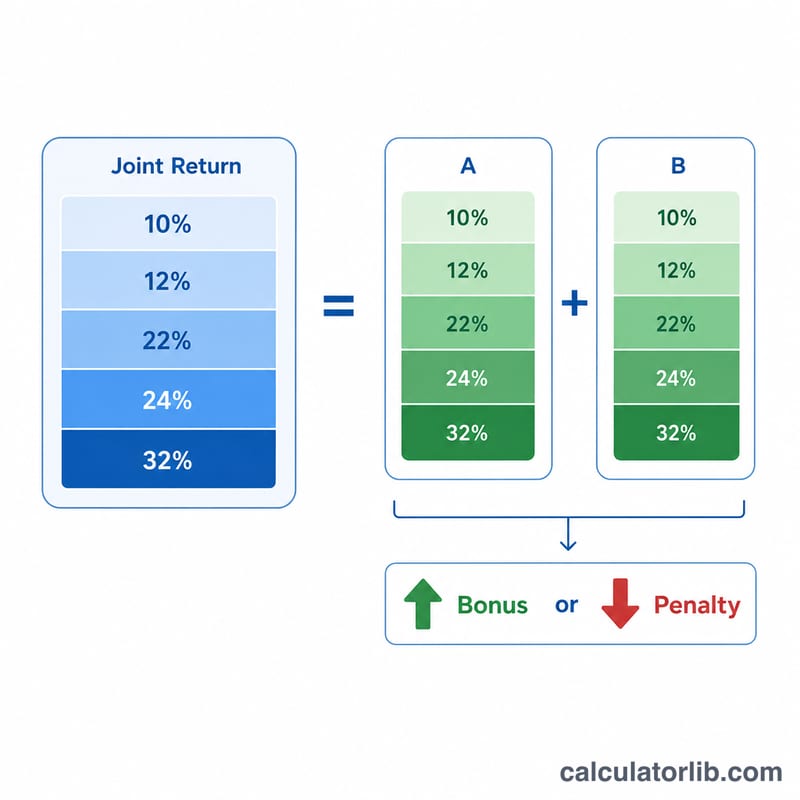
The Marriage Tax Calculator estimates whether getting married will cost you more in income tax (a "marriage penalty") or save you money (a "marriage bonus"). It does this by comparing the tax a couple would owe filing jointly against the combined tax each spouse would owe if they filed separately. Because tax brackets and rates are not always perfectly aligned for couples, two incomes combined can land in a higher or lower effective bracket — producing either a penalty or a bonus.
How to Use It
Enter each spouse's taxable income and the marginal tax rate that applies to them individually. Then enter the marginal rate that applies to the couple's combined income when filing jointly. The calculator multiplies each income by its rate, sums the separate taxes, and subtracts that from the joint tax. A positive result is a penalty (you pay more married); a negative result is a bonus (you pay less).
The Formula Explained
The core equation is
$$\text{Penalty} = \text{Tax}_{joint} - (\text{Tax}_A + \text{Tax}_B)$$where each individual tax equals income times the marginal rate:
$$\text{Tax} = \text{Income} \times \text{Rate}$$Joint tax is calculated as the combined income times the joint marginal rate. This simplified marginal-rate approach gives a quick estimate; real tax liability uses progressive brackets, deductions, and credits.
Worked Example
Suppose Spouse A earns $60,000 at a 22% rate and Spouse B earns $40,000 at a 12% rate. Separately they owe
$$\$13{,}200 + \$4{,}800 = \$18{,}000$$If their combined $100,000 is taxed jointly at 22%, the joint tax is $22,000. The marriage penalty is
$$\$22{,}000 - \$18{,}000 = \mathbf{\$4{,}000}$$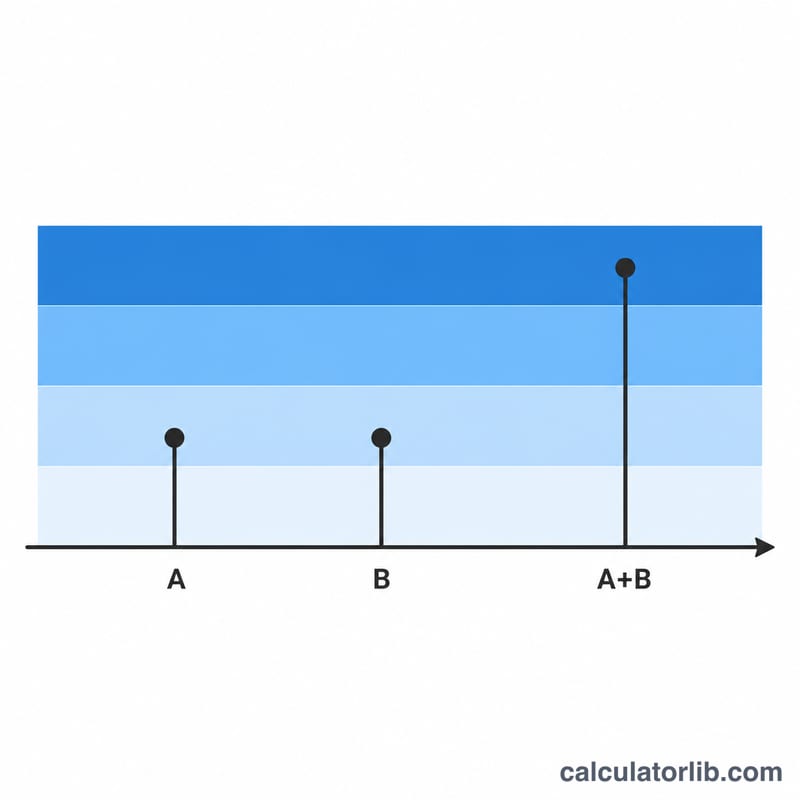
FAQ
Is a marriage penalty common? It most often affects couples with two similar high incomes, where combining pushes them into higher brackets.
What is a marriage bonus? When one spouse earns much more than the other, joint filing can lower the overall rate, producing a negative result (a bonus).
Is this exact? No — it uses single marginal rates rather than full progressive brackets, deductions, or credits. Use it for quick comparisons, not tax filing.