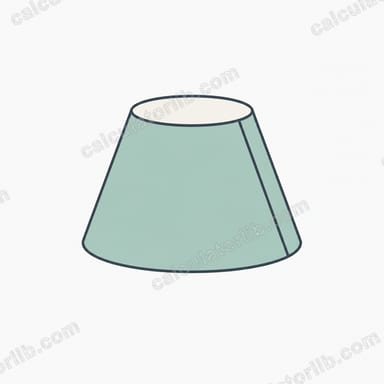

What Is a Cone Frustum?
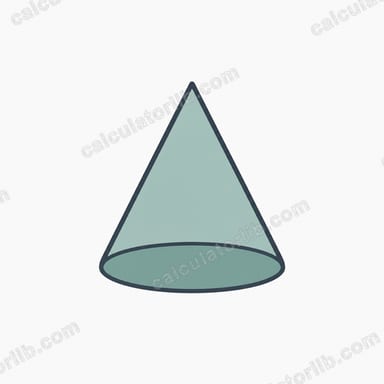
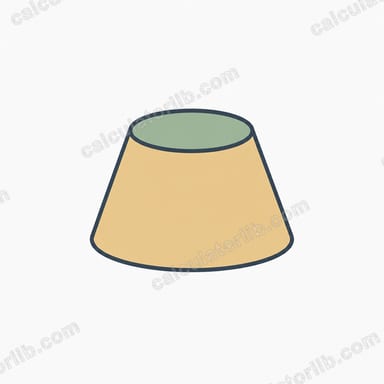
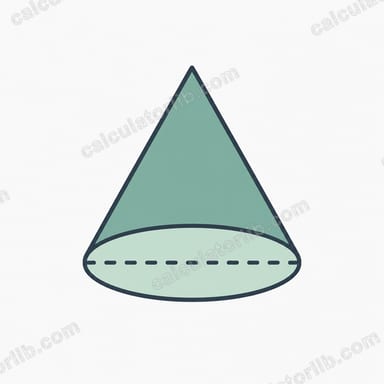
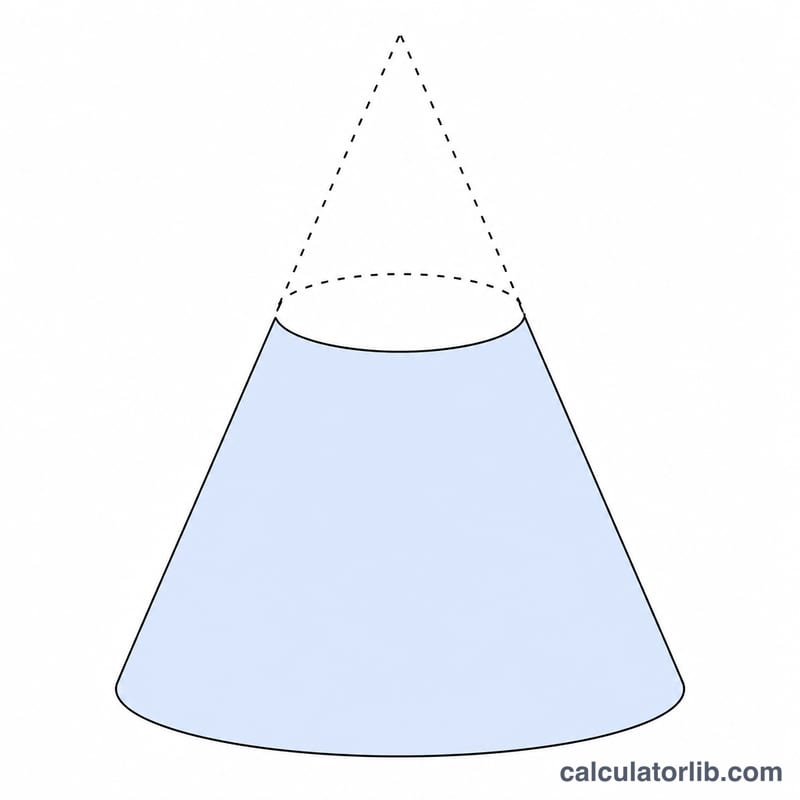
A cone frustum (also called a truncated cone) is the solid that remains when the top of a cone is sliced off parallel to its base. It has two circular faces of different sizes—a larger bottom and a smaller top—connected by a slanted surface. Common real-world examples include buckets, lampshades, drinking cups, and flower pots.
How to Use This Calculator
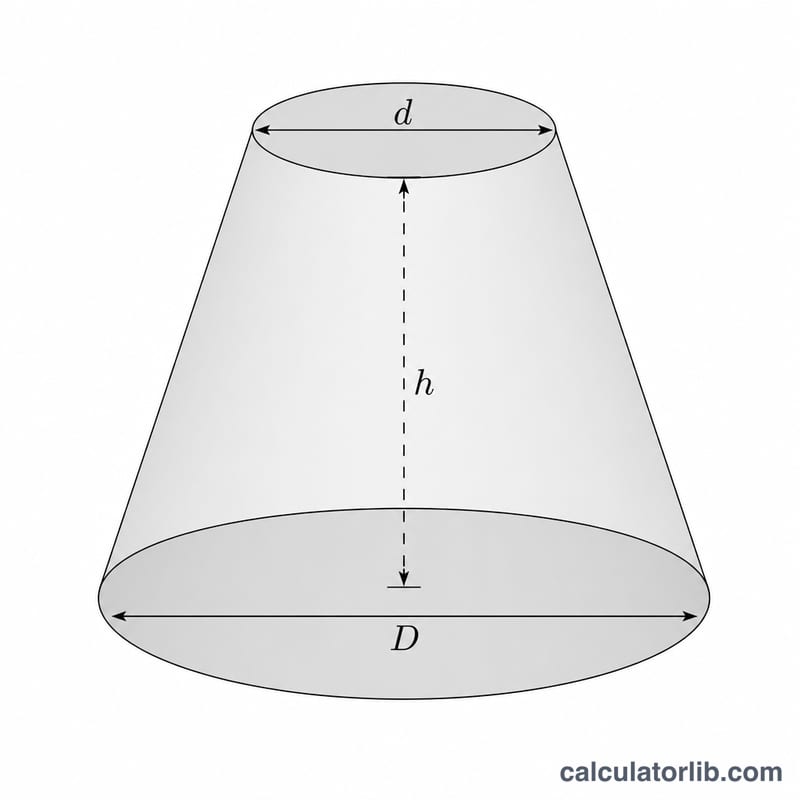
Enter three measurements: the bottom diameter (D), the top diameter (d), and the vertical height (h) of the frustum. Make sure all three values use the same unit (e.g., all in centimetres or all in inches). The calculator returns the enclosed volume in those cubic units.
The Formula Explained
The volume is calculated with:
$$V = \frac{\pi \, h}{12}\left( D^2 + D \cdot d + d^2 \right)$$
This uses diameters directly. It is equivalent to the radius-based formula \( V = \frac{\pi h}{3}\left( R^2 + Rr + r^2 \right) \), because each radius is half the corresponding diameter. The bracketed term blends the contributions of both faces, giving a smooth transition between the two circle sizes.
Worked Example
Suppose a bucket has a bottom diameter \( D = 10 \), a top diameter \( d = 6 \), and a height \( h = 8 \). First compute $$D^2 + D \cdot d + d^2 = 100 + 60 + 36 = 196.$$ Then $$V = \frac{\pi \times 8}{12} \times 196 = 2.0944 \times 196 \approx 410.50 \text{ cubic units.}$$
FAQ
Can I use radii instead of diameters? This tool expects diameters. If you only have radii, simply double them before entering.
What if the top and bottom diameters are equal? The frustum becomes a regular cylinder, and the formula reduces to \( V = \frac{\pi h D^2}{4} \).
Does unit matter? Use consistent units for all inputs; the result will be in the cube of that unit (e.g., cm³).