
What this calculator does
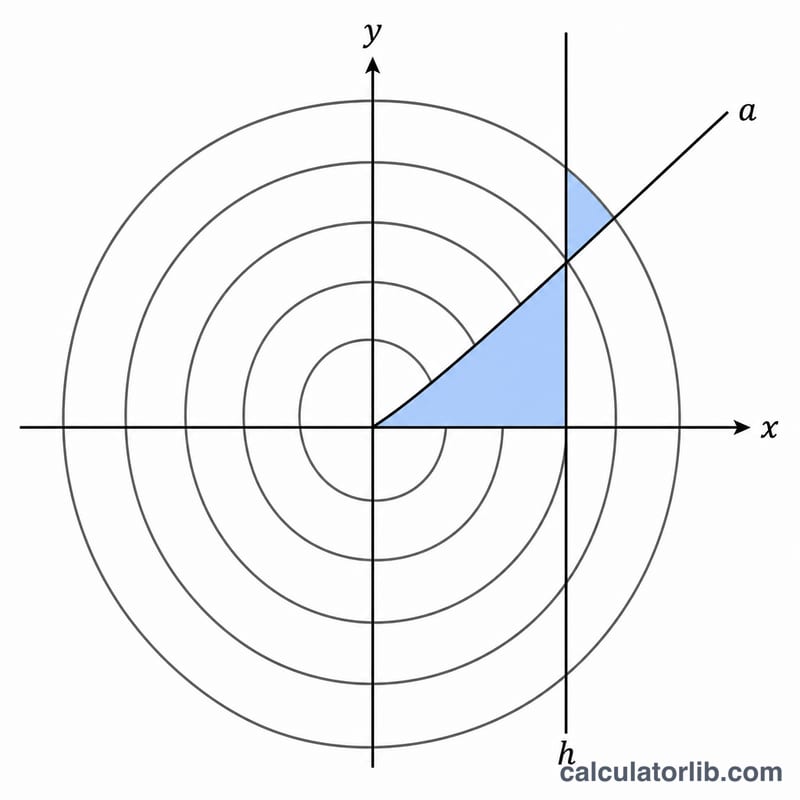
This tool evaluates two closely related special functions of the two-dimensional (bivariate) standard normal distribution: Owen's T function \(T(h,a)\) and the V function \(V(h,a)\). Both describe the probability mass of the standard normal density over a wedge-shaped region bounded by the straight line \(y = a\cdot x\). They appear throughout statistics — in skew-normal distributions, bivariate normal probabilities, reliability analysis and option pricing. This is pure mathematics and is region-independent (it applies everywhere).
How to use it
Enter the percentage point h (the upper limit of the x-integration and the standardized argument) and the coefficient a (the slope of the boundary line \(y = a\cdot x\)). Both are dimensionless real numbers. Press calculate to get \(T(h,a)\) and \(V(h,a)\).
The formula explained
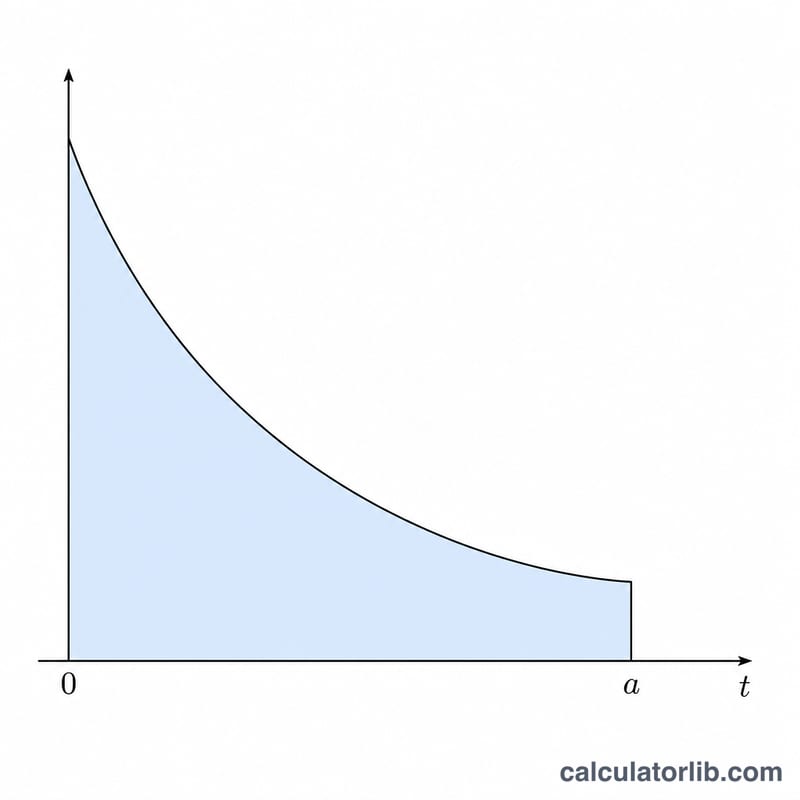
With the standard normal density \(\phi(x) = \frac{1}{\sqrt{2\pi}} e^{-x^{2}/2}\), Owen's T is computed directly as $$T(h,a) = \frac{1}{2\pi}\int_{0}^{a} \frac{e^{-\frac{1}{2}h^{2}(1+t^{2})}}{1+t^{2}}\,dt.$$ The calculator evaluates this integral with composite Simpson's rule on a fine grid (thousands of subintervals), which is stable because the integrand never blows up. The V function then follows from the page identity \(T(h,a) + V(h,a) = \frac{\arctan(a)}{2\pi}\), so $$V(h,a) = \frac{\arctan(a)}{2\pi} - T(h,a),$$ where arctan is in radians.
Worked example
For \(h = 2\) and \(a = 0.6\): the integral $$\int_{0}^{0.6} \frac{e^{-2(1+t^{2})}}{1+t^{2}}\,dt \approx 0.05990,$$ so \(T = \frac{0.05990}{6.283185} \approx 0.0095330\). Then $$V = \frac{\arctan(0.6)}{2\pi} - T = \frac{0.540419}{6.283185} - 0.0095330 \approx 0.0764779.$$
FAQ
Is T symmetric in h? Yes — T depends only on \(h^{2}\), so \(T(-h,a) = T(h,a)\). What about negative a? T is odd in a: \(T(h,-a) = -T(h,a)\), and likewise \(V(h,-a) = -V(h,a)\) because arctan is odd. What if a = 0? Both T and V are exactly 0, since the wedge collapses to a line of zero area.