
What Is Capillary Rise?
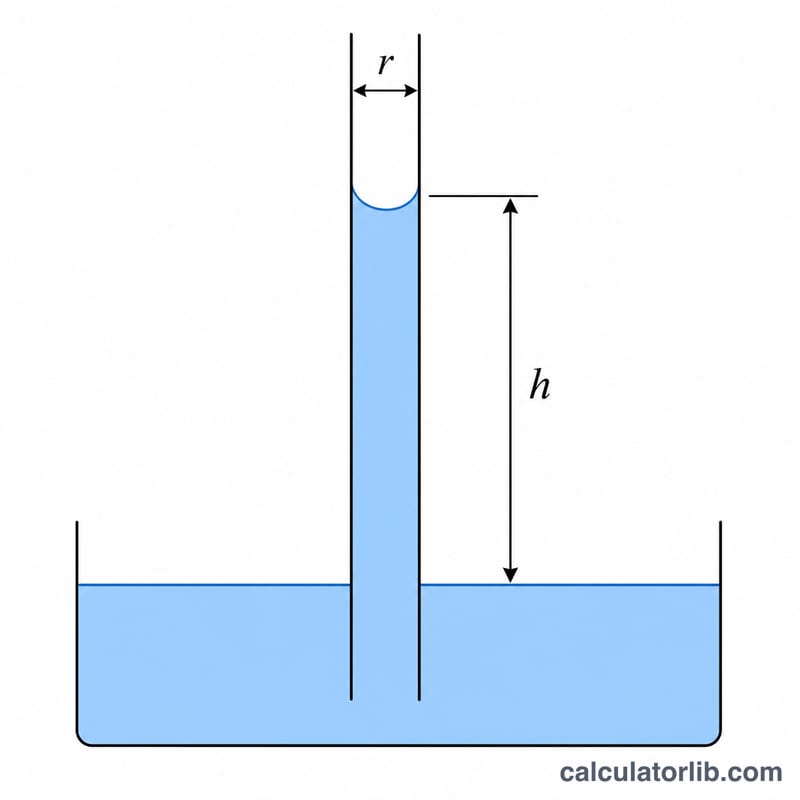
Capillary rise is the phenomenon where a liquid spontaneously climbs (or is depressed) inside a narrow tube against gravity. It is driven by the balance between adhesive forces (liquid to the tube wall) and cohesive forces (liquid to itself), expressed through surface tension. This calculator uses Jurin's Law to predict the equilibrium rise height in a thin cylindrical tube.
How to Use This Calculator
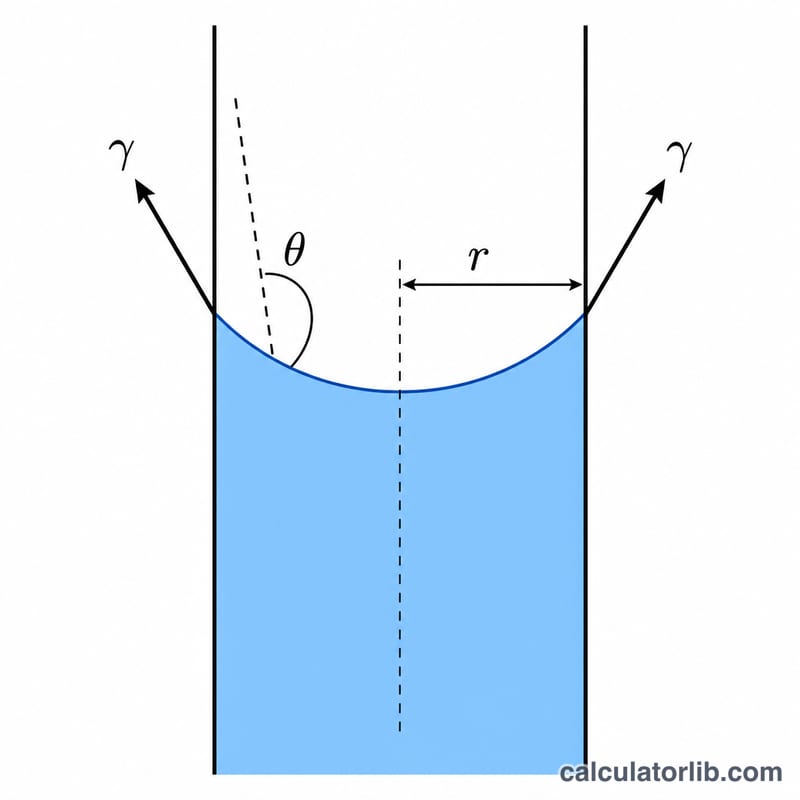
Enter the liquid's surface tension γ (in N/m), the contact angle θ between the liquid and the tube wall (in degrees), the liquid density ρ (kg/m³), the inner tube radius r (in meters), and gravitational acceleration g (default 9.81 m/s²). The calculator returns the rise height in both meters and millimeters. A contact angle below 90° gives a positive rise; above 90° (e.g. mercury on glass) gives a negative value, indicating depression.
The Formula Explained
Jurin's Law states $$h = \frac{2\,\gamma\cos\!\left(\theta\right)}{\rho\;g\;r}$$ The numerator captures the upward pull of surface tension around the tube's circumference projected vertically by \(\cos\theta\). The denominator is the weight per unit volume times the radius. Notice that height is inversely proportional to radius — the thinner the tube, the higher the liquid climbs.
Worked Example
For water in a glass tube: \(\gamma = 0.0728\ \text{N/m}\), \(\theta = 0°\) (\(\cos 0 = 1\)), \(\rho = 1000\ \text{kg/m}^3\), \(r = 0.0005\ \text{m}\), \(g = 9.81\ \text{m/s}^2\). Then $$h = \frac{2 \times 0.0728 \times 1}{1000 \times 9.81 \times 0.0005} = \frac{0.1456}{4.905} \approx 0.02968\ \text{m}$$ or about 29.68 mm.
FAQ
Why does water rise but mercury falls? Water wets glass (θ < 90°, cos positive), so it rises; mercury does not wet glass (θ ≈ 140°, cos negative), so it is depressed.
Does tube diameter matter? Yes — height scales with \(1/r\), so halving the radius doubles the rise.
What units should I use? Use SI units (N/m, kg/m³, meters) for a result in meters; the calculator also reports millimeters.