What the PMT Calculator Does
The PMT Calculator works out the fixed periodic payment needed to repay a loan that has a constant interest rate and equal payments. It is based on the same PMT formula used in spreadsheets and finance. Beyond the payment itself, it also tells you the total amount you will pay over the life of the loan, the total interest, and what share of your repayments goes to interest. The tool is generic and not country-specific — it works for any currency, since it deals only with amounts, rates and time.
The Inputs You Provide
- Loan Amount: the principal (P) you are borrowing — e.g. 100,000.
- Annual Interest Rate (%): the yearly nominal rate, e.g. 6.5.
- Loan Term (Years): how long you take to repay, e.g. 30.
- Payments Per Year: Monthly (12), Bi-weekly (26), Weekly (52), Quarterly (4), or Annually (1).
The Formula Explained
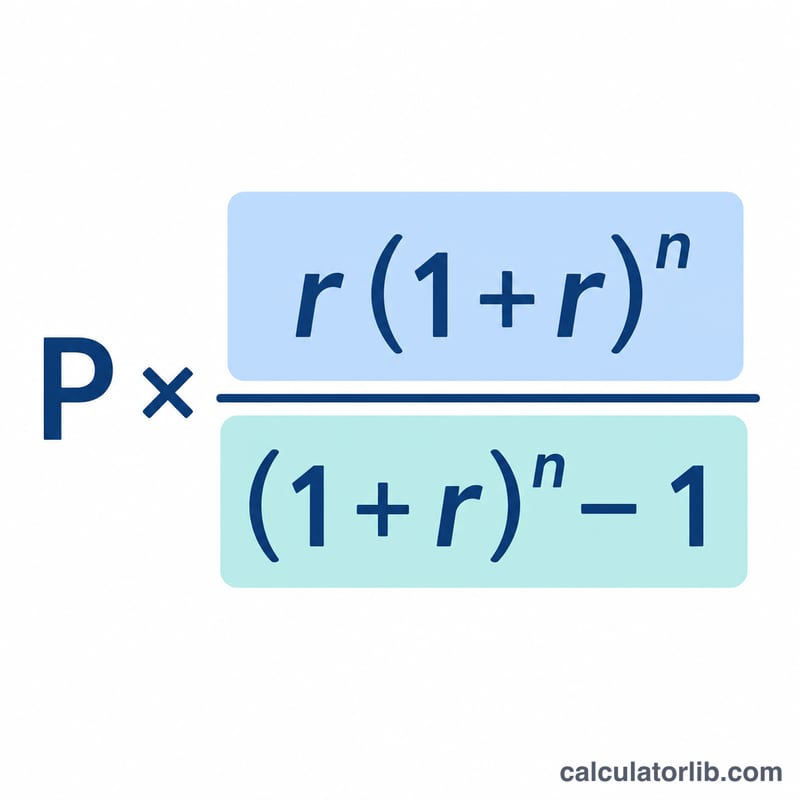
The calculator uses:
$$\text{PMT} = P \times \frac{r(1+r)^n}{(1+r)^n - 1}$$
Here the periodic rate \(r\) = (annual rate ÷ 100) ÷ payments per year, and the total number of payments \(n\) = term in years × payments per year. If the interest rate is 0%, it simply divides the loan amount by the number of payments. Total paid = \(\text{PMT} \times n\), and total interest = total paid − \(P\).
Worked Example
Borrow \(P = 100{,}000\) at 6.5% over 30 years, paid monthly (12).
- Periodic rate \(r = 0.065 \div 12 = 0.0054167\)
- Total payments \(n = 30 \times 12 = 360\)
- \((1+r)^{360} \approx 6.9919\)
- $$\text{PMT} = 100{,}000 \times \frac{0.0054167 \times 6.9919}{6.9919 - 1} \approx \mathbf{632.07}\text{ per month}$$
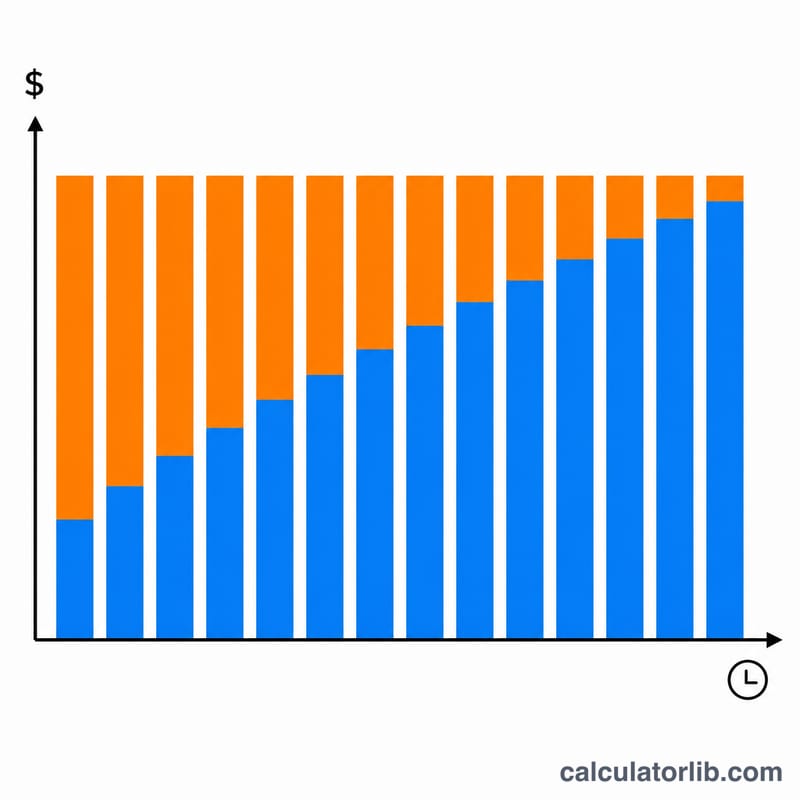
- Total paid \(\approx 227{,}544\); total interest \(\approx 127{,}544\) (about 56% of the total).
FAQ
Does paying more often reduce my payment? Each individual payment is smaller with more frequent payments, but the total interest changes only slightly because the periodic rate scales with frequency in this nominal model.
What if I enter 0% interest? The calculator falls back to a simple split: loan amount divided by the total number of payments.
Is this the same as a mortgage payment? Yes — for principal and interest. It does not include taxes, insurance or fees, so a real-world bill may be higher.