
What Is the Addiction Cost Calculator?
The Addiction Cost Calculator turns a habit into hard numbers. By entering how much you spend per day and how long you've been spending it, you can see both the money already gone and the money you could reclaim by quitting. Whether the cost comes from alcohol, cigarettes, gambling, or any other recurring expense, seeing the figures in dollars often provides powerful motivation for recovery.
How to Use It
Enter your typical daily spend in dollars and the number of days of use so far. The calculator instantly shows your total spent, your weekly and monthly cost, and the headline figure: how much you'd save over the next 365 days if you stopped today.
The Formula Explained
Two simple multiplications drive the tool:
$$\text{Total Spent} = \text{daily spend} \times \text{days of use}$$ — your sunk cost so far.
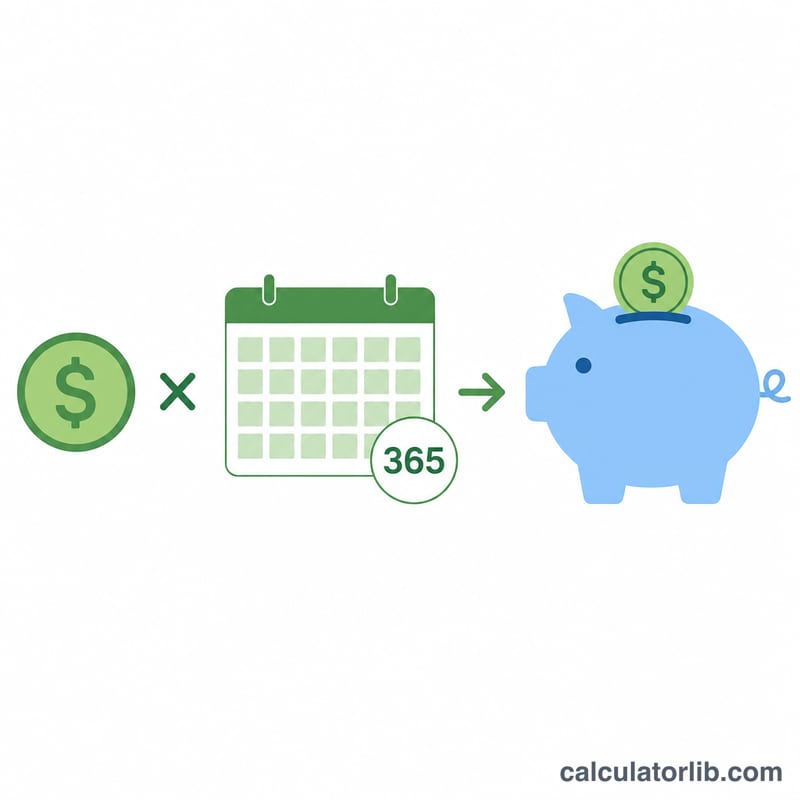
$$\text{Projected Savings} = \text{daily spend} \times 365$$ — the money you keep over a full year of recovery. We also show weekly (\(\times 7\)) and monthly (\(\times 30\)) figures so you can picture shorter milestones.
Worked Example
Suppose you spend $20 a day and have been doing so for 365 days. Total spent = \(20 \times 365 = \) $7,300. Projected one-year savings = \(20 \times 365 = \) $7,300. Weekly spend = \(20 \times 7 = \) $140, and monthly = \(20 \times 30 = \) $600. That's a $7,300 reward for one year of staying clean.
Cost Across Common Habits
The calculator multiplies your daily spend by 365 to project a year of avoided spending. The table below applies that same formula to several realistic daily habits, also breaking the cost down by week (\(\text{daily} \times 7\)) and by an average month (\(\text{daily} \times 30.44\)).
| Habit | Daily spend | Weekly (×7) | Monthly (×30.44) | 365-day projected savings |
|---|---|---|---|---|
| Energy drinks | $5 | $35 | $152 | $1,825 |
| Cigarettes | $8 | $56 | $244 | $2,920 |
| Daily takeout | $12 | $84 | $365 | $4,380 |
| Alcohol | $15 | $105 | $457 | $5,475 |
| Gambling | $25 | $175 | $761 | $9,125 |
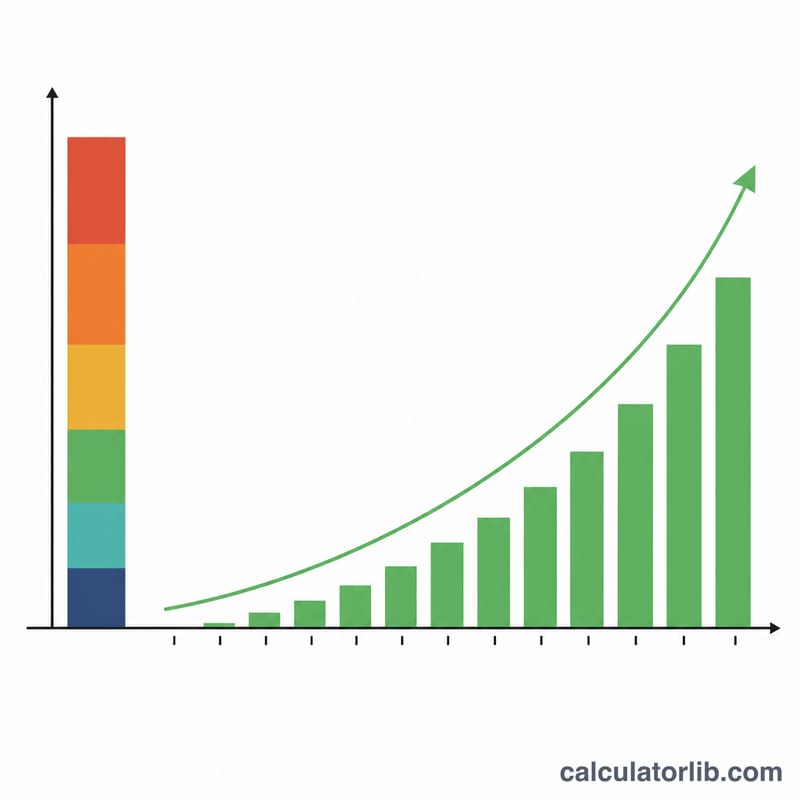
Even a modest-looking daily habit compounds quickly: a $15-per-day spend reaches $5,475 over a single year. If that same amount were instead deposited and grew at 5% compounded monthly, it would be worth more still over time.
What Your Result Means
Your result is a conservative, direct-spend minimum. It captures only the money handed over for the substance or activity itself — the price of the drinks, packs, bets, or purchases. It deliberately excludes the many indirect costs that often dwarf the direct spend, such as health care and treatment, higher insurance premiums, legal fees, property damage, lost wages, reduced productivity, and missed opportunities. In other words, the true cost of an addiction is almost always higher than the number shown here.
Two figures are worth distinguishing:
- Total already spent — your daily spend multiplied by the number of days you have used (\(\text{daily spend} \times \text{days of use}\)). This is a backward-looking estimate of money already gone.
- Projected savings — your daily spend multiplied by 365 (\(\text{daily spend} \times 365\)). This is a forward-looking estimate of what you could keep over the next year if the spending stopped today.
The 365-day figure is an annual benchmark, not a guarantee. It assumes your spending was steady and that the full amount is redirected rather than re-spent elsewhere. Actual outcomes vary with the day-to-day variability of the habit, life circumstances, and how consistently the savings are set aside. Treating the number as a motivational target — for example, by moving the equivalent amount into a dedicated savings account — turns the estimate into a concrete, trackable goal.
This is general information, not medical or financial advice. If you or someone you know is struggling with addiction, please consult a qualified health professional or a recognized support service.
FAQ
Does this include health or legal costs? No — it counts only the direct daily spend. Real-world costs (medical bills, lost income, legal fees) are usually much higher, so treat this as a conservative minimum.
Why is projected savings always based on 365 days? It standardizes the figure to one full year regardless of how long you've already been spending, giving a clear annual benchmark.
Can I use this for non-substance habits? Yes. Any recurring daily expense — vaping, energy drinks, daily takeout — works with the same math.