
What Is the Army Drill Pay Calculator?
Applies to the United States (US Army Reserve and Army National Guard). This tool estimates how much you earn for drilling based on the standard military pay rule that each drill period is worth 1/30 of your monthly active-duty base pay. Drill pay rates follow the annual DoD pay tables; enter the monthly base pay for your rank and years of service to get an estimate.
How to Use It
Enter your monthly base pay (the active-duty figure for your grade and time-in-service from the current military pay chart). Then enter the number of drill periods you are paid for. A typical Inactive Duty Training (IDT) drill weekend contains 4 drill periods — two on Saturday and two on Sunday — so a normal weekend is "4". A "Multiple Unit Training Assembly" (MUTA-4) is one weekend.
The Formula Explained
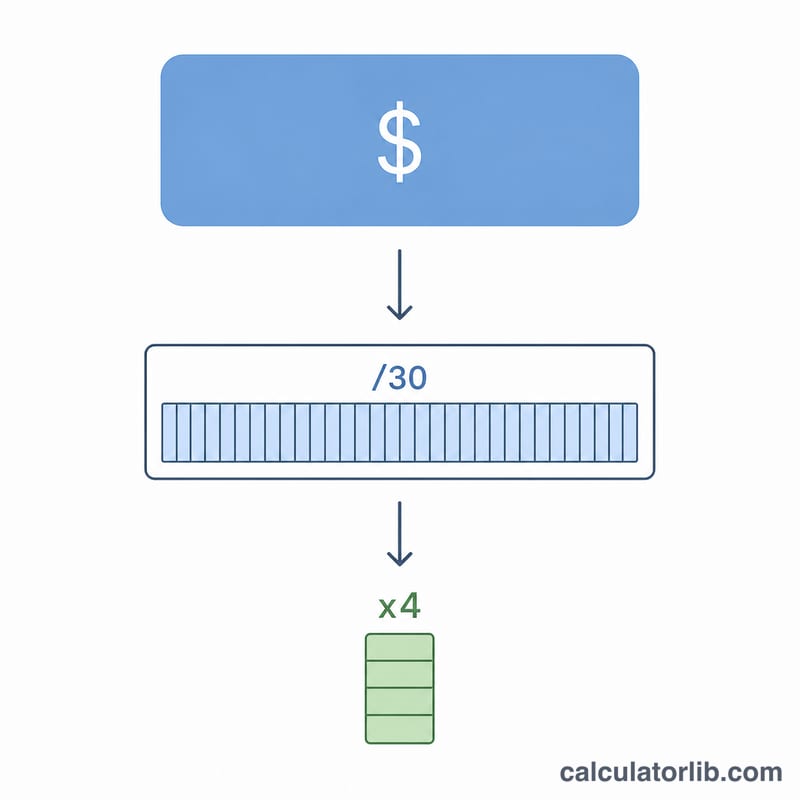
Reserve and Guard members earn one day of base pay for each drill period, and a "day" for this purpose is defined as 1/30 of monthly base pay. So:
$$\text{Drill Pay} = \frac{\text{Monthly Base Pay}}{30} \times \text{Number of Drill Periods}$$
Because four periods are paid per weekend, a standard MUTA-4 weekend pays the equivalent of four daily rates.
Worked Example
Suppose your monthly base pay is $3,000 and you drill one weekend (4 periods). Pay per period = \(3{,}000 \div 30 = \$100\). Drill pay = \(100 \times 4 = \$400\) for the weekend.
Drill Periods by Duty Type (MUTA Reference)
Reserve and National Guard drill pay is counted in drill periods (also called "unit training assemblies"). Each drill period equals one quarter of a day of active-duty base pay, and the standard "drill weekend" consists of four periods (two on Saturday, two on Sunday). The Army schedules these using MUTA (Multiple Unit Training Assembly) designations.
| MUTA Designation | Typical Duty | Drill Periods Paid | Pay (in days of base pay) |
|---|---|---|---|
| MUTA-1 | Single assembly (one 4-hour period) | 1 | 1/4 day |
| MUTA-2 | One full drill day | 2 | 1/2 day |
| MUTA-4 | Standard drill weekend (Sat + Sun) | 4 | 1 full day |
| MUTA-5 | Extended weekend (e.g. Fri evening + Sat/Sun) | 5 | 1 1/4 days |
| MUTA-6 | Extended weekend (three drill days) | 6 | 1 1/2 days |
Important pay rules:
- A maximum of 2 drill periods are paid per calendar day, regardless of how many hours are worked.
- Each drill period is at least 4 hours of training.
- A typical training year is built around 12 standard MUTA-4 weekends, giving roughly 48 paid drill periods per year (plus separate annual training, which is paid at full active-duty rates).
- Drill pay covers base pay only — it does not include BAH or BAS in the same way active duty does.
Drill Pay Across Ranks and Drill Counts
The per-period rate equals monthly base pay divided by 30. A standard drill weekend pays 4 periods (one full day of base pay), and a typical training year of 12 weekends pays about 48 periods. The figures below use representative monthly base-pay amounts to illustrate the math; always confirm your exact rate against the current military pay table for your grade and time-in-service.
| Rank / Time-in-Service | Monthly Base Pay (example) | Per Drill Period (÷30) | 4-Period Weekend | Annual (48 drills) |
|---|---|---|---|---|
| E-4, 4 yrs | $2,700 | $90.00 | $360.00 | $4,320.00 |
| E-6, 8 yrs | $3,900 | $130.00 | $520.00 | $6,240.00 |
| E-7, 12 yrs | $4,800 | $160.00 | $640.00 | $7,680.00 |
| O-3, 6 yrs | $6,600 | $220.00 | $880.00 | $10,560.00 |
| O-4, 12 yrs | $8,400 | $280.00 | $1,120.00 | $13,440.00 |
Per period \(=\dfrac{\text{Monthly Base Pay}}{30}\); weekend \(=\) per period \(\times 4\); annual \(=\) per period \(\times 48\). Drill pay is taxable income; for an estimate of take-home on an annualized figure you can run the annual total through a salary after-tax calculator.
Key Terms Defined
- Drill period
- The basic unit of reserve-component pay, equal to one quarter (1/4) of a day of active-duty base pay. Each period represents at least 4 hours of training; a standard drill weekend has 4 periods.
- IDT (Inactive Duty Training)
- The official category for weekend drills and similar part-time training. IDT is paid by the drill period rather than by the day, which is what distinguishes it from active-duty service.
- MUTA (Multiple Unit Training Assembly)
- The scheduling label for how many drill periods a training event covers — e.g. MUTA-4 is the typical two-day, four-period weekend.
- Monthly base pay
- The active-duty basic pay for your grade and time-in-service, set by the annual military pay table. It is the input divided by 30 to find your per-period drill rate.
- Active-duty pay table
- The Department of Defense schedule that lists monthly basic pay by pay grade (E-1 to O-10) and years of service. Drill pay is derived directly from this table.
- BAH / BAS
- Basic Allowance for Housing and Basic Allowance for Subsistence. These allowances are not paid for ordinary weekend drills (IDT), which is why a drill-pay estimate uses base pay only. They are payable during longer active-duty orders such as annual training.
- Time-in-service
- Cumulative years of military service, which raises your basic pay step within a given grade. More time-in-service means a higher monthly base pay and therefore a higher per-period drill rate.
FAQ
How many drill periods are in a weekend? A standard MUTA-4 weekend has 4 drill periods.
Does this include allowances or taxes? No. This is gross base drill pay only; it excludes BAH, BAS, bonuses, and tax withholding.
Where do I find my monthly base pay? Use the current military pay table for your rank and years of service — that monthly figure is the input.