
What is the Calories to Kilojoules Converter?
This tool converts food energy between calories (kcal) and kilojoules (kJ), the two units most commonly printed on nutrition labels worldwide. The "calorie" used in nutrition is actually a kilocalorie (kcal), often written simply as "Cal" or "calorie" on packaging. Kilojoules are the SI metric unit used on labels in countries such as Australia, New Zealand, and across the EU (where both units usually appear).
How to use it
Enter your energy value, pick the conversion direction (kcal → kJ or kJ → kcal), and read the converted result instantly. Use it to compare a label that lists only kilojoules against one that lists calories, or to plan meals when your fitness app uses a different unit.
The formula explained
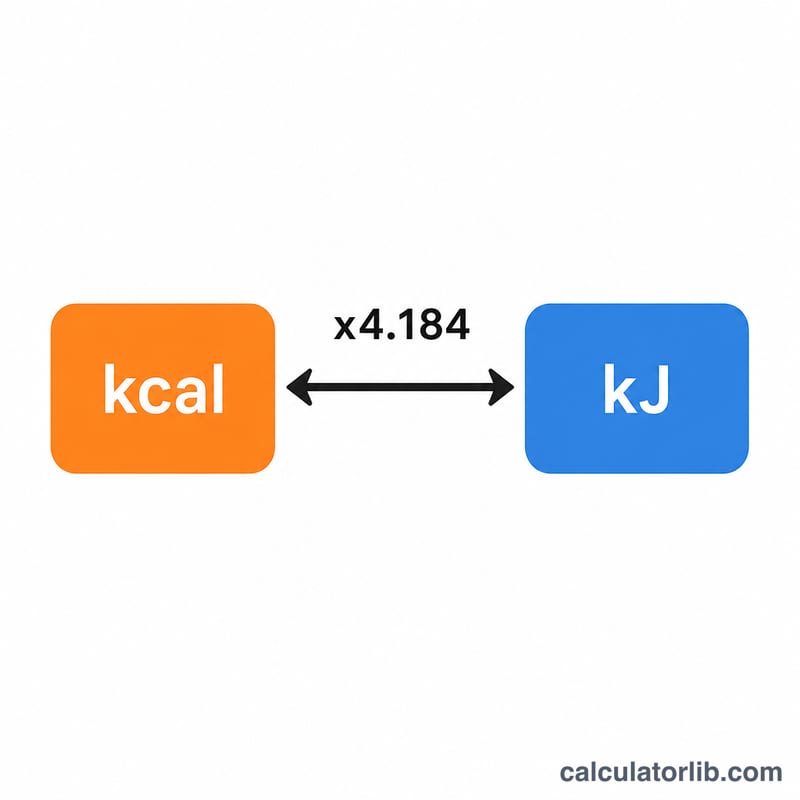
The conversion is based on the international (thermochemical) definition where \(1\ \text{kcal} = 4.184\ \text{kJ}\). To convert calories to kilojoules, multiply by 4.184:
$$\text{kJ} = \text{Value (kcal)} \times 4.184$$To convert kilojoules to calories, divide by 4.184:
$$\text{kcal} = \frac{\text{Value (kJ)}}{4.184}$$Because the factor is exact and constant, conversions are perfectly linear and reversible.
Worked example
Suppose a snack lists 250 kcal. Multiply:
$$250 \times 4.184 = \textbf{1{,}046}\ \textbf{kJ}$$Going the other way, a drink labelled 500 kJ equals
$$500 \div 4.184 = \textbf{119.5}\ \textbf{kcal}$$which you might round to about 120 calories.
kcal to kJ Conversion Table
Energy on food labels is reported in both kilocalories (kcal, often just called "Calories") and kilojoules (kJ). The conversion uses the exact factor \(1\text{ kcal} = 4.184\text{ kJ}\). To convert in the other direction, divide by 4.184 (i.e. \(1\text{ kJ} = 0.239\text{ kcal}\)).
kcal → kJ
| Calories (kcal) | Kilojoules (kJ) |
|---|---|
| 50 | 209.2 |
| 100 | 418.4 |
| 200 | 836.8 |
| 250 | 1046 |
| 500 | 2092 |
| 1000 | 4184 |
| 2000 | 8368 |
kJ → kcal (reverse lookup)
| Kilojoules (kJ) | Calories (kcal) |
|---|---|
| 100 | 23.9 |
| 500 | 119.5 |
| 1000 | 239.0 |
| 2000 | 478.0 |
| 8400 | 2007.6 |
For example, a 250 kcal snack equals \(250 \times 4.184 = 1046\text{ kJ}\), and an 8400 kJ daily intake equals \(8400 \div 4.184 \approx 2008\text{ kcal}\).
FAQ
Is a calorie the same as a kilocalorie? In everyday nutrition, yes — the "calories" on food labels are kilocalories (kcal). This converter uses kcal throughout.
Why 4.184 and not 4.2? 4.184 is the precise thermochemical conversion factor. 4.2 is a common rounded approximation; use 4.184 for accuracy.
Which unit do food labels use? It varies by country. The US uses calories (kcal), while Australia and the EU show kilojoules (and often calories too).