What is the CST to UTC Converter?
This tool converts a time given in Central Standard Time (CST) to Coordinated Universal Time (UTC). CST is the standard time used in the central United States, Mexico, and parts of Canada during the non-daylight-saving months, and it sits at a fixed offset of UTC−6. To go from CST to UTC you simply add 6 hours. Note: when Daylight Saving Time is active the central zone uses CDT (UTC−5) instead — this converter assumes standard time (CST).
How to use it
Enter the CST hour using the 24-hour clock (0 to 23) and the minutes (0 to 59). The calculator adds 6 hours, wraps the result around midnight using modulo 24, and tells you whether the conversion pushes the time into the next UTC day.
The formula explained
Because CST = UTC − 6, the reverse is UTC = CST + 6. Minutes are unchanged because the offset is a whole number of hours. The expression \((\text{CST Hour} + 6) \bmod 24\) keeps the result within a single 24-hour clock. If \(\text{CST Hour} + 6\) is 24 or more, the UTC date is one calendar day ahead.
$$\text{UTC Hour} = \left(\text{CST Hour} + 6\right) \bmod 24, \qquad \text{UTC Minute} = \text{Minute}$$The full set of relationships is:
$$\begin{gathered} \text{UTC Hour} = \left(\text{CST Hour} + 6\right) \bmod 24 \\[1em] \text{UTC Minute} = \text{Minute} \\[1em] \text{Day Offset} = \begin{cases} +1 & \text{CST Hour} + 6 \ge 24 \\ 0 & \text{otherwise} \end{cases} \end{gathered}$$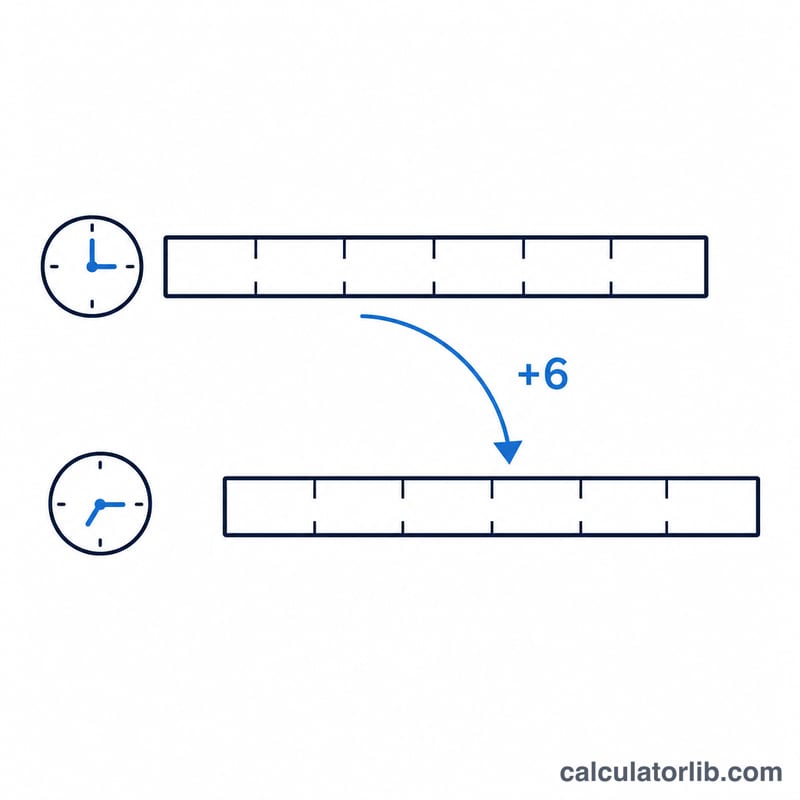
Worked example
Suppose it is 20:30 CST. Add 6 hours: \(20 + 6 = 26\). Since \(26 \ge 24\), subtract 24 to get hour 2, and flag a +1 day rollover. The minutes stay at 30. Result: 02:30 UTC, next day.
$$\text{UTC Hour} = (20 + 6) \bmod 24 = 26 \bmod 24 = 2$$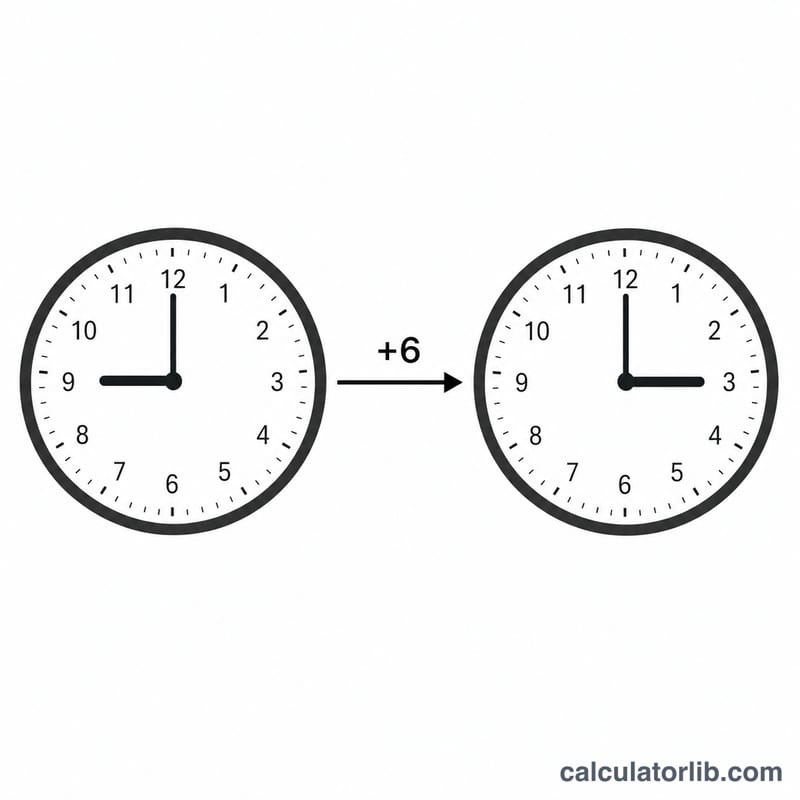
CST to UTC Quick Conversion Table
Central Standard Time (CST) is UTC−6, so you convert to UTC by adding 6 hours. If the result reaches 24:00 or more, subtract 24 and move to the next UTC calendar day. Times below use the 24-hour format.
| CST (UTC−6) | UTC | UTC date |
|---|---|---|
| 00:00 | 06:00 | Same day |
| 03:00 | 09:00 | Same day |
| 06:00 | 12:00 | Same day |
| 09:00 | 15:00 | Same day |
| 12:00 | 18:00 | Same day |
| 15:00 | 21:00 | Same day |
| 17:00 | 23:00 | Same day |
| 18:00 | 00:00 | Next day (+1) |
| 21:00 | 03:00 | Next day (+1) |
| 23:59 | 05:59 | Next day (+1) |
Any CST time from 18:00 onward rolls over to the next UTC day. For example, 21:00 CST on March 1 is 03:00 UTC on March 2. The minutes never change, because the offset is a whole number of hours. The formula is \(\text{UTC Hour} = (\text{CST Hour} + 6) \bmod 24\).
CST vs CDT vs Other US Zones Compared to UTC
The table shows the same local clock time, 12:00 (noon), in several North American time zones and the UTC time it corresponds to. The offsets and daylight saving rules are those of the United States.
| Zone | UTC offset | Local time | UTC time | When it applies |
|---|---|---|---|---|
| CST (Central Standard Time) | UTC−6 | 12:00 | 18:00 | Standard time, roughly early November to mid-March |
| CDT (Central Daylight Time) | UTC−5 | 12:00 | 17:00 | Daylight saving time, roughly mid-March to early November |
| EST (Eastern Standard Time) | UTC−5 | 12:00 | 17:00 | Standard time, roughly early November to mid-March |
| MST (Mountain Standard Time) | UTC−7 | 12:00 | 19:00 | Standard time, roughly early November to mid-March |
| PST (Pacific Standard Time) | UTC−8 | 12:00 | 20:00 | Standard time, roughly early November to mid-March |
In the US, daylight saving time starts on the second Sunday in March and ends on the first Sunday in November. During daylight saving time the Central zone uses CDT (UTC−5), so converting a Central time with the CST offset of 6 hours gives a result that is one hour off. The same offset, UTC−5, is used by CDT in summer and EST in winter, which is why both show 17:00 UTC in the table. Check which label (CST or CDT) applies on your date before converting.
FAQ
Is CST the same as CDT? No. CST is UTC−6 (winter); CDT is UTC−5 (summer daylight saving). This converter uses CST.
Do minutes change? No — the offset is exactly 6 hours, so minutes carry over unchanged.
Why does the date sometimes change? Adding 6 hours can cross midnight UTC, so evening CST times often land on the next UTC calendar day.