
What is a currency converter?
A currency converter turns an amount of money expressed in one national currency into its equivalent value in another currency. It relies on a single number, the exchange rate, which tells you how many units of the target currency one unit of the source currency is worth. This tool performs that conversion instantly and shows a clear breakdown of the inputs and result.
The formula
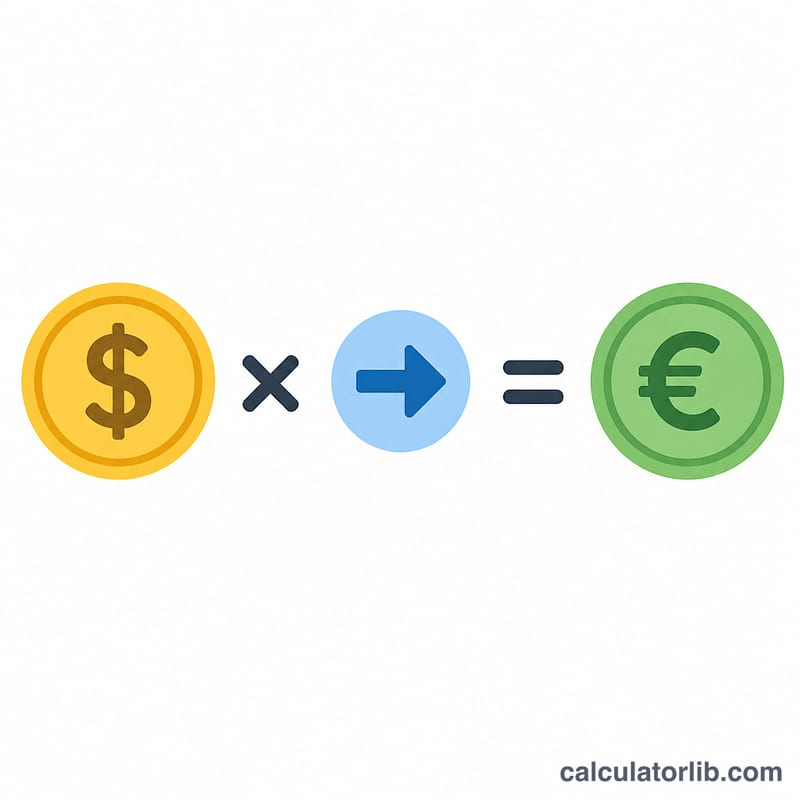
The conversion is a simple multiplication. If \(A\) = amount in the source currency and \(r\) = the exchange rate (target units per one source unit), then the converted value \(C\) is:
$$C = A \times r$$To convert back the other way, divide by the same rate, or equivalently multiply by its reciprocal \( \frac{1}{r} \).
How to use it
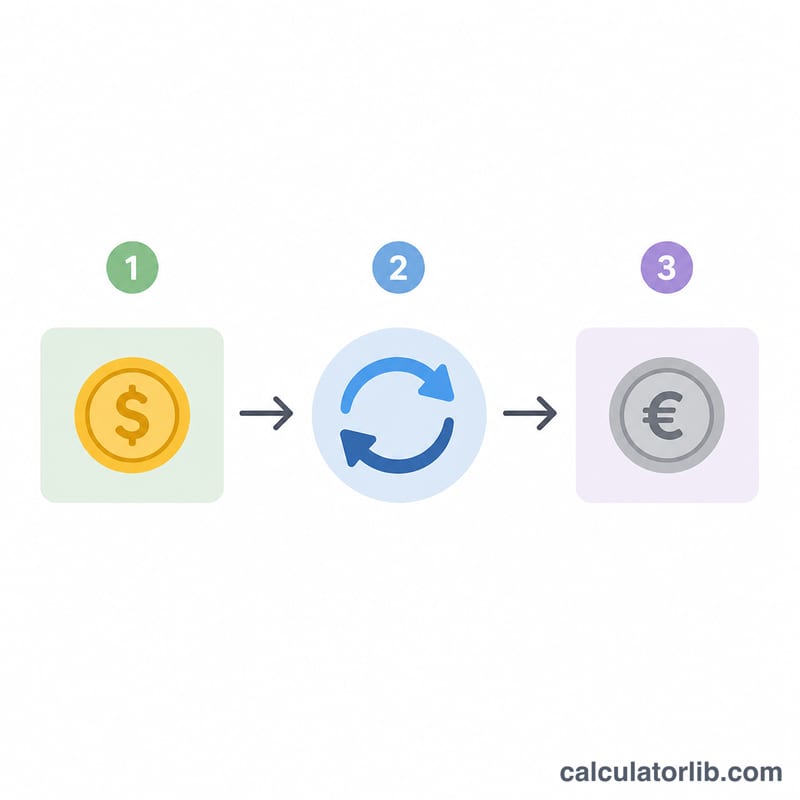
Enter the amount you want to convert, choose the source (from) and target (to) currencies, and type the current exchange rate for that pair. The rate is quoted as the number of target-currency units per one unit of the source currency. Press calculate to see the converted amount.
Worked example
Suppose you want to convert 100 US Dollars to Euros and the rate is \(0.92\) EUR per USD:
$$C = 100 \times 0.92 = 92.00\ \text{EUR}$$So $100 becomes 92.00 EUR at that rate. If the rate later rises to \(0.95\), the same $100 would be worth \(100 \times 0.95 = 95.00\) EUR.
More Worked Examples
Every conversion uses the formula \(C = A \times r\). Here \(A\) is the amount in the source (base) currency and \(r\) is the number of target-currency units per 1 source unit. All rates below are made up for illustration and are not current market quotes.
Example 1: Reverse conversion (EUR to USD)
Say you know the rate as r = 0.92 EUR per 1 USD, but you want to convert 250 EUR into USD. That is the opposite direction, so you either divide by the rate or multiply by its reciprocal.
Reciprocal rate:
$$\frac{1}{r} = \frac{1}{0.92} \approx 1.0870 \text{ USD per EUR}$$Conversion:
$$C = \frac{250}{0.92} = 250 \times 1.086957 \approx 271.74 \text{ USD}$$Do the calculation with the full reciprocal and round only at the end. If you round the reciprocal to 1.0870 first, you get \(250 \times 1.0870 = 271.75\), which is one cent off. With large amounts, rounding the rate too early adds up to noticeable errors.
Example 2: A high-unit currency (USD to JPY)
Convert 1,500 USD to JPY at a hypothetical rate of r = 151.2345 JPY per 1 USD.
$$C = 1{,}500 \times 151.2345 = 226{,}851.75 \text{ JPY}$$The raw result is 226,851.75 JPY. ISO 4217 gives the Japanese yen 0 decimal places, so the amount you can actually pay or receive is rounded to a whole yen: ¥226,852. Currencies such as USD and EUR use 2 decimal places, and a few, such as the Kuwaiti dinar (KWD), use 3.
Example 3: Conversion with a 2% rate markup (GBP to USD)
Convert 2,000 GBP to USD. The hypothetical mid-market rate is r = 1.27 USD per GBP, and the provider builds a 2% markup into the rate it gives you.
Pure (mid-market) conversion:
$$C_{\text{mid}} = 2{,}000 \times 1.27 = 2{,}540.00 \text{ USD}$$Effective rate after the markup:
$$r_{\text{eff}} = r \times (1 - 0.02) = 1.27 \times 0.98 = 1.2446$$Marked-up conversion:
$$C_{\text{eff}} = 2{,}000 \times 1.2446 = 2{,}489.20 \text{ USD}$$You receive 2,489.20 USD. The markup costs you:
$$2{,}540.00 - 2{,}489.20 = 50.80 \text{ USD}$$That is exactly 2% of the mid-market result, because \(0.02 \times 2{,}540 = 50.80\). A markup like this is often not listed as a fee, so compare the rate you are offered with the mid-market rate to see what you are really paying.
Key Terms: Exchange Rate Definitions
- Base (source) currency: The currency you are converting from. In a rate quote, it is the currency worth exactly 1 unit.
- Quote (target) currency: The currency you are converting to. The rate tells you how many units of it you get for 1 unit of the base currency.
- Exchange rate: The number of quote-currency units per 1 base-currency unit. In market notation, a quote such as EUR/USD = 1.08 means 1 EUR buys 1.08 USD. Always check which currency is the base, because sources write pairs in different ways.
- Direct vs indirect quote: A direct quote gives the price of 1 unit of foreign currency in your home currency. An indirect quote gives how much foreign currency 1 unit of your home currency buys. Which one is "direct" depends on the country you are in.
- Reciprocal (inverse) rate: The rate for the opposite direction, \(1/r\). If 1 USD = 0.92 EUR, then 1 EUR ≈ 1.0870 USD.
- Mid-market rate: The midpoint between the bid and ask prices on the wholesale currency market. It is the usual benchmark and includes no markup.
- Bid and ask (buy/sell) rates: The bid is the price at which a dealer will buy the base currency from you. The ask (or offer) is the price at which it will sell the base currency to you. The ask is always higher than the bid.
- Spread: The gap between the ask and bid rates (ask − bid). It is one way providers earn money on currency exchange.
- Rate markup (margin): The percentage by which a provider's rate is worse than the mid-market rate. The effective rate is \(r_{\text{eff}} = r \times (1 - m)\), where \(m\) is the markup as a decimal.
- ISO 4217 currency codes: The international standard three-letter codes for currencies, such as USD (US dollar), EUR (euro), GBP (pound sterling), JPY (Japanese yen), CAD, AUD, INR and CNY.
- Minor unit (decimal places): The smallest subdivision of a currency, also defined in ISO 4217. USD and EUR have 2 decimal places (cents), JPY has 0, and some currencies, such as KWD and BHD, have 3. Round converted amounts to the target currency's minor unit.
Mid-Market vs Marked-Up Rates: Scenario Comparison
This table converts a fixed 1,000 USD to EUR. It starts from a hypothetical mid-market rate of 0.92 EUR per USD and applies different markups. The effective rate is \(r_{\text{eff}} = 0.92 \times (1 - m)\), and the converted amount is \(1{,}000 \times r_{\text{eff}}\).
| Markup % | Effective rate (EUR per USD) | Converted amount (EUR) | Difference from mid-market (EUR) |
|---|---|---|---|
| 0% | 0.9200 | 920.00 | 0.00 |
| 0.5% | 0.9154 | 915.40 | −4.60 |
| 1% | 0.9108 | 910.80 | −9.20 |
| 2.5% | 0.8970 | 897.00 | −23.00 |
| 4% | 0.8832 | 883.20 | −36.80 |
The cost grows in direct proportion to the markup. Each 1% of markup on this conversion costs €9.20, which is 1% of the €920 mid-market result. The same percentage applied to a larger amount costs proportionally more.
Note: These figures are illustrative only and are not current quotes. Real exchange rates change constantly while markets are open, and the rate you get also depends on the provider and payment method. Providers may also charge fixed fees on top of the markup. To estimate the real cost, check the live mid-market rate and compare it with the provider's offered rate at the time you convert.
FAQ
Where does the exchange rate come from? You supply the rate, so you can use a live mid-market rate, your bank's rate, or a rate that includes a fee margin.
Does this include bank fees? No. The result is the pure mathematical conversion. To model fees, reduce the rate or subtract the fee from the result.
How do I convert in the opposite direction? Divide the amount by the rate instead of multiplying, since the reverse rate is \( \frac{1}{r} \).