What is the IST to EST Converter?
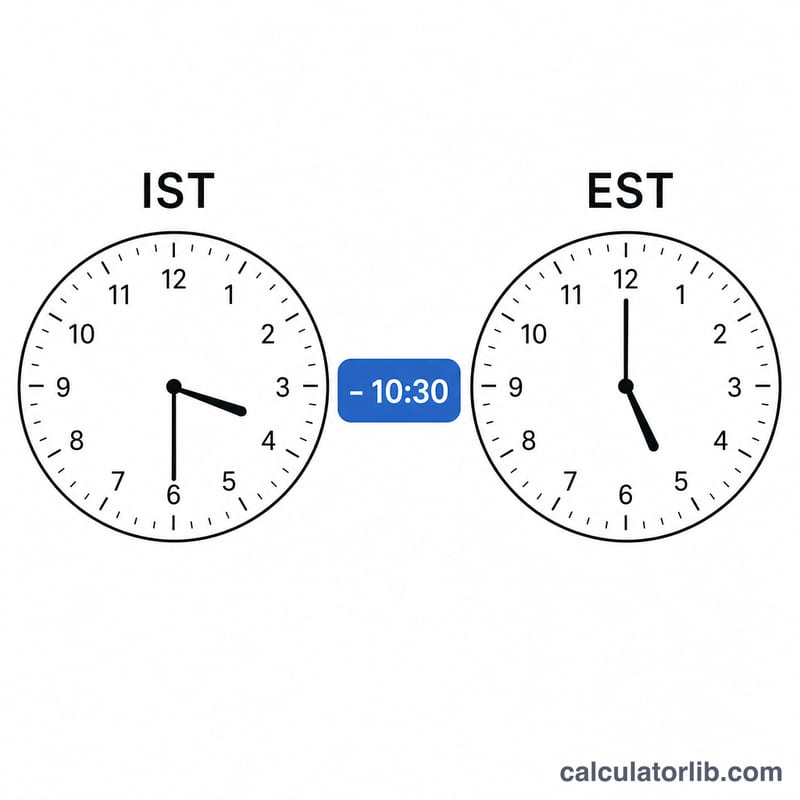
This tool converts a time given in India Standard Time (IST, UTC+5:30) to United States Eastern Standard Time (EST, UTC−5:00). The two zones differ by a fixed 10 hours and 30 minutes, so EST is always IST minus 10h 30m. Note this uses standard time (EST); during US daylight saving (EDT, UTC−4) the gap shrinks to 9h 30m.

How to use it
Enter the IST hour using a 24-hour clock (0–23) and the minute (0–59). The calculator returns the equivalent Eastern time, the EST hour and minute separately, and a day offset that tells you whether the result lands on the previous calendar day.
The formula explained
We convert the IST time to minutes since midnight, subtract 630 minutes (10×60 + 30), then wrap the result into the 0–1439 range with modulo 1440. If the subtraction goes below zero, the EST time falls on the previous day, so the day offset is −1.
$$\text{EST} = \Big(\,60\cdot\text{IST Hour} + \text{IST Minute} - 630\,\Big) \bmod 1440$$
Worked example
For 14:00 IST: minutes = 840. \(840 - 630 = 210\) minutes = 3:30. Since \(210 \geq 0\), the day offset is 0 — so 2:00 PM in India is 3:30 AM the same day in New York.
More Worked Examples
Each example below uses the same three steps. First, convert the IST time to minutes after midnight. Second, subtract the 630-minute offset (10 h 30 min). Third, take the result modulo 1440, the number of minutes in a day, so it stays within one day. If the subtraction gives a negative number, the EST time falls on the previous calendar day (day offset −1). Otherwise it falls on the same day (day offset 0). India Standard Time is fixed at UTC+5:30 all year. US Eastern Standard Time is UTC−5:00. These examples use standard time. While the US Eastern zone observes daylight saving time (EDT, UTC−4:00), the difference is 9 h 30 min instead.
$$\text{EST} = (60 \cdot H + M - 630) \bmod 1440$$Example 1: 09:15 IST (crosses back to the previous day)
- Minutes after midnight: \(60 \cdot 9 + 15 = 540 + 15 = 555\).
- Subtract the offset: \(555 - 630 = -75\). The result is negative, so the time falls on the previous day.
- Modulo step: \(-75 \bmod 1440 = -75 + 1440 = 1365\).
- Convert back to hours and minutes: \(1365 \div 60 = 22\) remainder \(45\), because \(22 \cdot 60 = 1320\) and \(1365 - 1320 = 45\).
Result: 09:15 IST = 22:45 EST on the previous day (day offset −1). For example, 09:15 IST on a Tuesday is 22:45 EST on Monday.
Example 2: 10:30 IST (the boundary case)
- Minutes after midnight: \(60 \cdot 10 + 30 = 600 + 30 = 630\).
- Subtract the offset: \(630 - 630 = 0\). The result is not negative, so the day does not change.
- Modulo step: \(0 \bmod 1440 = 0\).
- Convert back: \(0\) minutes = 0 h 0 min.
Result: 10:30 IST = 00:00 EST (midnight) on the same day (day offset 0). This is the dividing line. Any IST time earlier than 10:30 gives a negative value in step 2, so it maps to the previous US day. Any time from 10:30 onward stays on the same date.
Example 3: 23:45 IST (same day, afternoon in the US)
- Minutes after midnight: \(60 \cdot 23 + 45 = 1380 + 45 = 1425\).
- Subtract the offset: \(1425 - 630 = 795\). The result is positive, so the day does not change.
- Modulo step: \(795 \bmod 1440 = 795\), because 795 is already between 0 and 1439.
- Convert back: \(795 \div 60 = 13\) remainder \(15\), because \(13 \cdot 60 = 780\) and \(795 - 780 = 15\).
Result: 23:45 IST = 13:15 EST (1:15 PM) on the same day (day offset 0).
| IST | 60·H + M | − 630 | mod 1440 | EST | Day offset |
|---|---|---|---|---|---|
| 09:15 | 555 | −75 | 1365 | 22:45 | −1 (previous day) |
| 10:30 | 630 | 0 | 0 | 00:00 | 0 (same day) |
| 23:45 | 1425 | 795 | 795 | 13:15 | 0 (same day) |
FAQ
Is EST the same as EDT? No. EST is standard time (winter); EDT is daylight time (summer) and is one hour ahead of EST.
Why 10.5 hours? IST is UTC+5:30 and EST is UTC−5:00, a difference of 10 hours 30 minutes.
What does the day offset mean? A −1 offset means the converted Eastern time is on the previous calendar day relative to the IST date.