
What Is the Battery Watt-Hours Calculator?
Battery capacity is usually printed in milliamp-hours (mAh), but airlines, shippers, and many spec sheets describe a battery's energy in watt-hours (Wh). This calculator converts a battery's capacity and nominal voltage into watt-hours so you can compare batteries fairly, check airline carry-on limits (typically 100 Wh per battery, up to 160 Wh with airline approval), and size power banks for your devices.
How to Use It
Enter the battery capacity in milliamp-hours (mAh) and the nominal voltage in volts (V). Both values are usually printed on the battery, the device label, or the manufacturer's spec sheet. Press calculate to get the energy in watt-hours.
The Formula Explained
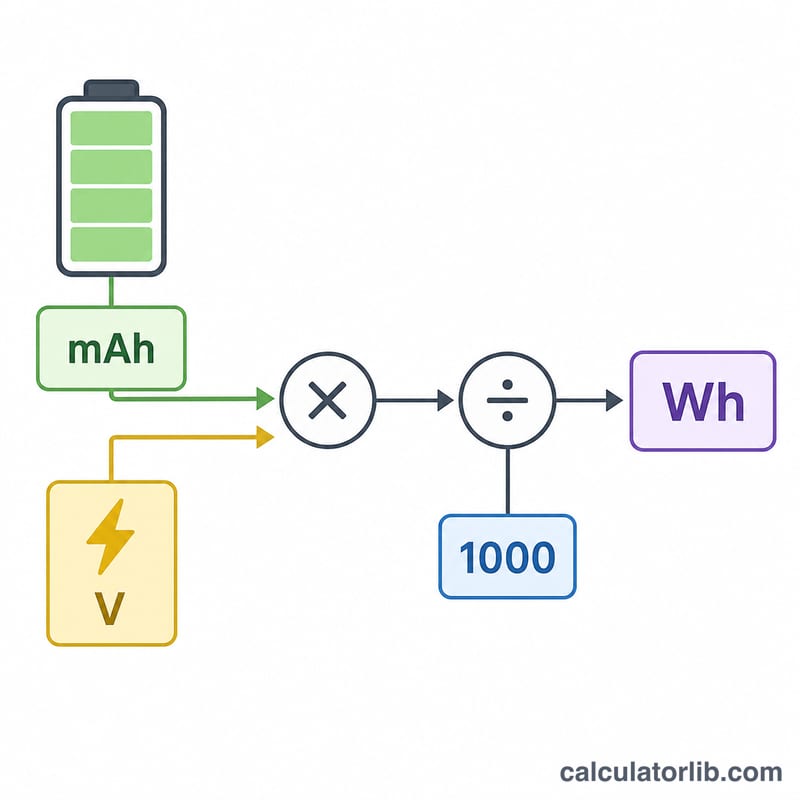
The conversion is simple: $$\text{Wh} = \frac{\text{mAh} \times \text{V}}{1000}$$. Capacity in mAh is divided by 1000 to convert to amp-hours (Ah), then multiplied by voltage to give watt-hours. For example, a 5000 mAh cell at 3.7 V holds \(5000 \times 3.7 \div 1000 = 18.5\) Wh.
Worked Example
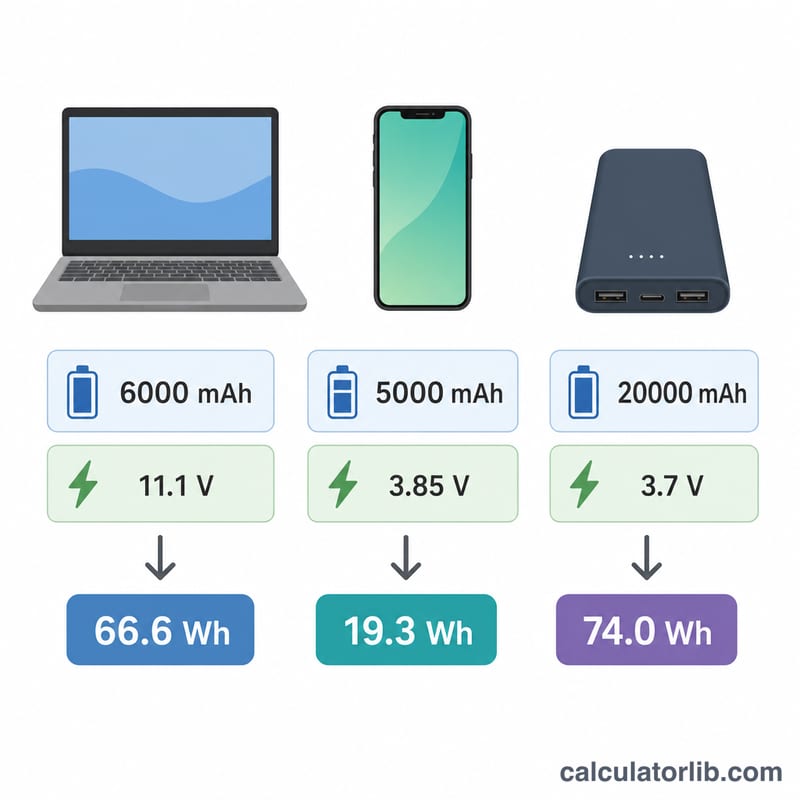
A laptop battery rated 5000 mAh with a nominal pack voltage of 11.1 V stores $$5000 \times 11.1 \div 1000 = 55.5 \text{ Wh}$$ That is comfortably below the 100 Wh airline carry-on limit.
FAQ
Which voltage should I use? Use the nominal voltage of the whole pack (e.g. 3.7 V for a single Li-ion cell, 11.1 V for a 3-cell laptop pack), not the maximum charge voltage.
Why convert mAh to Wh? Watt-hours measure actual energy and let you compare batteries of different voltages. Two 5000 mAh batteries can hold very different energy if their voltages differ.
Is this exact? The math is exact, but real usable energy is slightly lower due to internal resistance, discharge rate, and temperature.