What is the IST to CST Converter?
This tool converts a clock time in India Standard Time (IST) to Central Standard Time (CST), the standard time used in the central United States and parts of Canada and Mexico. IST is fixed at UTC+5:30, while CST is UTC−6:00. The fixed gap between them is exactly 11 hours and 30 minutes, with India always ahead.
How to use it
Enter the IST hour (0–23, 24-hour format) and the minute (0–59). The calculator subtracts 11.5 hours and displays the equivalent CST time, noting whether the result rolls back to the previous day. Note that this uses standard time (CST); during US daylight saving time the central zone observes CDT (UTC−5), which is only 10.5 hours behind IST.
The formula explained
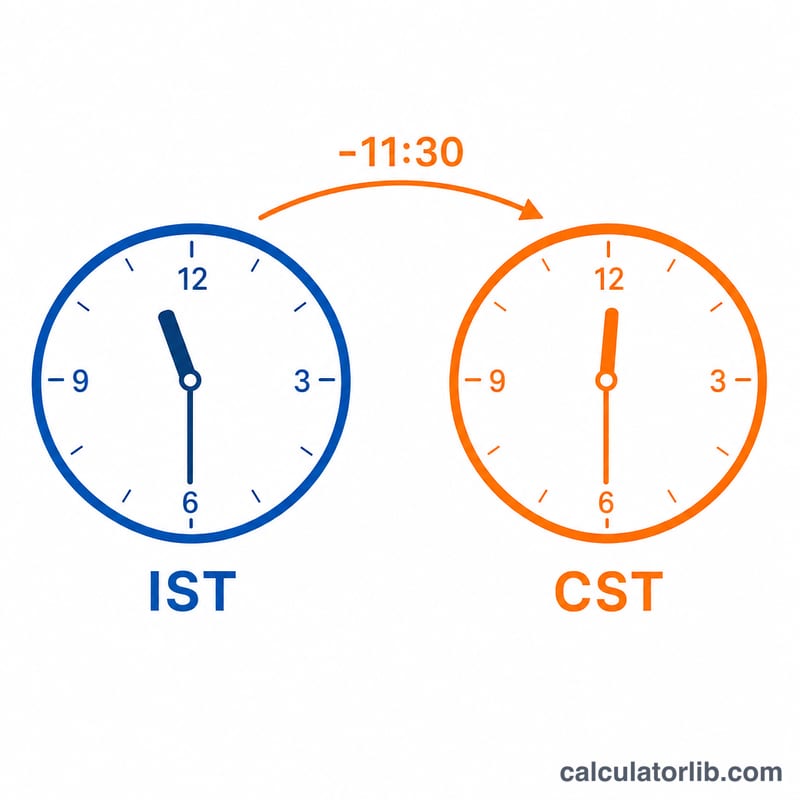
Because IST = UTC+5:30 and CST = UTC−6:00, the offset between them is (+5:30) − (−6:00) = 11:30. To go from IST to CST you subtract this amount: CST = IST − 11:30. If the subtraction takes the time before midnight, the date moves back by one day.
$$\text{CST} = \left(\left(\left(60\cdot\text{IST Hour} + \text{IST Minute}\right) - 690\right) \bmod 1440\right) \;\text{minutes}$$The full conversion, accounting for day wrap-around, is:
$$\begin{gathered} \text{CST}_{\text{total}} = \left(\left(T - 690\right) \bmod 1440 + 1440\right) \bmod 1440 \\[1.5em] \text{where}\quad \left\{ \begin{aligned} T &= 60\cdot\text{IST Hour} + \text{IST Minute} \\ \text{CST Hour} &= \left\lfloor \text{CST}_{\text{total}} / 60 \right\rfloor \\ \text{CST Minute} &= \text{CST}_{\text{total}} \bmod 60 \end{aligned} \right. \end{gathered}$$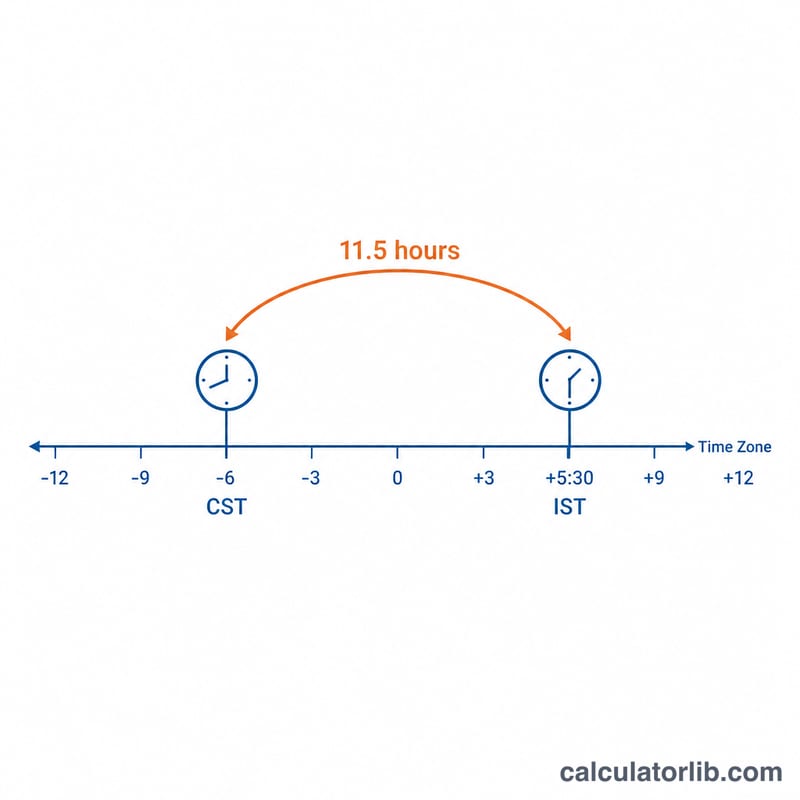
Worked example
Suppose it is 10:00 IST. Subtract 11 hours 30 minutes: \(10\!:\!00 - 11\!:\!30 = -1\!:\!30\), which wraps to 22:30 CST the previous day. For 20:00 IST: \(20\!:\!00 - 11\!:\!30 = 08\!:\!30\) CST the same day.
IST to CST Quick Conversion Table
India Standard Time (IST, UTC+5:30) is 11 hours 30 minutes ahead of Central Standard Time (CST, UTC−6). To convert, subtract 11:30 from the IST time. If the result would be negative, add 24 hours and move to the previous calendar day. The CDT column shows summer time (UTC−5), when IST is 10:30 ahead.
| IST | CST (IST − 11:30) | CST date | CDT (IST − 10:30) |
|---|---|---|---|
| 00:00 | 12:30 | Previous day | 13:30 (previous day) |
| 06:00 | 18:30 | Previous day | 19:30 (previous day) |
| 09:00 | 21:30 | Previous day | 22:30 (previous day) |
| 09:30 | 22:00 | Previous day | 23:00 (previous day) |
| 12:00 | 00:30 | Same day | 01:30 (same day) |
| 15:00 | 03:30 | Same day | 04:30 (same day) |
| 18:00 | 06:30 | Same day | 07:30 (same day) |
| 21:00 | 09:30 | Same day | 10:30 (same day) |
| 23:30 | 12:00 | Same day | 13:00 (same day) |
In minutes, the calculator computes \(\left(60h + m - 690\right) \bmod 1440\). For 09:00 IST: \(60\cdot 9 + 0 - 690 = -150\), and \(-150 + 1440 = 1290\) minutes, which is 21:30 on the previous day.
CST vs CDT: IST Conversion Across the Year
India does not observe daylight saving time, so IST stays at UTC+5:30 all year. The US Central time zone does observe it. Under current US rules, daylight saving time runs from the second Sunday in March to the first Sunday in November, with clocks changing at 2:00 a.m. local time. During that period Central time is CDT (UTC−5); the rest of the year it is CST (UTC−6). As a result, the gap between India and US Central time changes from 11:30 to 10:30 during US summer time.
| IST | CST (UTC−6), 11:30 behind | CDT (UTC−5), 10:30 behind |
|---|---|---|
| 09:00 | 21:30 (previous day) | 22:30 (previous day) |
| 14:00 | 02:30 (same day) | 03:30 (same day) |
| 21:00 | 09:30 (same day) | 10:30 (same day) |
Practical note: a recurring meeting fixed at a given IST time will land one hour later on the US Central clock during daylight saving time than it does in winter. Around the change dates in March and November, check the exact date before scheduling. The US rules described here apply to the United States; other countries in the Central time region may follow different daylight saving rules.
Key Terms: IST, CST, CDT and UTC Offset
- IST (India Standard Time): The single time zone used across India, UTC+5:30. India does not observe daylight saving time.
- CST (Central Standard Time): The North American Central time zone in winter, UTC−6.
- CDT (Central Daylight Time): The Central zone during daylight saving time, UTC−5. In the US it runs from the second Sunday in March to the first Sunday in November.
- UTC offset: The difference between a local time and Coordinated Universal Time, written as + or − hours and minutes. The difference between two zones is the subtraction of their offsets: \(+5{:}30 - (-6{:}00) = 11{:}30\).
- Day wrap-around: When subtracting the offset crosses midnight, the clock time wraps within 24 hours and the date shifts. For IST times before 11:30, the CST time falls on the previous calendar day.
Caution: The abbreviation CST is ambiguous. It can also mean China Standard Time (UTC+8) or Cuba Standard Time (UTC−5). This converter uses US/Canada Central Standard Time (UTC−6). Confirm which zone is intended before scheduling anything.
FAQ
Why 11.5 hours and not a whole number? India uses a half-hour offset (UTC+5:30), so the difference with most US zones includes a 30-minute component.
Does this handle daylight saving? No — it converts to standard CST (UTC−6). When the US is on CDT (summer), use a 10.5-hour difference instead.
What does "previous day" mean? Subtracting the offset can push the CST time before midnight, so the calendar date is one day earlier than the IST date.