

What is winning percentage?
Winning percentage measures how often a team or player wins relative to the total number of decisions played. It is the standard figure shown in baseball standings, but the math is universal — it works for any win/loss sport or game. This calculator counts only wins and losses; ties (draws) are not included.
How to use this calculator
Enter the number of Wins and the number of Losses, then read the result. The main value is shown baseball-style as a three-decimal average with the leading zero dropped (for example .643), and the table also shows the same figure as a percent and the total games played.
The formula
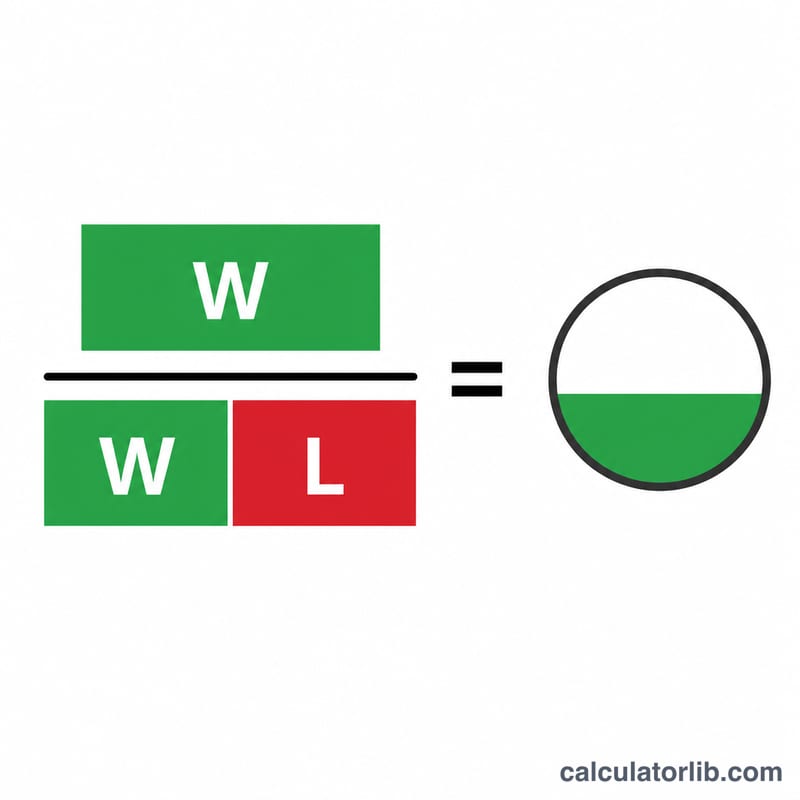
The winning percentage is simply wins divided by total games:
$$\text{Winning Percentage} = \frac{\text{Wins}}{\text{Wins} + \text{Losses}}$$
The result is a ratio between 0 and 1. Baseball convention writes it to three decimals; some sources round to four decimals before display. If no games have been played (\(\text{wins} + \text{losses} = 0\)) the result is conventionally treated as .000 to avoid division by zero.
Worked example
Suppose a team has 90 wins and 50 losses. Total games = \(90 + 50 = 140\). Winning percentage = \(90 / 140 = 0.642857\ldots\), which displays as .643 or about 64.3%.
Interpreting Your Winning Percentage
Baseball winning percentage is the share of decided games a team has won, expressed as a three-decimal figure such as .500, .618 or .432. It is the standard sorting key in Major League Baseball standings, where teams are ranked from highest to lowest winning percentage rather than by raw win totals. The formula is
$$\text{Win\%} = \frac{\text{Wins}}{\text{Wins} + \text{Losses}}$$
A value of .500 means a team has won exactly as many games as it has lost — a perfectly even record. For example, a team at 81–81 over a 162-game season finishes with a winning percentage of .500. Any figure above .500 indicates more wins than losses (a winning record), while any figure below .500 indicates more losses than wins (a losing record).
As general context for how these numbers play out across a full MLB season:
- ~.600 and above: A strong season. Over 162 games, .600 corresponds to roughly 97 wins, a total that has historically been competitive for division titles and playoff berths.
- .500 to .600: A winning record, ranging from barely above even up to clear contention.
- Around .400 to .500: A below-.500, losing season; .400 over 162 games is about 65 wins.
- ~.400 and below: A poor season, typically near the bottom of a division.
Winning percentage also underlies the games back (GB) column in the standings. Games back measures how far a team trails the division or league leader and is computed as
$$\text{GB} = \frac{(\text{Leader Wins} - \text{Team Wins}) + (\text{Team Losses} - \text{Leader Losses})}{2}$$
The leader is always 0.0 games back. Because each game involves both a win for one side and a loss for the other, a single head-to-head result between the leader and a chaser swings the gap by a full game, while results against other opponents move it by half a game. As long as a trailing team has a lower winning percentage than the leader, its games-back value is positive; a team can be a fraction of a game back (for example 1.5 GB) when the two clubs have played a different number of games.
These thresholds describe how winning percentage is read in standard MLB standings and are general reference points, not predictions or advice about any specific team or outcome.
FAQ
Do ties count? No. This calculator uses only wins and losses. If your league records ties, leave them out or handle them separately.
Why is it shown as .643 instead of 0.643? Baseball traditionally drops the leading zero, so 0.643 is written .643.
What if no games have been played? The denominator would be zero, so the result is reported as .000 rather than an error.