
What Is Batting Average?
Batting average (AVG) is the most familiar hitting statistic in baseball and softball. It measures how often a batter gets a hit, calculated as the number of hits divided by the number of official at-bats. A .300 average — getting a hit 30% of the time — is generally considered the mark of an excellent hitter, while .250 is roughly league average.
How to Use This Calculator
Enter the player total number of hits and total at-bats, then read the result. The average is shown in the traditional three-decimal form (for example .333) and also as a percentage. Note that at-bats exclude walks, hit-by-pitch, sacrifices, and times reaching on interference — those plate appearances are not counted in the denominator.
The Formula Explained
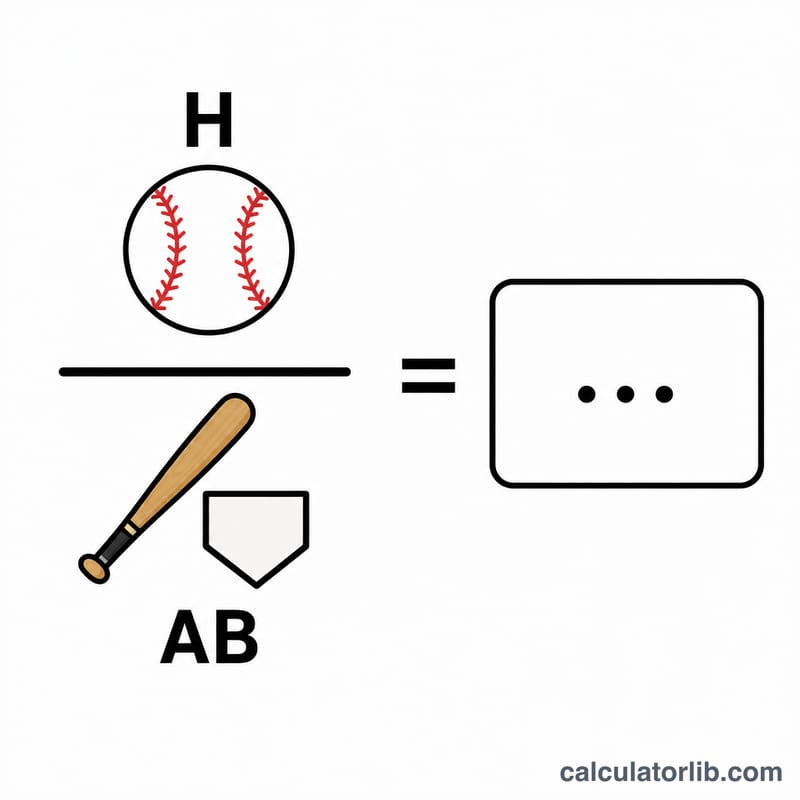
The equation is simply:
$$\text{AVG} = \frac{\text{Hits}}{\text{At-Bats}}$$Because at-bats are always a whole number of opportunities and a batter cannot get more hits than at-bats, the result is always between 0.000 and 1.000. By convention the leading zero is dropped, so 0.275 is written and spoken as "two seventy-five."
Worked Example
Suppose a player records 60 hits in 200 at-bats. Dividing 60 by 200 gives 0.300, written as .300. Expressed as a percentage that is 30%, meaning the hitter reaches base via a hit in 30 out of every 100 official at-bats.
$$\text{AVG} = \frac{60}{200} = 0.300$$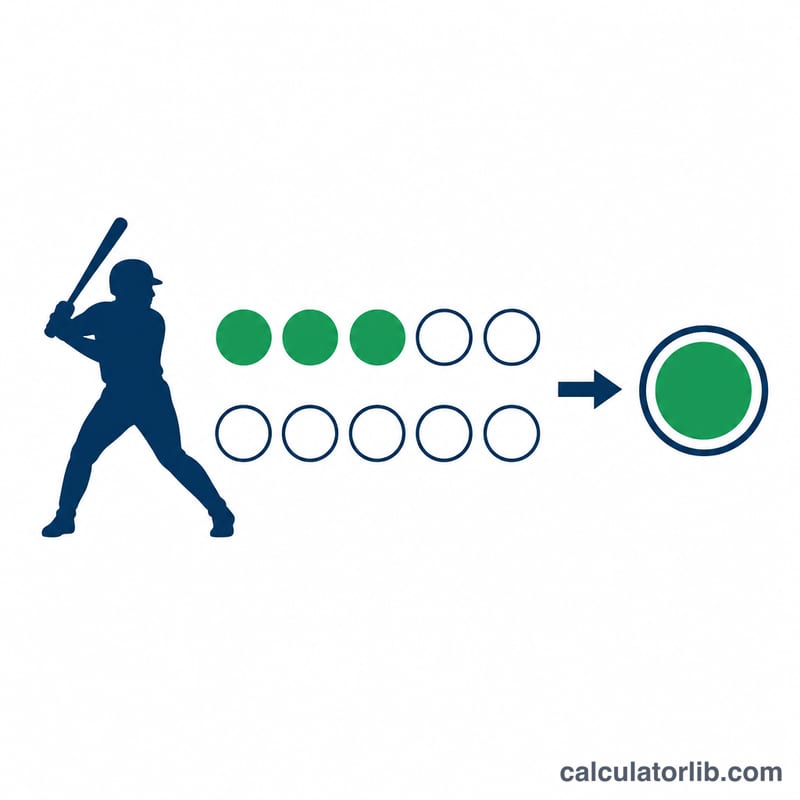
AVG Across Common Hit/At-Bat Scenarios
Batting average is computed as \(\text{AVG} = \dfrac{\text{Hits}}{\text{At-Bats}}\), then reported to three decimal places (e.g. \(.300\)) and spoken as "three hundred." Multiplying that decimal by 100 gives the percentage form — the share of at-bats that produced a hit. The table below shows realistic hit/at-bat combinations spanning a single game up to a full season, so you can see how each additional hit (or hitless at-bat) nudges the average.
| Hits / At-Bats | AVG (3 decimals) | Percentage | Context |
|---|---|---|---|
| 1 / 4 | .250 | 25.0% | A typical 1-for-4 game |
| 3 / 10 | .300 | 30.0% | Hot stretch over a few games |
| 30 / 100 | .300 | 30.0% | Solid early-season mark |
| 60 / 200 | .300 | 30.0% | Sustained through ~half a season |
| 150 / 500 | .300 | 30.0% | Excellent full-season total |
| 162 / 550 | .295 | 29.5% | Strong qualified-batter season |
Notice that \(3/10\), \(30/100\), \(60/200\) and \(150/500\) all round to the same \(.300\) — the average tracks the ratio, not the raw totals. Early in a season a single hit swings the average sharply (going 4-for-10 instead of 3-for-10 jumps you from \(.300\) to \(.400\)), while late in the season the same hit barely moves the third decimal because the denominator is so large. That is why a \(.300\) average is far more impressive over \(500\) at-bats than over \(10\).
FAQ
Do walks count as at-bats? No. Walks, hit-by-pitches, and sacrifice plays are plate appearances but not at-bats, so they do not lower your batting average.
What is a good batting average? Anything around .300 is very good, .250 is about average, and .400 over a full season has not happened in MLB since 1941.
Can the average exceed 1.000? No. Since hits can never exceed at-bats, the maximum possible value is 1.000 (a hit every time).