

What Is the Billable Hours Calculator?
The Billable Hours Calculator helps freelancers, consultants, lawyers, agencies, and any time-based professional quickly determine how much to invoice a client. Enter the number of hours you worked on a project and your hourly rate, and the tool returns the total billable amount. It is a fast way to estimate revenue before drafting an invoice or to sanity-check a client's bill.
How to Use It
Enter your billable hours — the total time spent on work you can charge for (you can use decimals, e.g. 7.5 hours). Then enter your hourly rate in your currency. The calculator multiplies the two and shows the total instantly. Track only the hours that are billable to the client; exclude internal admin or non-chargeable time.
The Formula Explained
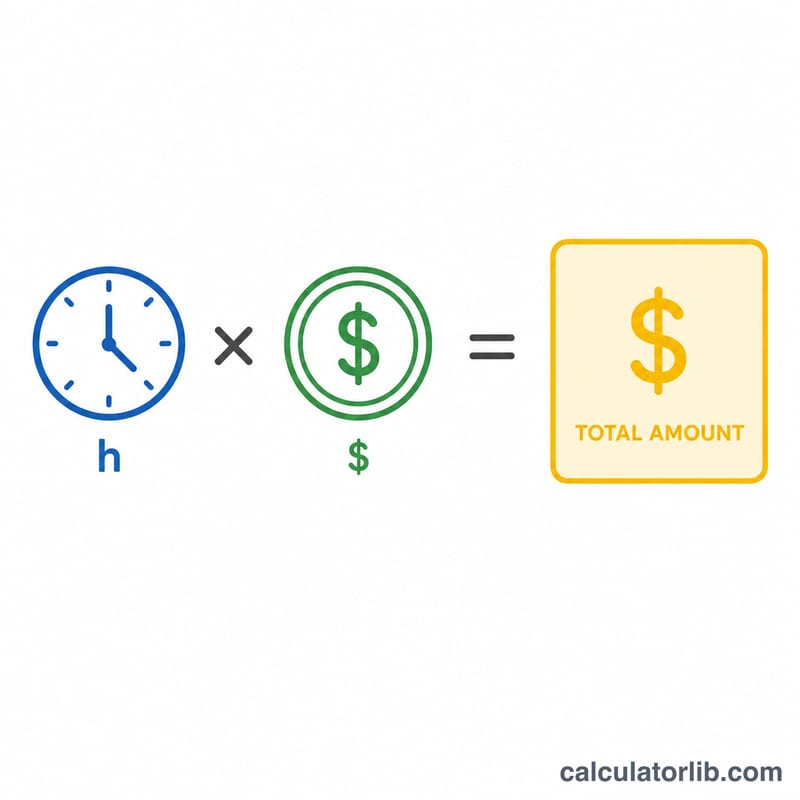
The math is simple: $$\text{Billable Amount} = \text{Billable Hours} \times \text{Hourly Rate}$$ If you bill in fractions of an hour, convert minutes to a decimal first — 15 minutes is \(0.25\) hours, 30 minutes is \(0.5\), and 45 minutes is \(0.75\).
Worked Example
Suppose you worked 40 billable hours on a project and charge $150 per hour. Your total billable amount is $$40 \times \$150 = \$6{,}000$$ If you instead billed 7.5 hours at $200/hour, the total would be $$7.5 \times \$200 = \$1{,}500$$
Minutes-to-Decimal Conversion Table
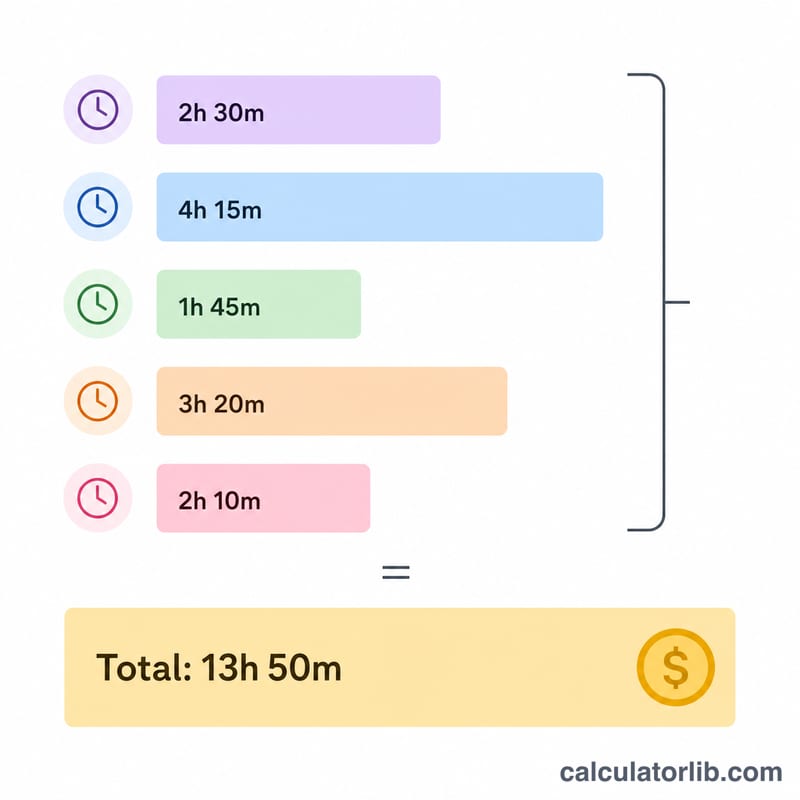
Time tracking systems and invoices bill in decimal hours, not minutes. To convert minutes to a decimal fraction of an hour, divide the minutes by 60:
$$\text{Decimal Hours} = \frac{\text{Minutes}}{60}$$For example, 45 minutes is \(45 \div 60 = 0.75\) hours. Use the table below to convert logged minutes accurately before multiplying by your hourly rate.
| Minutes | Decimal Hours |
|---|---|
| 5 min | 0.083 |
| 6 min | 0.100 |
| 10 min | 0.167 |
| 12 min | 0.200 |
| 15 min | 0.250 |
| 20 min | 0.333 |
| 25 min | 0.417 |
| 30 min | 0.500 |
| 35 min | 0.583 |
| 40 min | 0.667 |
| 45 min | 0.750 |
| 50 min | 0.833 |
| 55 min | 0.917 |
| 60 min | 1.000 |
Many law firms bill in tenths of an hour (6-minute increments), so a 15-minute call would round to 0.3 hours under that convention even though the exact value is 0.25.
Billable Amount Across Common Rate & Hour Scenarios
The total amount is simply \(\text{Amount} = \text{Hours} \times \text{Rate}\). The table below shows how billable totals scale across rates typical of freelancers ($50–$100/hr), consultants ($150–$200/hr), and attorneys ($200–$300+/hr) over a small project (10 hours), a full work week (40 hours), and a two-week sprint (80 hours).
| Hourly Rate | 10 hours | 40 hours | 80 hours |
|---|---|---|---|
| $50 | $500 | $2,000 | $4,000 |
| $100 | $1,000 | $4,000 | $8,000 |
| $200 | $2,000 | $8,000 | $16,000 |
| $300 | $3,000 | $12,000 | $24,000 |
Worked example: A consultant logs 40 hours at $150/hr. The billable amount is \(40 \times \$150 = \$6{,}000\). If you instead know your target annual income and want to back into the right number, a freelance hourly rate calculator can set the rate, while an hourly to annual salary calculator projects $150/hr over a full year.
Key Terms Defined
- Billable Hours
- Time spent on work that can be directly invoiced to a client, such as client meetings, deliverable production, and research tied to a specific engagement.
- Non-Billable / Overhead Hours
- Time spent on running your business that cannot be charged to a client — administration, marketing, invoicing, professional development, and unpaid breaks.
- Hourly Rate
- The amount charged for each hour of billable work. It should cover your desired income plus overhead, taxes, and non-billable time, not just your take-home target.
- Blended Rate
- A single average rate applied across team members or task types of differing value. It is calculated as total fees divided by total hours, smoothing out a mix of junior and senior work into one figure.
- Utilization Rate
- The percentage of available working hours that are actually billable, computed as \(\text{Utilization} = \frac{\text{Billable Hours}}{\text{Total Worked Hours}} \times 100\%\). A common professional-services benchmark is roughly 60–80%.
- Retainer
- A fee paid in advance that reserves a set block of hours or ongoing availability. Billable work is then drawn down against the retainer balance until it is exhausted and replenished.
FAQ
What counts as a billable hour? Any time spent on work directly chargeable to a client under your agreement — meetings, research, drafting, and revisions, but typically not general overhead.
Can I enter partial hours? Yes. Use decimals such as \(1.25\) for one hour and fifteen minutes.
Does this include taxes or fees? No. The result is the pre-tax billable amount; add any applicable sales tax, VAT, or platform fees separately on your invoice.