
What Is the Blood Sugar Conversion Calculator?
Blood glucose (blood sugar) is reported in two different units around the world. The United States and a few other countries use milligrams per deciliter (mg/dL), while most of the world — including the UK, Canada, Australia and much of Europe — uses millimoles per liter (mmol/L). This calculator converts a glucose reading between the two units instantly, in either direction, so you can compare lab results, glucose-meter readings and clinical targets no matter where they came from.
How to Use It
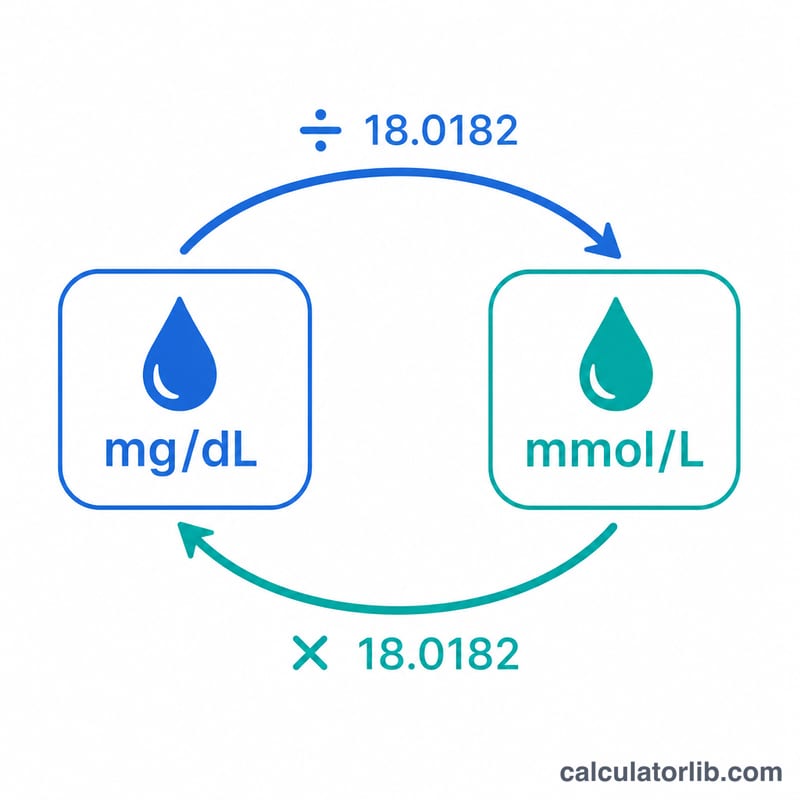
Choose the direction of conversion (mg/dL → mmol/L or mmol/L → mg/dL), type in your blood sugar value, and the converted result appears immediately. The conversion uses the molar mass of glucose, giving a fixed factor of \(18.0182\).
The Formula Explained
Glucose has a molar mass of about 180.16 g/mol. Converting mg/dL to mmol/L involves dividing by \(18.0182\):
$$\text{mmol/L} = \frac{\text{mg/dL}}{18.0182}$$$$\text{mg/dL} = \text{mmol/L} \times 18.0182$$The factor \(18.0182\) comes from the molecular weight of glucose and the unit definitions of deciliters and liters.
Worked Example
Suppose a US lab reports a fasting glucose of 100 mg/dL. To express this in mmol/L: $$100 \div 18.0182 = 5.55 \text{ mmol/L}$$ Going the other way, a reading of 7 mmol/L equals $$7 \times 18.0182 = 126.1 \text{ mg/dL}$$
mg/dL to mmol/L Conversion Table
Blood glucose is reported in milligrams per deciliter (mg/dL) in countries such as the United States, and in millimoles per liter (mmol/L) in most of the rest of the world. The two units are related by the molar mass of glucose, giving the standard conversion factor 18.0182:
$$\text{mmol/L} = \frac{\text{mg/dL}}{18.0182} \qquad \text{mg/dL} = \text{mmol/L} \times 18.0182$$For example, a common fasting threshold of 126 mg/dL converts to \(126 \div 18.0182 = \) 6.99 mmol/L.
| mg/dL | mmol/L (÷ 18.0182) |
|---|---|
| 50 | 2.8 |
| 70 | 3.9 |
| 90 | 5.0 |
| 100 | 5.6 |
| 126 | 7.0 |
| 140 | 7.8 |
| 180 | 10.0 |
| 200 | 11.1 |
| 250 | 13.9 |
| 300 | 16.7 |
Values are rounded to one decimal place, which is the typical reporting precision for mmol/L.
Blood Glucose Categories in Both Units
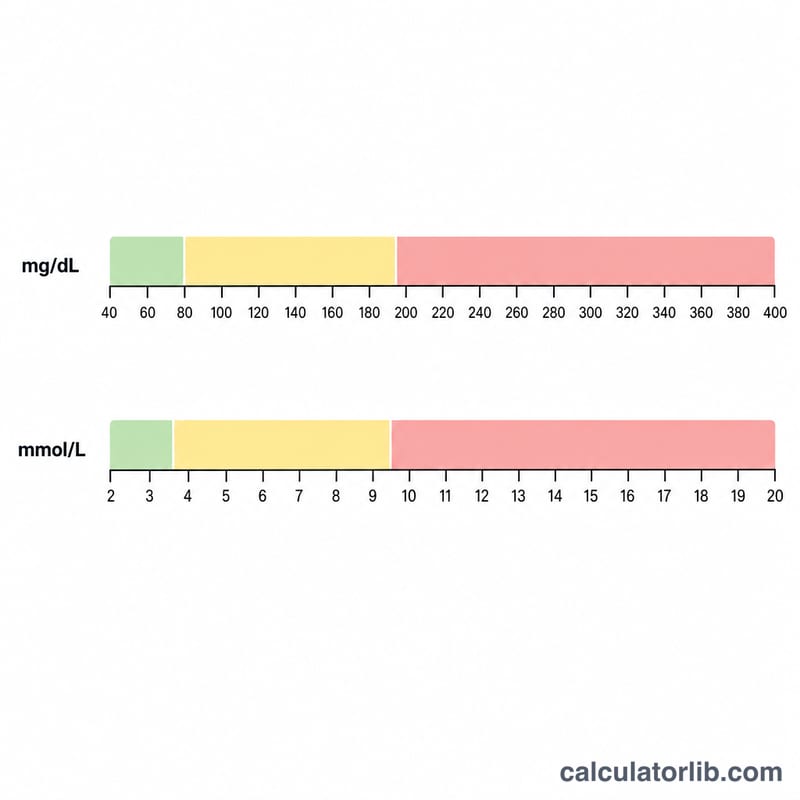
The table below shows the diagnostic thresholds used by the American Diabetes Association (ADA) and World Health Organization (WHO) for fasting plasma glucose and the 2-hour value during a 75 g oral glucose tolerance test (OGTT), expressed in both units. Conversions use the 18.0182 factor.
| Category | Fasting glucose | 2-hour OGTT |
|---|---|---|
| Normal | < 100 mg/dL (< 5.6 mmol/L) | < 140 mg/dL (< 7.8 mmol/L) |
| Prediabetes | 100–125 mg/dL (5.6–6.9 mmol/L) | 140–199 mg/dL (7.8–11.0 mmol/L) |
| Diabetes | ≥ 126 mg/dL (≥ 7.0 mmol/L) | ≥ 200 mg/dL (≥ 11.1 mmol/L) |
Notes: "Prediabetes" by fasting glucose is also called impaired fasting glucose (IFG); by the 2-hour OGTT it is called impaired glucose tolerance (IGT). A diabetes diagnosis generally requires confirmation on a repeat test or a second abnormal result, and an HbA1c of 6.5% or higher is an additional diagnostic criterion. These cut-points apply to venous plasma glucose and are not a substitute for clinical evaluation.
Interpreting Your Result
Once you have converted a value, what it means depends heavily on when the sample was taken relative to eating:
- Fasting (no food for at least 8 hours): a normal result is below 100 mg/dL (5.6 mmol/L). Values of 100–125 mg/dL (5.6–6.9 mmol/L) suggest prediabetes, and 126 mg/dL (7.0 mmol/L) or higher on repeat testing is in the diabetes range.
- 2 hours after a meal (postprandial) or 2-hour OGTT: under 140 mg/dL (7.8 mmol/L) is generally considered normal; 200 mg/dL (11.1 mmol/L) or above is in the diabetes range.
- Random (any time of day): a random value of 200 mg/dL (11.1 mmol/L) or higher together with symptoms of high blood sugar is suggestive of diabetes.
- Low readings: a glucose below about 70 mg/dL (3.9 mmol/L) is generally classified as hypoglycemia and may need prompt attention, especially in people taking insulin or other glucose-lowering medication.
Converting the number between units does not change its meaning — 126 mg/dL and 7.0 mmol/L describe exactly the same blood sugar level. Single readings can be affected by recent food and drink, illness, stress, exercise, medications, and measurement technique, so a single value should not be used to self-diagnose. If you track long-term control with HbA1c, related tools can estimate your average glucose from an HbA1c result.
This is general information, not professional medical advice. Only a qualified healthcare professional can interpret your blood glucose in the context of your full medical history, symptoms, and other test results. Discuss any abnormal or concerning value with your clinician before changing diet, medication, or activity.
FAQ
Is 18.0182 the right factor? Yes — it is derived from the molar mass of glucose (≈180.16 g/mol). Some sources round it to 18, which gives slightly less precise results.
What are normal fasting levels? Roughly 70–99 mg/dL (3.9–5.5 mmol/L) is considered normal fasting glucose, though you should always interpret results with a healthcare professional.
Does this work for HbA1c? No. HbA1c uses a different conversion (the DCCT/IFCC formula). This tool is only for instantaneous blood glucose values.