
What Is the Caffeine Intake Calculator?
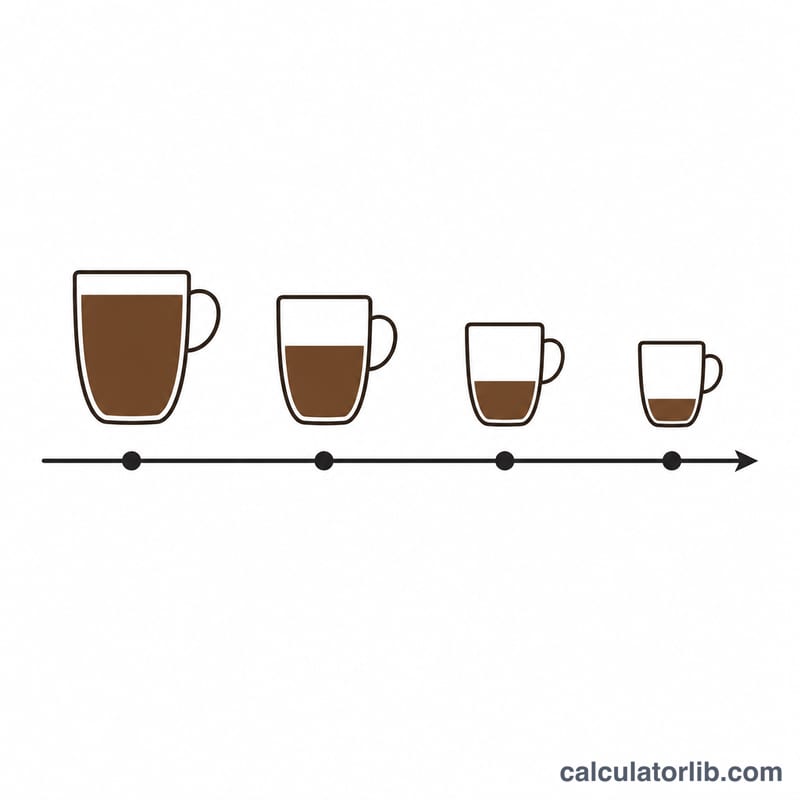
This calculator estimates how much caffeine is still active in your body a given number of hours after you consumed it. Caffeine is cleared from the bloodstream through exponential decay, so it follows a predictable half-life curve. By default we use a half-life of about 5 hours, which is a common average for healthy adults, but you can adjust it because individual metabolism, pregnancy, smoking, and certain medications can shift it significantly.
How to Use It
Enter the caffeine dose in milligrams (a typical 240 ml cup of brewed coffee has roughly 95 mg, an espresso shot about 63 mg, and a standard energy drink 80–160 mg). Enter how many hours have passed since you drank it, and optionally tweak the half-life. The calculator returns the milligrams still remaining, the amount eliminated, and the percentage left.
The Formula Explained
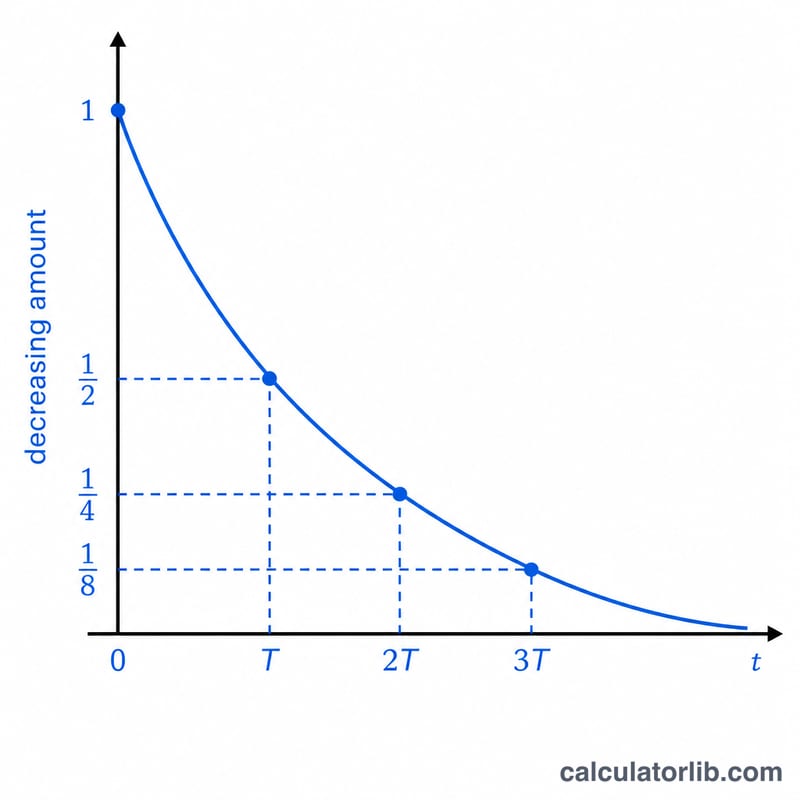
Caffeine decay follows first-order kinetics: $$R = D \times 0.5^{\frac{t}{t_{\frac{1}{2}}}}$$ Here \(D\) is the original dose, \(t\) is the elapsed time in hours, and \(t_{\frac{1}{2}}\) is the half-life. Each time \(t\) equals one half-life, the remaining amount halves. After two half-lives only a quarter remains, after three only an eighth, and so on.
Worked Example
Suppose you drink a coffee containing 200 mg of caffeine and want to know how much is left after 5 hours with a 5-hour half-life. The exponent is \(5 / 5 = 1\), so $$R = 200 \times 0.5^{1} = 100 \text{ mg}.$$ After 10 hours it would be $$200 \times 0.5^{2} = 50 \text{ mg}.$$
Caffeine Content of Common Foods & Drinks
Caffeine content varies widely depending on brand, brewing method, bean or leaf variety, and steeping time. The values below are typical ranges for common servings; use the midpoint as a reasonable estimate when entering your dose into the calculator.
| Source | Typical serving | Caffeine (mg) |
|---|---|---|
| Brewed coffee | 8 fl oz (240 mL) | 80–135 (≈95) |
| Espresso | 1 shot (30 mL) | 60–75 (≈63) |
| Instant coffee | 8 fl oz (240 mL) | 30–90 (≈62) |
| Decaf coffee | 8 fl oz (240 mL) | 2–7 (≈3) |
| Black tea | 8 fl oz (240 mL) | 40–70 (≈47) |
| Green tea | 8 fl oz (240 mL) | 20–45 (≈28) |
| Cola (soft drink) | 12 fl oz (355 mL) | 30–45 (≈35) |
| Energy drink | 8 fl oz (240 mL) | 70–120 (≈80) |
| Dark chocolate | 1 oz (28 g) | 15–30 (≈22) |
For example, if you finish a standard brewed coffee (≈95 mg) and want to know how much remains after 5 hours assuming a 5-hour half-life, the model predicts 47.5 mg still circulating.
Key Terms Explained
- Dose (D)
- The amount of caffeine consumed at one time, measured in milligrams (mg). In the formula this is the starting quantity before any elimination.
- Elapsed time (t)
- The number of hours that have passed since the dose was taken. Larger values of \(t\) mean more of the caffeine has been cleared.
- Half-life (t½)
- The time required for the amount in the body to fall to half its current value. For caffeine in healthy adults this is commonly cited as roughly 5 hours, though it ranges from about 3 to 7 hours and can be much longer in pregnancy.
- First-order / exponential decay
- A process in which a constant fraction (not a constant amount) is removed per unit time. It is described by \(C = D \times (0.5)^{t/t_{1/2}}\), the basis of this calculator.
- Elimination
- The overall removal of caffeine from the body, primarily through metabolism in the liver and excretion. The half-life summarizes how fast elimination proceeds.
- Percentage remaining
- The fraction of the original dose still present, expressed as a percent: \(100 \times (0.5)^{t/t_{1/2}}\). After one half-life it is 50%, after two half-lives 25%, after three 12.5%, and so on.
FAQ
Is the 5-hour half-life accurate for everyone? No. Caffeine half-life ranges from about 1.5 to 9.5 hours depending on genetics, liver function, pregnancy, oral contraceptives, and smoking. Adjust the half-life field for a closer estimate.
Should I use this for medical decisions? No. This is an educational estimate, not medical advice. Consult a healthcare professional for caffeine sensitivity or sleep concerns.
How long until caffeine is mostly gone? After about 5 half-lives (roughly 25 hours at a 5-hour half-life) less than 4% of the dose remains.