

This Combinations Calculator (nCr) helps you compute the total number of ways to choose a sample size from a set of distinct objects where order does not matter and repetitions are not allowed. It’s perfect for solving problems involving combinations and permutations in probability, statistics, and more.
What Are Combinations?
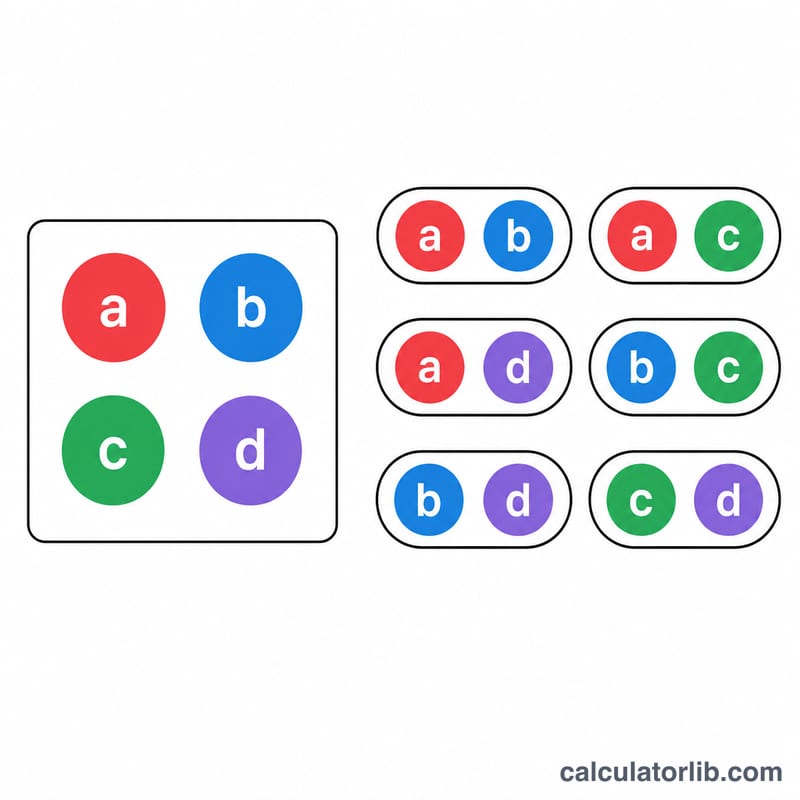
In combinatorics, a combination is a way of selecting items from a larger set where the order is not important. This differs from permutations, where the order is important.
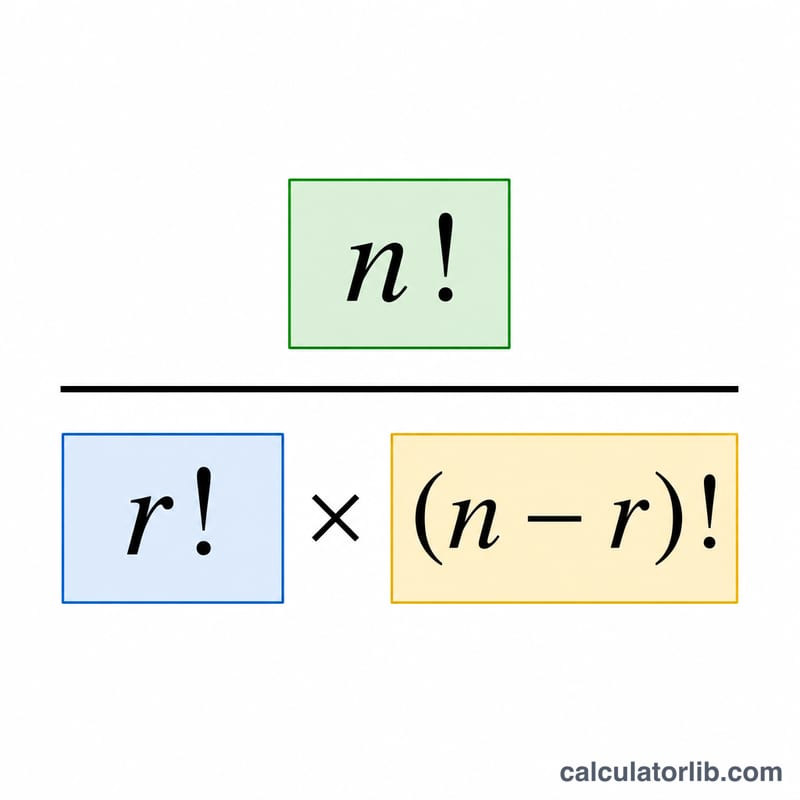
The standard combinations formula is:
$$C(n, r) = \binom{n}{r} = \frac{n!}{r!\,(n - r)!}$$Where:
- \(n\) = total number of elements in the set
- \(r\) = sample size or number of items selected
- \(!\) = factorial
This calculator computes combinations without repetitions — meaning each object is chosen only once per combination.
When to Use This Calculator
- Selecting a group of winners from a larger pool
- Choosing cards from a deck where order does not matter
- Solving statistical problems related to combinations and permutations
- Calculating the total number of permutations when only combinations are required
How It Works
- Enter the number of elements (n): Input the total count in the set of objects.
- Enter the sample size (r): Define how many elements you want to choose.
- Click Calculate: The calculator uses the combinations formula to compute the result.
- View the result: You’ll see how many ways you can choose
relements fromnwhen order does not matter.
Example Calculation
Suppose you want to choose 3 elements from a set of 10:
$$n = 10, \quad r = 3$$ $$10C3 = \frac{10!}{3!(10-3)!} = \frac{10 \times 9 \times 8}{3 \times 2 \times 1} = 120$$So, there are 120 combinations of 3 elements from a set of 10.
Frequently Asked Questions
1. What’s the difference between combinations and permutations?
Combinations are used when order does not matter, while permutations apply when the order is important. For example, selecting team members is a combination, while assigning tasks is a permutation.
2. Can I calculate combinations with repetitions?
This calculator is designed for combinations without repetitions. If repetitions are allowed, a different formula must be used: n+r-1Cr.
3. What happens if the sample size exceeds the total number of elements?
You cannot select more elements than are available in the set. If r > n, the combination is mathematically undefined.
nCr Reference Table for Common Values
The table below gives \(C(n, r)\) for small values of \(n\) (from 1 to 10) across every valid choice of \(r\) (from 0 up to \(n\)). This is the well-known Pascal's triangle: each interior value equals the sum of the two values diagonally above it, and each row is symmetric because \(C(n, r) = C(n, n-r)\). Read off the value where your row \(n\) meets your column \(r\).
| n \ r | 0 | 1 | 2 | 3 | 4 | 5 | 6 | 7 | 8 | 9 | 10 |
|---|---|---|---|---|---|---|---|---|---|---|---|
| 1 | 1 | 1 | |||||||||
| 2 | 1 | 2 | 1 | ||||||||
| 3 | 1 | 3 | 3 | 1 | |||||||
| 4 | 1 | 4 | 6 | 4 | 1 | ||||||
| 5 | 1 | 5 | 10 | 10 | 5 | 1 | |||||
| 6 | 1 | 6 | 15 | 20 | 15 | 6 | 1 | ||||
| 7 | 1 | 7 | 21 | 35 | 35 | 21 | 7 | 1 | |||
| 8 | 1 | 8 | 28 | 56 | 70 | 56 | 28 | 8 | 1 | ||
| 9 | 1 | 9 | 36 | 84 | 126 | 126 | 84 | 36 | 9 | 1 | |
| 10 | 1 | 10 | 45 | 120 | 210 | 252 | 210 | 120 | 45 | 10 | 1 |
Note that \(C(n, 0) = C(n, n) = 1\) (there is exactly one way to choose nothing, and one way to choose everything) and \(C(n, 1) = n\) (there are \(n\) ways to pick a single item).
More Worked Examples
Each example substitutes the values directly into the combinations formula \(C(n, r) = \dfrac{n!}{r!\,(n-r)!}\), where order does not matter.
-
Poker hands — 52 choose 5. A standard deck has 52 cards and a poker hand is 5 cards drawn without regard to order:
$$C(52, 5) = \frac{52!}{5!\,(52-5)!} = \frac{52 \times 51 \times 50 \times 49 \times 48}{5 \times 4 \times 3 \times 2 \times 1} = \frac{311{,}875{,}200}{120}$$which gives 2,598,960 distinct five-card hands.
-
Choosing all of them — 6 choose 6. When you must select every item, there is only one possible group:
$$C(6, 6) = \frac{6!}{6!\,(6-6)!} = \frac{6!}{6! \times 0!} = \frac{720}{720 \times 1} = 1$$This uses the convention that \(0! = 1\). So \(C(6, 6) = \) 1.
-
Choosing none — 8 choose 0. There is exactly one way to pick nothing from a set (the empty selection):
$$C(8, 0) = \frac{8!}{0!\,(8-0)!} = \frac{8!}{1 \times 8!} = 1$$Hence \(C(8, 0) = \) 1.
-
A committee — 10 choose 3. Selecting a 3-person committee from 10 candidates (positions are not distinguished):
$$C(10, 3) = \frac{10!}{3!\,(10-3)!} = \frac{10 \times 9 \times 8}{3 \times 2 \times 1} = \frac{720}{6}$$giving 120 possible committees. If the roles were distinct (chair, secretary, treasurer), order would matter and you would instead compute the permutation 720.
Key Terms & Definitions
- Combination
- A selection of items from a larger set where the order of selection does not matter. The number of combinations of \(r\) items from \(n\) is written \(C(n, r)\), \(\binom{n}{r}\), or "n choose r."
- Permutation
- An ordered arrangement of items. Because order matters, permutations are always at least as many as combinations: \(P(n, r) = C(n, r) \times r!\). For example, \{A, B\} and \{B, A\} count as one combination but two permutations.
- n (set size)
- The total number of distinct items available to choose from — the size of the whole set. In the formula it is the top number of \(\binom{n}{r}\).
- r (sample size)
- The number of items you are selecting from the set. It must satisfy \(0 \le r \le n\). In the formula it is the bottom number of \(\binom{n}{r}\).
- Factorial (!)
- The product of all positive integers up to a number: \(n! = n \times (n-1) \times \cdots \times 2 \times 1\). By definition \(0! = 1\). Factorials appear throughout the combinations formula. For example, \(5! = 120\).
- "Order does not matter"
- The defining property of combinations: two selections containing the same items are considered identical regardless of the sequence in which they were picked. This is why \(C(n, r)\) divides the ordered count \(P(n, r)\) by \(r!\) to remove duplicate orderings.
nCr Across Different Scenarios
The same combinations formula, \(C(n,r)=\dfrac{n!}{r!\,(n-r)!}\), powers many everyday counting problems. Because order does not matter in a combination, nCr answers questions like “how many distinct groups can be formed” rather than “how many ordered sequences.” The table below works several realistic cases, each computed with this calculator.
| Scenario | n (total) | r (chosen) | nCr | Real-world context |
|---|---|---|---|---|
| Small pairing | 5 | 2 | 10 | Number of ways to pick 2 teammates from 5 people, or 2 toppings from 5 options. |
| Committee selection | 10 | 3 | 120 | Distinct 3-member subcommittees that can be drawn from a group of 10. |
| 6/49 lottery | 49 | 6 | 13,983,816 | Total possible draws of 6 numbers from 49 — the odds of matching all six on one ticket are 1 in this many. |
| Poker hands | 52 | 5 | 2,598,960 | Number of distinct 5-card hands dealt from a standard 52-card deck (ignoring order). |
| Pizza toppings | 8 | 3 | 56 | Ways to choose 3 toppings from a menu of 8, where the order chosen doesn’t matter. |
Worked check for the poker case: \(C(52,5)=\dfrac{52!}{5!\,(52-5)!}=\dfrac{52\cdot51\cdot50\cdot49\cdot48}{5\cdot4\cdot3\cdot2\cdot1}=\dfrac{311{,}875{,}200}{120}=2{,}598{,}960.\) If order did matter, you would instead use permutations, \(P(n,r)=\dfrac{n!}{(n-r)!}\), giving a much larger count.