

What this calculator does
The Days Until Due Date Calculator counts how many days remain between today and any target date you choose. It also expresses that gap as a decimal number of weeks and as a tidy "X weeks and Y days" breakdown, so you can plan deadlines, vacations, exams, or events at a glance.
How to use it
Enter the year, month, and day of your target date and submit. The calculator compares that date against today (normalized to midnight) and returns three numbers: the total days remaining, the equivalent in weeks, and the weeks-and-days split. A positive number means the date is in the future; a negative number means it has already passed.
The formula explained
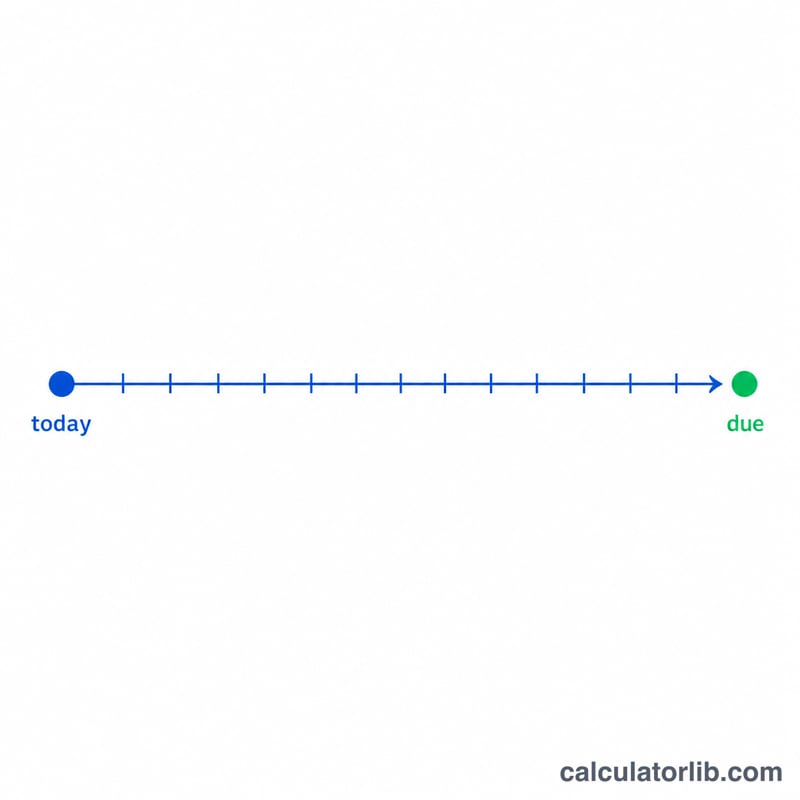
The core math is simple subtraction of calendar dates: $$\text{days} = \text{due date} - \text{today}$$. Both dates are set to midnight so partial days never skew the count. To convert to weeks, divide the day count by \(7\). The whole-week portion is the floor of that division, and the leftover days are the remainder after removing complete weeks.
Worked example
Suppose today is 1 June 2025 and your due date is 25 June 2025. The gap is 24 days. As weeks that is $$24 \div 7 \approx 3.43 \text{ weeks}.$$ Broken down, \(\lfloor 24 \div 7 \rfloor = 3\) whole weeks with a remainder of \(24 - 21 = 3\) days — so "3 weeks and 3 days."

FAQ
Does it count today? No — it measures the gap from the start of today to the start of the due date, so a date set to today returns 0 days.
What if the date is in the past? The days value becomes negative, telling you how many days have elapsed since the date. The weeks-and-days breakdown uses the absolute value.
Does it handle leap years and month lengths? Yes. It uses real calendar arithmetic, so February 29 and varying month lengths are handled automatically.