What is the EST to CST Converter?
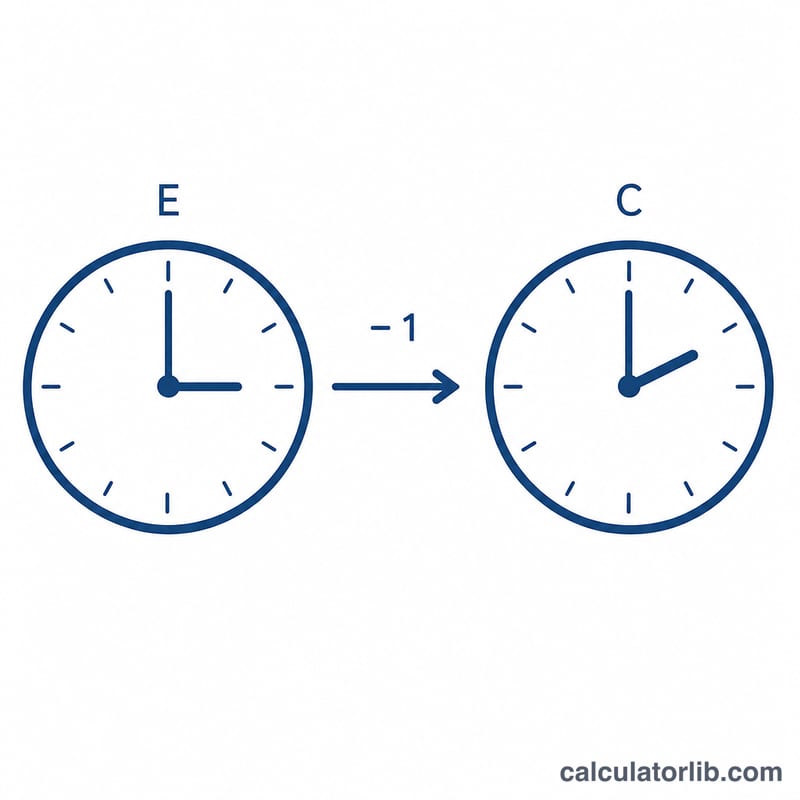
This tool converts a time in Eastern Time (EST) to the equivalent time in Central Time (CST). Both are time zones used in the United States and Canada. Central Time is always exactly one hour behind Eastern Time, so when it is 3:00 PM in New York (EST), it is 2:00 PM in Chicago (CST).
How to use it
Enter the EST hour using the 24-hour clock (0–23) and the minute (0–59). The converter subtracts one hour and displays the matching CST time, automatically wrapping around midnight so an early-morning EST time still produces a correct CST result.
The formula explained
The conversion is simply CST = EST − 1 hour. Internally the time is changed into total minutes since midnight, 60 minutes are subtracted, and the result is taken modulo 1440 (the number of minutes in a day) to keep it inside a single 24-hour cycle.
$$\text{CST} = \left(\left(\left(\text{EST Hour} \times 60 + \text{EST Minute}\right) - 60\right) \bmod 1440\right)$$
Worked example
Suppose it is 14:30 (2:30 PM) EST. In minutes that is \(14 \times 60 + 30 = 870\). Subtract 60 to get 810 minutes, which equals 13 hours and 30 minutes — so the CST time is 13:30 (1:30 PM).
Time Zone Terms: EST, EDT, CST, CDT and UTC Offsets
The terms below follow United States usage. Canada uses the same zone names and the same daylight saving dates. Other countries, including most of Mexico, follow different rules, so check local rules before applying these dates outside the US.
| Term | Meaning | UTC offset |
|---|---|---|
| EST | Eastern Standard Time, used in winter | UTC−5 |
| EDT | Eastern Daylight Time, used in summer | UTC−4 |
| CST | Central Standard Time, used in winter | UTC−6 |
| CDT | Central Daylight Time, used in summer | UTC−5 |
| UTC | Coordinated Universal Time, the reference that all offsets are measured from | ±0 |
Eastern Time (ET) and Central Time (CT) are the general names for each zone. They cover both the standard and daylight versions. People often write "EST" or "CST" all year, even in summer, when the correct labels are EDT and CDT. For converting between the two zones this rarely matters. Both zones switch on the same dates, so Central Time stays 1 hour behind Eastern Time all year: EST (UTC−5) to CST (UTC−6) in winter, and EDT (UTC−4) to CDT (UTC−5) in summer.
US daylight saving dates: Clocks move forward one hour on the second Sunday in March and back one hour on the first Sunday in November. Each zone changes at 2:00 AM local time. These rules have applied since 2007 under the Energy Policy Act of 2005. Because each zone switches at its own 2:00 AM, the Eastern zone changes one hour before the Central zone. For about one hour on each changeover night, the two zones show the same time or two hours apart. Outside that window the difference is always exactly 1 hour.
Example cities: Eastern Time includes New York, Atlanta, Miami, Boston and Detroit. Central Time includes Chicago, Dallas, Houston, Minneapolis and New Orleans.
Split states: Zone boundaries do not follow state lines exactly. Florida's western Panhandle, west of the Apalachicola River, is on Central Time. Most of Indiana is on Eastern Time, but its northwest and southwest corners are on Central Time. Kentucky and Tennessee are split: eastern Kentucky and East Tennessee use Eastern Time, and the western parts use Central Time. Four counties in Michigan's Upper Peninsula that border Wisconsin use Central Time. Texas is mostly Central, but El Paso is on Mountain Time. Always check the zone of the actual city, not just the state.
24-hour clock and the previous-day rollover: The converter turns the time into minutes after midnight (0 to 1439). It subtracts 60 minutes, then wraps the result into a single day with the modulo operation:
$$\text{CST minutes} = \left( (\text{hour} \times 60 + \text{minute}) - 60 \right) \bmod 1440$$On the 24-hour clock, 00:00 is midnight and 13:00 is 1:00 PM. An Eastern time between 00:00 and 00:59 converts to the previous day in Central Time. For example, 00:30 EST:
$$(0 \times 60 + 30 - 60) \bmod 1440 = -30 \bmod 1440 = 1410 \text{ minutes}$$1410 minutes is 23 hours 30 minutes (1410 = 23 × 60 + 30). So 00:30 EST on a Tuesday is 23:30 (11:30 PM) CST on Monday. For any Eastern time from 01:00 onward, the Central time falls on the same calendar day.
FAQ
Is CST always 1 hour behind EST? Yes. Both zones observe daylight saving on the same dates, so the one-hour gap is constant year-round (EDT vs CDT keeps the same difference).
What happens just after midnight? 00:30 EST converts to 23:30 CST the previous day — the calculator wraps the time correctly.
Does this account for daylight saving? The fixed 1-hour offset holds whether the regions are on standard or daylight time, so no extra adjustment is needed.