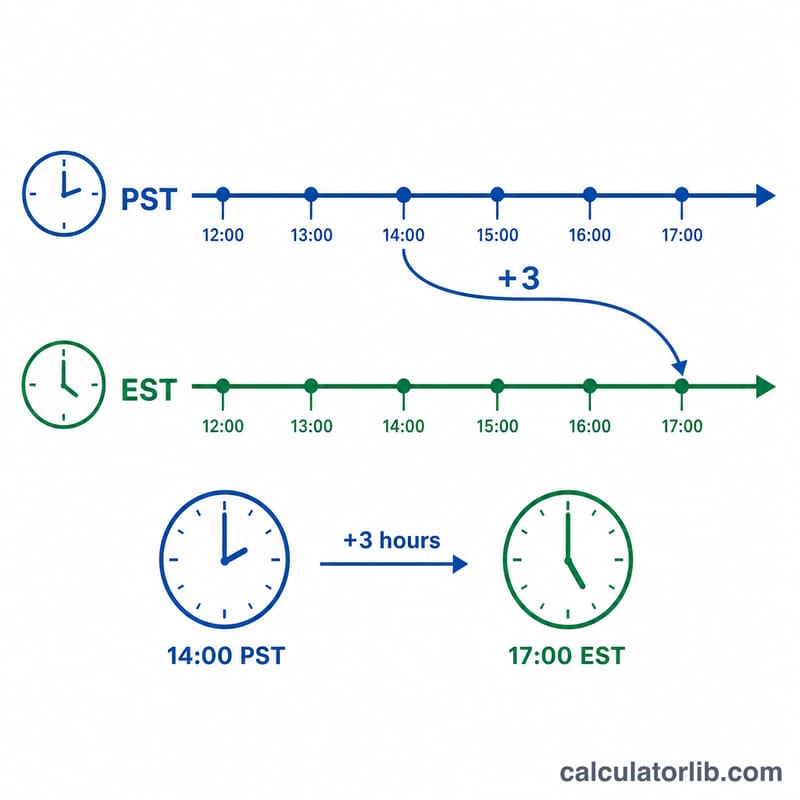
This tool converts a time in Pacific Standard Time (PST) to the equivalent time in Eastern Standard Time (EST). The continental United States spans four main time zones, and the Pacific and Eastern coasts are separated by a fixed 3-hour difference during standard time. When it is 9:00 AM in Los Angeles (PST), it is 12:00 PM in New York (EST).
How to Use It
Enter the hour (0–23, 24-hour clock) and minute of the PST time you want to convert. The calculator adds 3 hours and returns the EST time in 24-hour format. If the conversion crosses midnight, a "next day" note is shown so you know the date has rolled over.
The Formula Explained
The conversion is simply EST = PST + 3 hours. Internally the time is converted to total minutes after midnight, 180 minutes (3 hours) are added, and the result is wrapped within a 24-hour clock. Any whole-day overflow is reported as a day offset.
Worked example: For 11:30 PM PST (23:30), total minutes = \(23\times60 + 30 = 1410\). Add 180 → 1590 minutes. \(1590 - 1440 = 150\) minutes = 02:30, with a +1 day offset. So 11:30 PM PST = 2:30 AM EST the next day.
Werbung
EST is 3 hours ahead of PST, so add 3 hours to convert.
FAQ
Is the difference always 3 hours? Yes — Pacific and Eastern time always differ by 3 hours, whether in standard time (PST/EST) or daylight time (PDT/EDT), as long as both zones observe the same daylight rules.
What about Daylight Saving Time? This tool uses the fixed standard-time offset. During DST the abbreviations become PDT and EDT, but the 3-hour gap remains the same.
Why use 24-hour format? It removes AM/PM ambiguity, especially when the conversion crosses midnight into the next day.
Rechnen Sie UTC in WIB einfach um. Der UTC-WIB-Zeitumrechner liefert genaue Werte für die Westindonesische Zeit, z. B. 12pm UTC in WIB, 9am UTC in WIB, 6pm UTC in WIB und mehr.
12:00 UTC entspricht 4:00 AM PST (UTC−8) im Winter und 5:00 AM PDT (UTC−7) von März bis November. Wählen Sie Datum und UTC-Zeit; der Rechner nutzt den passenden Offset.
Rechnen Sie Blutzucker (Glukose) sofort zwischen mg/dL und mmol/L um. Kostenloser Blutzucker-Einheitenrechner in beide Richtungen mit dem Faktor 18,0182.
Berechnen Sie Ihr Arbeitsgewicht für Bankdrücken, Kniebeuge oder jede andere Übung als Prozentsatz Ihres Einwiederholungsmaximums (1RM). Schneller Rechner für das Trainingsgewicht in % vom 1RM.
Berechnen Sie den APY (Annual Percentage Yield) aus Nominalzins und Zinsperiode. Ermitteln Sie die effektive Jahresrendite mit der Formel APY = (1 + r/n)^n − 1.