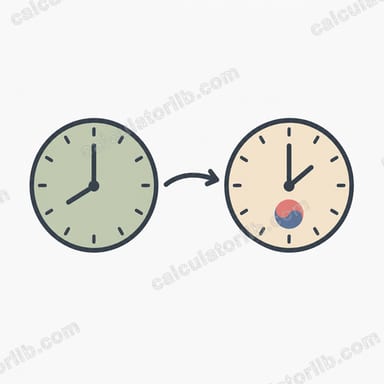
What is the UTC to KST Converter?
This tool converts a time given in Coordinated Universal Time (UTC) to Korea Standard Time (KST), the time zone used throughout South Korea. KST is fixed at UTC+9 all year round — South Korea does not observe daylight saving time, so the offset never changes.
How to use it
Enter the UTC hour (0–23) and minute (0–59), then submit. The calculator adds 9 hours and reports the resulting KST time in 24-hour format. If adding 9 hours pushes the clock past midnight, it also tells you the date rolls over to the next day.
The formula explained
The conversion is simply KST = UTC + 9 hours. Internally we convert the input to minutes-of-day, add 540 minutes (9 hours), then take the result modulo 1440 (minutes per day) to wrap around midnight. The number of full days added becomes the day offset.
$$\text{KST} = \left(\text{UTC Hour} \times 60 + \text{UTC Minute} + 9 \times 60\right) \bmod 1440$$
$$\begin{gathered} T = \left(\text{UTC Hour} \times 60 + \text{UTC Minute} + 9 \times 60\right) \bmod 1440 \\[1.5em] \text{where}\quad \left\{ \begin{aligned} \text{KST Hour} &= \left\lfloor \tfrac{T}{60} \right\rfloor \\ \text{KST Minute} &= T \bmod 60 \end{aligned} \right. \end{gathered}$$

Worked example
Suppose it is 20:30 UTC. Adding 9 hours gives 29:30, which is 1 day and 5 hours 30 minutes. So the KST time is 05:30 the next day.
$$\left(20 \times 60 + 30 + 9 \times 60\right) \bmod 1440 = 1770 \bmod 1440 = 330$$
$$\text{KST Hour} = \left\lfloor \tfrac{330}{60} \right\rfloor = 5, \quad \text{KST Minute} = 330 \bmod 60 = 30$$
FAQ
Does Korea use daylight saving time? No. South Korea has not used DST since 1988, so KST stays at UTC+9 year-round.
Is KST the same as JST? Yes, Korea Standard Time and Japan Standard Time are both UTC+9, so they share the same clock time.
What does "next day" mean in the result? Because KST is ahead of UTC, late-UTC times can land on the following calendar day in Korea — the result flags this for you.