
What is the 6 Month Calculator?
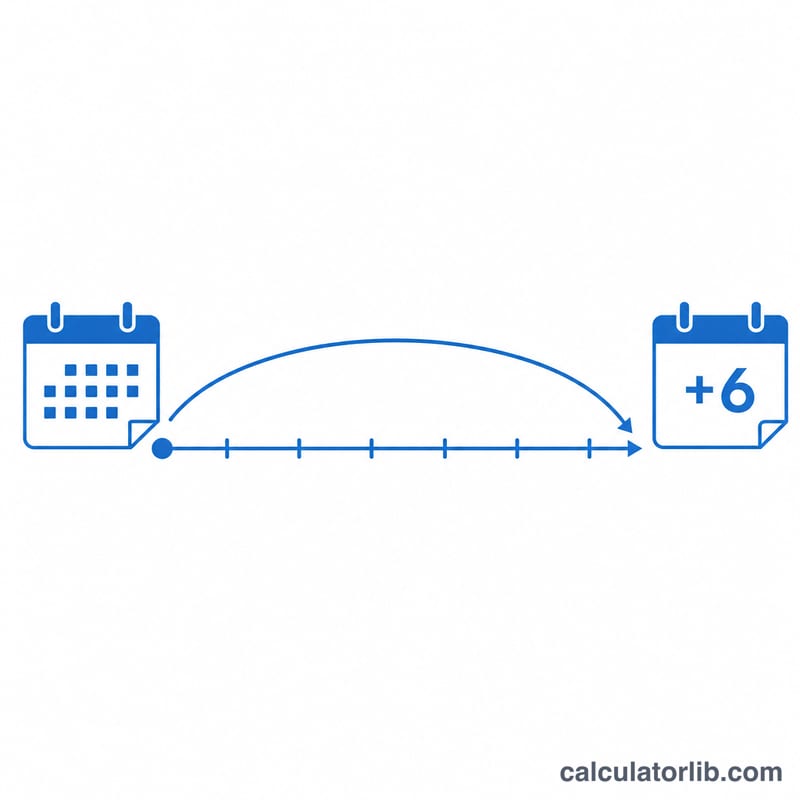
The 6 Month Calculator tells you the exact calendar date that falls six months after any start date. It is useful for planning lease renewals, loan reviews, subscription billing, warranty windows, medical follow-ups, and project milestones — anywhere a "six months later" deadline matters.
How to use it
Enter your start year, choose the start month from the dropdown, and type the start day. The calculator adds six calendar months and returns the resulting date along with its day of the week. If the original day does not exist in the target month (for example, August 31 + 6 months would land on a non-existent February 31), the result is clamped to the last valid day of that month.
The formula explained
The core relationship is:
$$\text{Result Date} = \text{Start Date} + 6 \text{ months}$$Months are handled as a zero-based index. We compute index \( = (\text{startMonth} - 1) + 6 \). The new month is \( (\text{index} \bmod 12) + 1 \) and the year increases by \( \lfloor \text{index} \div 12 \rfloor \). The day is then capped to the maximum number of days in the resulting month so the date is always valid.
$$\text{month} = ((m-1)+6)\bmod 12 + 1,\quad \text{year} = y + \left\lfloor \frac{(m-1)+6}{12} \right\rfloor$$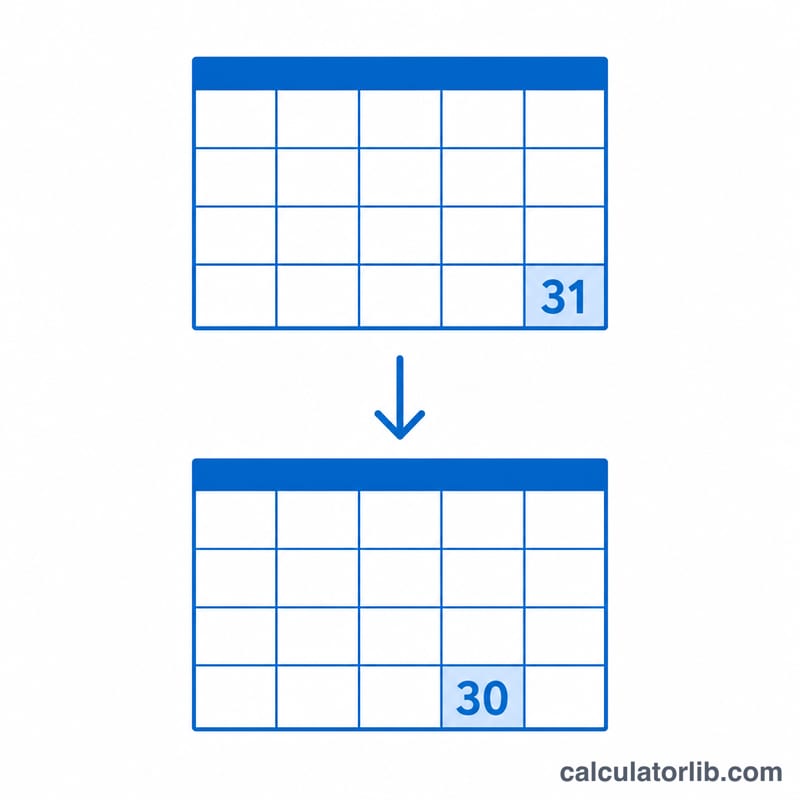
Worked example
Start date: January 15, 2024. Index \( = (1 - 1) + 6 = 6 \). New month \( = (6 \bmod 12) + 1 = 7 \) (July). Year \( = 2024 + \lfloor 6 \div 12 \rfloor = 2024 \). July has 31 days, so day 15 stays. Result: July 15, 2024.
6-Month Results Across Different Start Dates
Adding six calendar months keeps the same day-of-month whenever possible, but it caps the day to the last valid day when the target month is shorter (end-of-month clamping). When the six months push past December, the year rolls forward. The table below shows several representative start dates, the date six months later, and the resulting weekday.
| Start Date | +6 Months | Day of Week | Note |
|---|---|---|---|
| Jan 15, 2025 | Jul 15, 2025 | Tuesday | Same day, same year |
| Aug 31, 2025 | Feb 28, 2026 | Saturday | Clamped (no Feb 31) + year rollover |
| Oct 1, 2025 | Apr 1, 2026 | Wednesday | Year rollover |
| Dec 31, 2025 | Jun 30, 2026 | Tuesday | Clamped (no Jun 31) + year rollover |
| Feb 29, 2024 | Aug 29, 2024 | Thursday | Leap day, August has the 29th |
You can confirm any weekday above with a day-of-the-week tool, and a result such as Jul 15, 2025 lands on a Tuesday.
More Worked Examples
Each example uses the zero-based month index \(m = (\text{Start Month} - 1) + 6\), then derives the result year from \(\lfloor m/12 \rfloor\), the result month from \(m \bmod 12\), and finally caps the day at the number of days in that target month.
Example 1 — End-of-month clamp: Aug 31, 2025
- Index the month: \(m = (8 - 1) + 6 = 13\).
- Year carry (floor division): \(\lfloor 13 / 12 \rfloor = 1\), so Year \(= 2025 + 1 = 2026\).
- Result month (modulo): \((13 \bmod 12) + 1 = 1 + 1 = 2\) → February.
- Day cap: February 2026 has 28 days, so Day \(= \min(31, 28) = 28\).
- Result: February 28, 2026 — a Saturday.
Example 2 — Year-crossing, no clamp: Oct 10, 2025
- Index the month: \(m = (10 - 1) + 6 = 15\).
- Year carry (floor division): \(\lfloor 15 / 12 \rfloor = 1\), so Year \(= 2025 + 1 = 2026\).
- Result month (modulo): \((15 \bmod 12) + 1 = 3 + 1 = 4\) → April.
- Day cap: April 2026 has 30 days, so Day \(= \min(10, 30) = 10\) — no clamping needed.
- Result: April 10, 2026, which falls on a Friday.
FAQ
What if my day doesn't exist in the target month? The result snaps to the last day of that month — e.g. August 31 + 6 months becomes February 28 (or 29 in a leap year).
Does it count exactly 183 days? No. It uses calendar-month addition, which is how most contracts and billing cycles define "six months," not a fixed day count.
Can it cross into the next year? Yes. Any start month from August to December rolls the result into the following year automatically.