
What Is the Ad Budget Calculator?
The Ad Budget Calculator helps marketers and advertisers work out how much money they need to spend to achieve a specific number of conversions. A "conversion" can be a sale, a sign-up, a lead, an app install, or any goal you track. By combining your target number of conversions with your cost per acquisition (CPA), you instantly see the total budget required to hit that goal.
How to Use It
Enter two values: the number of conversions you want to achieve (your target) and your cost per acquisition — the average amount you pay each time someone converts. The calculator multiplies these together to return the total ad budget. If you do not yet know your CPA, you can estimate it from past campaign data by dividing total spend by the number of conversions that spend produced.
The Formula Explained
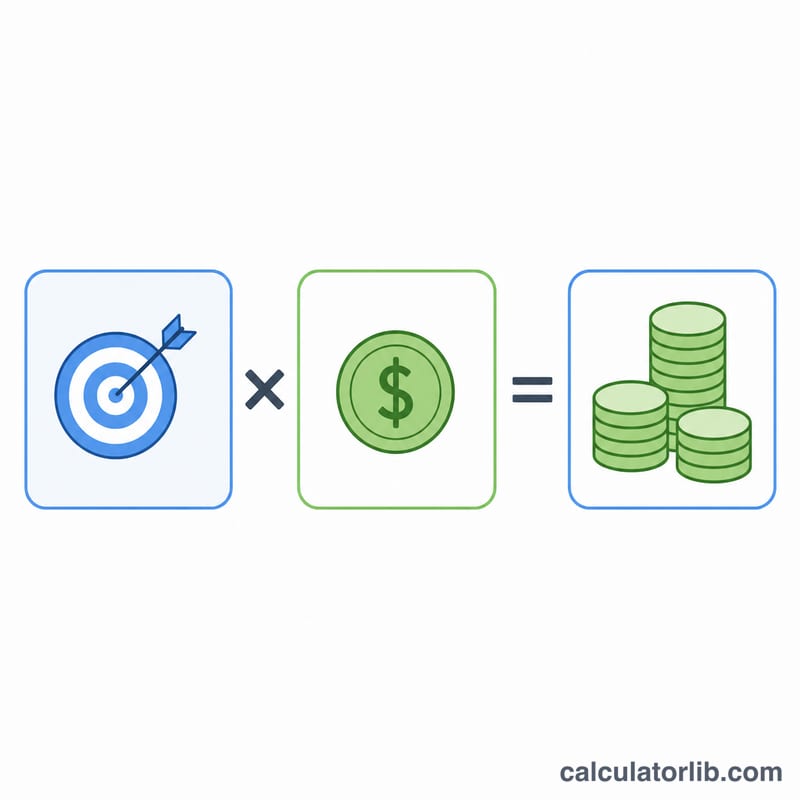
The calculation is straightforward:
$$\text{Budget} = \text{Target Conversions} \times \text{CPA}$$
For example, if you want 500 new customers and it costs $40 to acquire each one, your budget is \(500 \times \$40 = \$20{,}000\). Lowering your CPA through better targeting, creative, or landing pages reduces the budget needed for the same number of conversions.
Worked Example
Suppose you run a lead-generation campaign with a target of 250 leads and a CPA of $18. The required budget is $$250 \times \$18 = \$4{,}500.$$ If you only have $3,000 to spend, you would either need to reduce your target (\(3{,}000 \div 18 \approx 166\) leads) or improve efficiency to bring your CPA down to $12.
Typical CPA Benchmarks by Industry & Channel
Cost per acquisition (CPA) varies widely by industry vertical, advertising channel, and how a "conversion" is defined (a lead form, a sign-up, or a completed purchase). The figures below are widely-cited industry averages used for planning; your own account data should always take precedence once you have it.
Typical CPA by Industry Vertical
| Industry | Typical CPA Range | Common conversion type |
|---|---|---|
| E-commerce / Retail | $20 – $60 | Purchase |
| SaaS / B2B Software | $80 – $400 | Trial or demo signup |
| Finance & Insurance | $80 – $300 | Qualified lead |
| Legal Services | $90 – $600 | Case inquiry |
| Travel & Hospitality | $15 – $90 | Booking |
| Education | $50 – $250 | Enrollment lead |
Typical CPA by Channel
| Channel | Typical CPA Range | Notes |
|---|---|---|
| Google Search | $40 – $120 | High intent; cost rises with keyword competition |
| Google / Programmatic Display | $60 – $130 | Cheaper clicks but lower intent |
| Facebook / Meta | $10 – $50 | Strong for e-commerce and broad B2C |
| $70 – $250 | Premium B2B targeting; higher click costs |
These ranges are illustrative benchmarks, not guarantees. Bidding strategy, landing-page quality, audience, and seasonality can move CPA well outside a given band.
Budget Across Different Targets and CPAs
Required ad budget is simply target conversions multiplied by CPA: \( \text{Budget} = \text{Target Conversions} \times \text{CPA} \). The table shows total spend needed for common combinations.
| Target Conversions | CPA $10 | CPA $25 | CPA $50 |
|---|---|---|---|
| 100 | $1,000 | $2,500 | $5,000 |
| 250 | $2,500 | $6,250 | $12,500 |
| 500 | $5,000 | $12,500 | $25,000 |
| 1000 | $10,000 | $25,000 | $50,000 |
For example, to land 250 conversions at a $25 CPA you would need \( 250 \times \$25 = \$6{,}250 \) in ad spend. Doubling either the conversion target or the CPA doubles the budget, since the relationship is linear.
Key Terms Explained
- Conversion
- A completed action that counts as a goal for your campaign — a purchase, sign-up, lead form, app install, or call. What qualifies as a conversion depends on the objective you set.
- Cost Per Acquisition (CPA)
- The average amount of ad spend required to generate one conversion: \( \text{CPA} = \text{Ad Spend} \div \text{Conversions} \). Lower CPA means more efficient spending.
- Cost Per Click (CPC)
- The average price paid each time someone clicks your ad: \( \text{CPC} = \text{Ad Spend} \div \text{Clicks} \). CPC combined with conversion rate determines CPA.
- Conversion Rate (CVR)
- The share of clicks or visits that turn into conversions: \( \text{CVR} = \text{Conversions} \div \text{Clicks} \times 100\% \). Higher conversion rates pull CPA down for the same CPC.
- Target Conversions
- The number of conversions you want a campaign to deliver in a given period. It is the goal input that, multiplied by CPA, sets your required budget.
- Ad Budget / Media Spend
- The total amount allocated to running ads over a period. To hit a goal it must equal at least target conversions times expected CPA.
FAQ
What is CPA? Cost Per Acquisition is the average cost to gain one conversion, calculated as total ad spend divided by total conversions.
Does this include all marketing costs? No — it covers media spend only. Add agency fees, creative production, and tools separately for a full budget.
Can I use any currency? Yes. The result is in the same currency as the CPA you enter.