

What Is After-Tax Income?
After-tax income — also called take-home pay or net income — is the amount of money you keep after taxes are deducted from your gross earnings. This calculator gives a quick estimate based on a single effective tax rate, which is the overall percentage of your income paid in tax. It is jurisdiction-neutral: enter whatever effective rate applies to your situation (combining income tax, social contributions, etc.).
How to Use It
Enter your gross income (total earnings before tax) and your effective tax rate as a percentage. The calculator returns your annual after-tax income, the total tax paid, and your monthly take-home pay.
The Formula
The core calculation is straightforward:
$$\text{After-Tax} = \text{Gross} \times \left(1 - \dfrac{\text{Rate}}{100}\right)$$The effective tax rate differs from your marginal (top bracket) rate. To find it, divide your total tax bill by your gross income and multiply by 100.
Worked Example
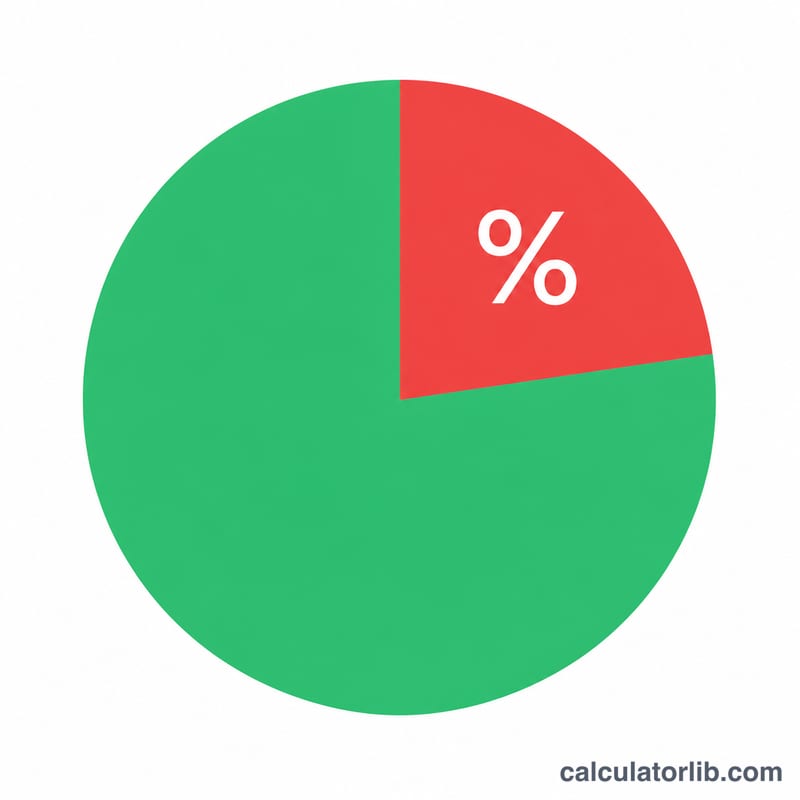
Suppose you earn $60,000 and your effective tax rate is 22%. Then:
$$\text{afterTax} = 60{,}000 \times \left(1 - \frac{22}{100}\right) = 60{,}000 \times 0.78 = 46{,}800$$\(\$46{,}800\) per year. Total tax paid is $13,200, and monthly take-home is $3,900.
Take-Home Pay Across Income & Tax Rate Scenarios
The table below applies the after-tax formula \(\text{After-Tax Income} = \text{Gross Income} \times \left(1 - \frac{\text{Tax Rate}}{100}\right)\) across common gross incomes and effective tax rates. The monthly take-home column simply divides the annual after-tax figure by 12.
| Gross Income | Effective Rate | Total Tax | After-Tax (Annual) | Monthly Take-Home |
|---|---|---|---|---|
| $30,000 | 15% | $4,500 | $25,500 | $2,125 |
| $30,000 | 22% | $6,600 | $23,400 | $1,950 |
| $30,000 | 30% | $9,000 | $21,000 | $1,750 |
| $60,000 | 15% | $9,000 | $51,000 | $4,250 |
| $60,000 | 22% | $13,200 | $46,800 | $3,900 |
| $60,000 | 30% | $18,000 | $42,000 | $3,500 |
| $90,000 | 15% | $13,500 | $76,500 | $6,375 |
| $90,000 | 22% | $19,800 | $70,200 | $5,850 |
| $90,000 | 30% | $27,000 | $63,000 | $5,250 |
| $120,000 | 15% | $18,000 | $102,000 | $8,500 |
| $120,000 | 22% | $26,400 | $93,600 | $7,800 |
| $120,000 | 30% | $36,000 | $84,000 | $7,000 |
Notice that holding the gross income fixed, every additional percentage point of effective tax reduces annual take-home by 1% of gross — for example, on $120,000 each point is $1,200 per year, or $100 per month. If you already know your total tax paid and want to confirm the underlying effective rate, you can work backward with an effective tax rate calculation.
Interpreting Your After-Tax Income
Your after-tax (take-home) income is the portion of gross earnings that remains once taxes are removed. It is the figure most relevant for budgeting, since it reflects money you can actually spend, save, or use to cover debts — gross income, by contrast, is the headline number before any deductions.
The effective tax rate used in this calculator is a blended, average rate: it represents total tax paid divided by gross (or taxable) income. Because it averages everything together, it is almost always lower than your marginal tax rate — the rate applied to your last dollar of income. In a progressive tax system, your first dollars are taxed in lower brackets and only income above each threshold is taxed at higher rates, so the average across all your income sits below the top bracket you reach. For example, reaching a 24% marginal bracket does not mean 24% of your whole income is taxed; the effective rate might be closer to 15–18%. To see this distinction for your own income you can compare a marginal rate against an effective one using a marginal-versus-effective tax tool.
An effective rate can also blend more than one type of tax. Depending on how you define it, the rate may combine federal income tax, state or provincial income tax, and payroll taxes (such as Social Security and Medicare in the US) into a single percentage. Using a broader, all-in effective rate produces a take-home figure closer to your real paycheck than income tax alone.
Real paychecks usually differ from this simplified calculation for two main reasons. First, pre-tax deductions — such as traditional 401(k) or retirement contributions, health insurance premiums, and flexible spending accounts — reduce taxable income before tax is applied, which can lower the tax you owe while also reducing cash in hand. Second, post-tax deductions — such as Roth contributions, garnishments, or certain insurance — come out after tax and reduce take-home pay without changing the tax calculation. The figure this tool produces is therefore a clean estimate based on a single effective rate; an actual pay stub itemizes each of these separately.
This is general information for educational purposes and is not tax or financial advice. For decisions about your specific situation, consult a qualified tax professional.
FAQ
Is this the same as my paycheck? Not exactly — real paychecks may include retirement contributions, health premiums, and other deductions beyond income tax.
What rate should I enter? Use your effective (average) tax rate, not your marginal bracket, for the most accurate take-home estimate.
Does it handle multiple tax brackets? No — it uses one blended effective rate. Combine all applicable taxes into that single percentage.