

What This Calculator Does
This tool converts a yearly (annual) salary into an equivalent hourly wage. It is handy when comparing a salaried job offer to an hourly position, estimating freelance rates, or simply understanding what your time is worth. By also showing daily, weekly and monthly equivalents, it gives a complete picture of your earnings at different time scales.
How to Use It
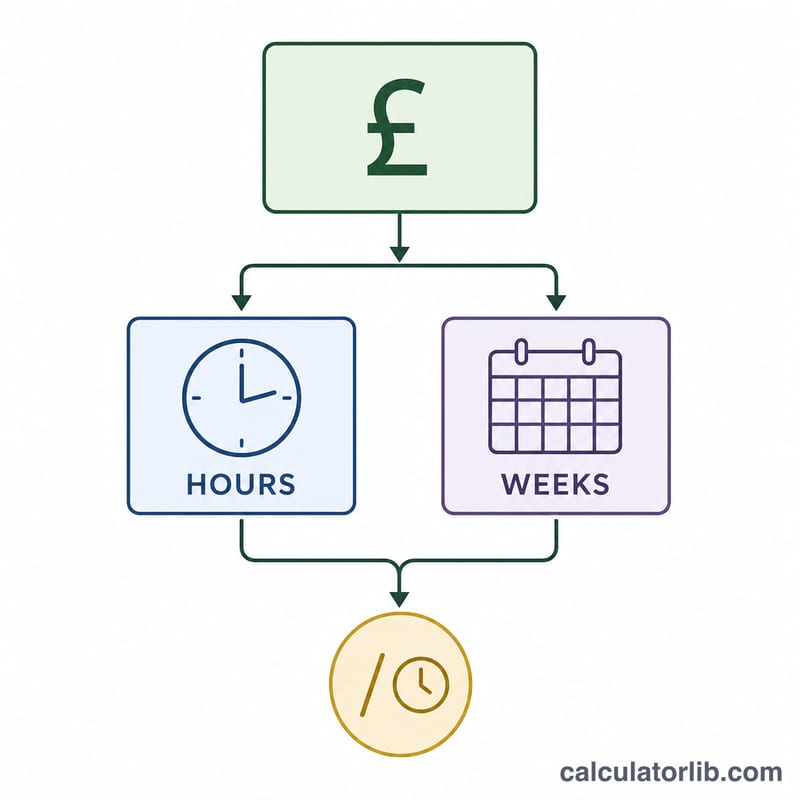
Enter your gross annual salary, the number of hours you typically work each week, and the number of weeks you work per year. Most full-time workers use 40 hours per week and 52 weeks per year, but you can adjust these if you take unpaid leave or work part-time. The calculator instantly divides your salary by total annual hours to find your hourly rate.
The Formula Explained
The core formula is simple:
$$\text{Hourly} = \frac{\text{Annual}}{\text{Hours per Week} \times \text{Weeks per Year}}$$
First, multiply hours per week by weeks per year to get total hours worked in a year. Then divide your annual salary by that figure. Weekly pay is your hourly rate times hours per week, daily pay assumes a 5-day work week, and monthly pay is simply your annual salary divided by 12.
Worked Example
Suppose you earn $52,000 per year and work 40 hours per week for 52 weeks. Total hours = \(40 \times 52 = 2{,}080\). Hourly rate = $$\$52{,}000 \div 2{,}080 = \$25.00 \text{ per hour}$$ Your weekly pay is \(\$25 \times 40 = \$1{,}000\), and your monthly pay is \(\$52{,}000 \div 12 \approx \$4{,}333.33\).

Common Annual Salaries Converted to Hourly
The table below converts common annual salaries into hourly, weekly and monthly pay using the standard full-time baseline of 40 hours per week and 52 weeks per year (2,080 working hours annually). The hourly rate is found by dividing the annual salary by total hours worked:
$$\text{Hourly Rate} = \frac{\text{Annual Salary}}{\text{Hours/Week} \times \text{Weeks/Year}} = \frac{\text{Annual Salary}}{2{,}080}$$| Annual Salary | Hourly Rate | Weekly Pay | Monthly Pay |
|---|---|---|---|
| $30,000 | $14.42 | $576.92 | $2,500.00 |
| $40,000 | $19.23 | $769.23 | $3,333.33 |
| $50,000 | $24.04 | $961.54 | $4,166.67 |
| $60,000 | $28.85 | $1,153.85 | $5,000.00 |
| $75,000 | $36.06 | $1,442.31 | $6,250.00 |
| $100,000 | $48.08 | $1,923.08 | $8,333.33 |
Monthly pay is calculated as the annual salary divided by 12, while weekly pay is the annual salary divided by 52. These are gross figures before any taxes or deductions.
How Hours and Weeks Affect Your Hourly Rate
The same annual salary produces very different hourly rates depending on how many hours you work each week and how many weeks you work each year. Below, a fixed salary of $52,000 is converted under four common scenarios. Notice that working fewer hours raises your effective hourly rate, while working more hours lowers it.
| Scenario | Hours/Week | Weeks/Year | Total Hours | Hourly Rate |
|---|---|---|---|---|
| Standard full-time | 40 | 52 | 2,080 | $25.00 |
| Unpaid 4 weeks leave | 40 | 48 | 1,920 | $27.08 |
| Part-time / shorter week | 35 | 52 | 1,820 | $28.57 |
| Long hours | 50 | 52 | 2,600 | $20.00 |
This is why two jobs advertising the same salary are not necessarily equal: a role expecting 50-hour weeks pays a meaningfully lower true hourly rate than one with a standard 40-hour week. If you want to check the math in the other direction, you can convert an hourly rate back to an annual salary using the same hours and weeks figures.
Understanding Your Hourly Equivalent
The hourly rate this calculator produces is a gross, pre-tax average. It tells you what each hour of standard work is worth on paper, but it deliberately excludes several things that affect both your paycheck and the real value of a job:
- Taxes and deductions. Your take-home pay is lower than the gross hourly figure after federal, state and payroll (FICA) taxes. For example, a $52,000 salary at an estimated 22% effective tax rate leaves roughly $40,560 per year in take-home pay.
- Overtime. Hourly and non-exempt workers may earn 1.5× or 2× their base rate for extra hours, which this average does not capture.
- Bonuses and commissions. Variable pay can raise your true earnings well above the base hourly figure.
- Benefits. Employer-paid health insurance, paid time off (PTO), retirement matching and other perks add real economic value that never shows up in the hourly number.
When comparing two job offers, look beyond the headline salary and hourly equivalent. A position paying a slightly lower hourly rate but offering strong health coverage, generous PTO and a retirement match can be worth more in total compensation than a higher base rate with no benefits. Use the hourly figure as a starting point for comparison, then adjust for taxes, expected hours and the full benefits package.
This is general information, not professional financial advice. Consult a qualified advisor for guidance specific to your situation.
FAQ
Should I use gross or net salary? Use your gross (pre-tax) annual salary for a fair comparison with advertised hourly rates, which are also usually quoted before tax.
How many weeks should I use? Use 52 if you are paid for vacation and holidays. If you take unpaid time off, reduce the weeks accordingly to see your effective hourly rate.
Does this include overtime? No. This is a straight average based on your standard schedule and does not account for overtime premiums or bonuses.