
What is the Appliance Running Cost Calculator?
This calculator estimates how much it costs to run an electrical appliance over a full year. By entering the device's power rating in watts, how many hours a day you use it, and the price you pay for electricity per kilowatt-hour (kWh), you instantly see the annual, monthly, and daily cost — along with the total energy consumed. It works with any currency and any electricity tariff, so it is useful worldwide.
How to use it
Find the wattage on the appliance label or its manual (e.g. a 1200 W kettle, a 150 W fridge). Enter the average number of hours you use it each day. Then enter your electricity price per kWh, which appears on your energy bill. The calculator multiplies these together to project a full year of usage.
The formula explained
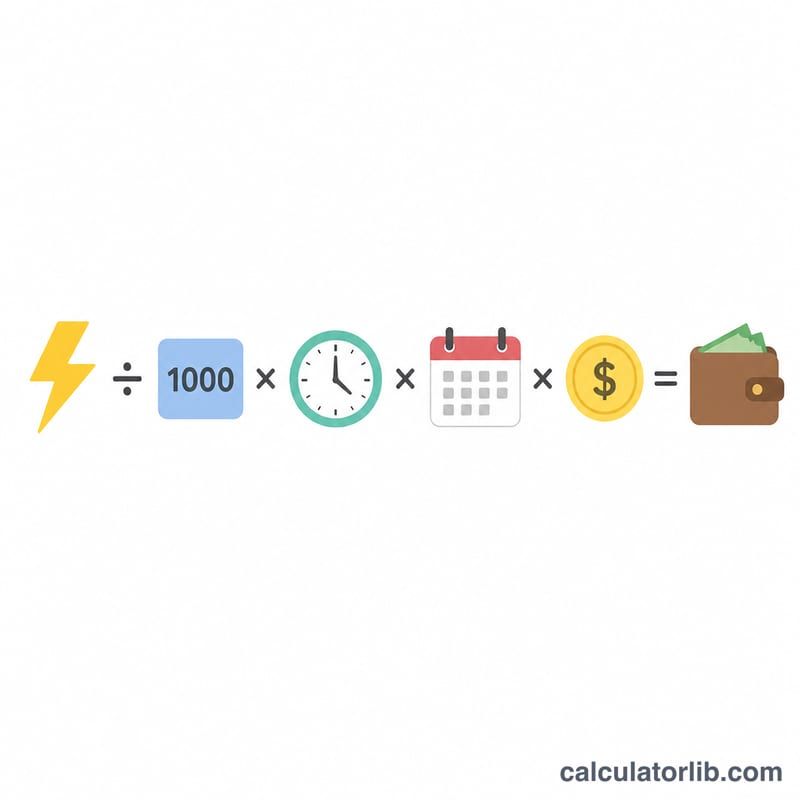
The core equation is $$\text{Annual Cost} = \frac{\text{Watts}}{1000} \times \text{Hours per day} \times 365 \times \text{Price per kWh}$$. Dividing watts by 1000 converts power into kilowatts. Multiplying by hours and by 365 days gives kilowatt-hours used per year. Multiplying that by your price per kWh gives the yearly cost.
Worked example
Suppose a 100 W lamp runs 5 hours a day and electricity costs 0.15 per kWh. Energy per year $$= \frac{100}{1000} \times 5 \times 365 = 182.5 \text{ kWh}.$$ Annual cost $$= 182.5 \times 0.15 = 27.375,$$ or about 27.38 per year — roughly 2.28 per month.
Typical Wattage of Common Appliances
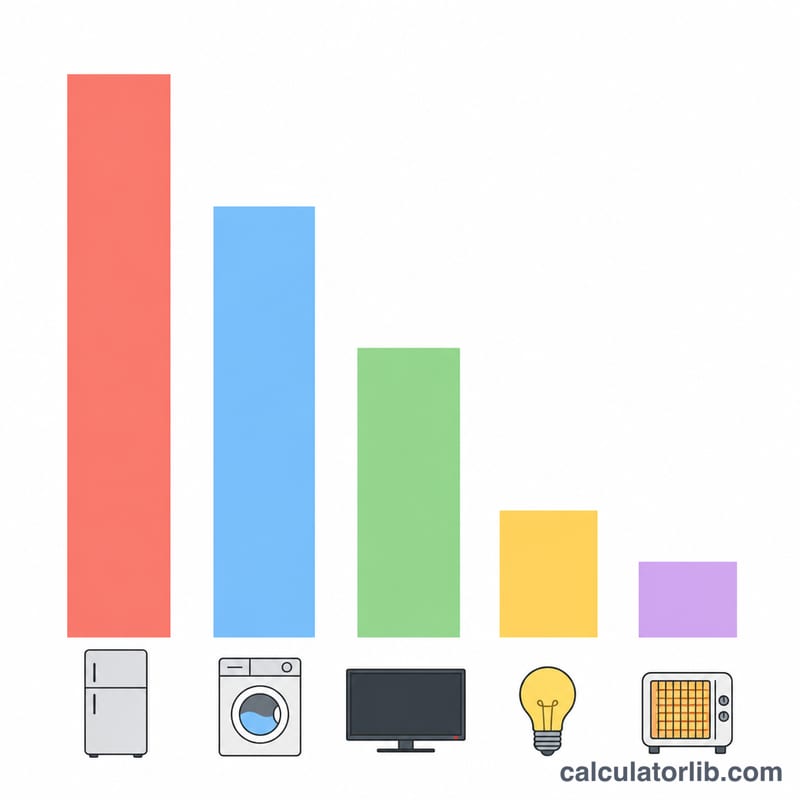
The power draw of an appliance is the single biggest factor in its running cost. The values below are typical operating ranges — your specific model may differ, so check the rating plate or nameplate (usually marked in watts, W) for an exact figure. For appliances that cycle on and off (fridges, freezers, air conditioners) or modulate power (washing machines), the average power over time is much lower than the peak figure, so estimate the effective hours/day accordingly.
| Appliance | Typical wattage (W) | Notes |
|---|---|---|
| LED light bulb | 5–15 W | Replaces a 40–100 W incandescent |
| Laptop computer | 30–70 W | Including charging |
| Desktop PC (with monitor) | 100–600 W | Higher for gaming/workstation |
| LED/LCD television | 50–200 W | Depends on screen size |
| Refrigerator / fridge-freezer | 100–400 W | Cycles on and off; ~1–2 kWh/day average |
| Chest / upright freezer | 100–400 W | Runs intermittently |
| Microwave oven | 600–1200 W | Short bursts of use |
| Electric kettle | 1500–3000 W | Very high power, very short run time |
| Toaster | 800–1500 W | Used for minutes at a time |
| Dishwasher | 1200–2400 W | Mostly water heating |
| Washing machine | 500–2200 W | Peak during heating; lower while spinning |
| Tumble dryer | 1800–5000 W | Heat-pump models use far less |
| Electric oven | 2000–3000 W | Element cycles to hold temperature |
| Electric hob ring | 1000–2000 W per ring | Per cooking zone |
| Space heater (portable) | 750–2000 W | Often run for many hours |
| Air conditioner (window unit) | 500–1500 W | Central systems much higher |
| Air conditioner (central) | 1500–5000 W | Depends on capacity (BTU) |
| Hair dryer | 1200–1875 W | Brief use |
| Vacuum cleaner | 500–1500 W | Short, intermittent use |
| Wi-Fi router | 5–20 W | Runs continuously |
| Phone charger | 5–25 W | Negligible when idle |
As a worked example, a 1500 W space heater run 5 hours a day at $0.17/kWh costs $465.38 per year. Compare that with a single 10 W LED bulb left on the same 5 hours: just $3.10 a year.
Typical Electricity Prices per kWh
Your price per kWh (also called the unit rate) is set by your supplier and varies by country, region, supplier, tariff type and — increasingly — time of day. The figures below are representative residential averages to help you sanity-check the rate you enter; for an exact figure, read the rate from your latest electricity bill. Many tariffs also add a fixed daily standing charge that this calculator does not include.
| Region | Typical residential rate | Notes |
|---|---|---|
| United States (average) | $0.14–0.18 / kWh | Wide state range; Hawaii & California much higher |
| United Kingdom | £0.22–0.28 / kWh | Capped element plus a separate daily standing charge |
| European Union (average) | €0.20–0.30 / kWh | Varies greatly by member state |
| Canada | C$0.10–0.18 / kWh | Hydro-rich provinces are cheaper |
| Australia | A$0.25–0.35 / kWh | Higher on flat tariffs |
To work out your own rate precisely, divide a bill total by the kilowatt-hours it covers (for example, a $120 bill for 800 kWh works out to $0.15/kWh). Time-of-use and economy tariffs charge different rates for peak and off-peak periods, so for an accurate annual estimate use the rate that applies during the hours the appliance actually runs.
These figures are general averages for guidance only and are not a quotation or financial advice — always confirm your actual unit rate with your energy supplier.
FAQ
Where do I find the wattage? Check the rating plate on the appliance, the user manual, or the manufacturer's website. Some devices list amps and volts instead — multiply them (\(W = V \times A\)).
Does this account for standby power? No. It assumes the device draws its rated wattage only while in use. For always-on devices, set hours per day to 24.
What price should I enter? Use the per-kWh unit rate from your latest electricity bill for the most accurate estimate.