

What Is Points Per Game (PPG)?
Points per game (PPG) is the most common scoring statistic in basketball. It expresses a player's average number of points scored across all games played, making it easy to compare scorers regardless of how many games each has appeared in. PPG appears on every box score, season summary, and player profile, and it is a quick benchmark for offensive output.
How to Use This Calculator
Enter the total points a player has scored over a span of games, then enter the number of games played. The calculator divides total points by games played and shows the scoring average. Use it for a single season, a career, a playoff run, or just a few recent games.
The Formula Explained
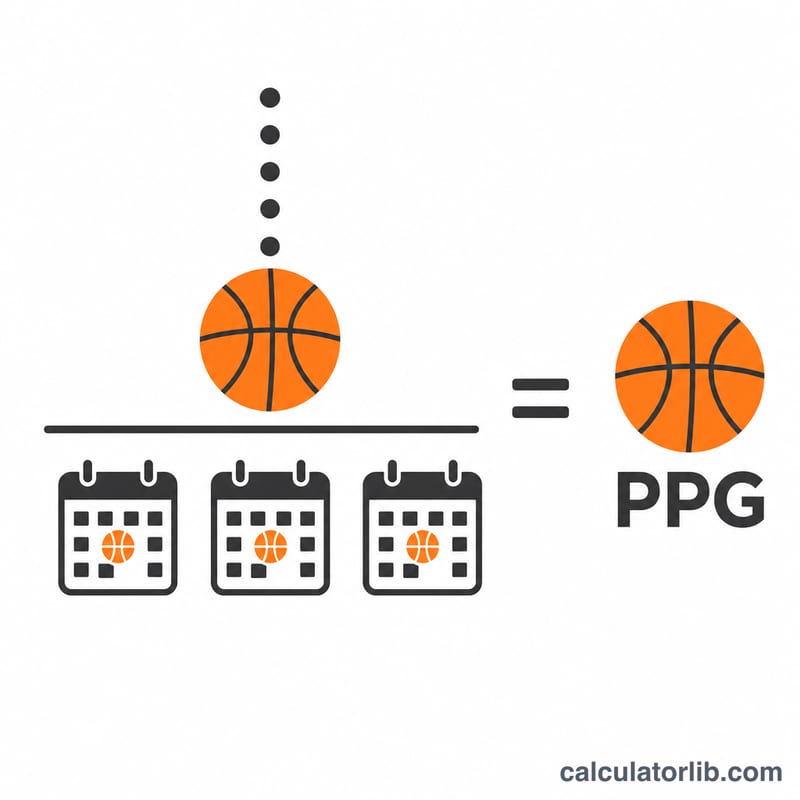
The math is a simple average:
$$\text{PPG} = \frac{\text{Total Points}}{\text{Games Played}}$$Total points is the cumulative sum of every point scored (field goals, three-pointers, and free throws). Games played counts each game the player actually appeared in — games missed should be excluded so the average reflects real production.
Worked Example
Suppose a player scores 1,850 points across 82 games in a season. Dividing 1,850 by 82 gives about 22.56 points per game.
$$\frac{1{,}850}{82} \approx 22.56$$If another player scored 600 points in 25 games, their PPG is
$$\frac{600}{25} = 24.0$$a higher average despite fewer total points.
PPG Tiers in Basketball
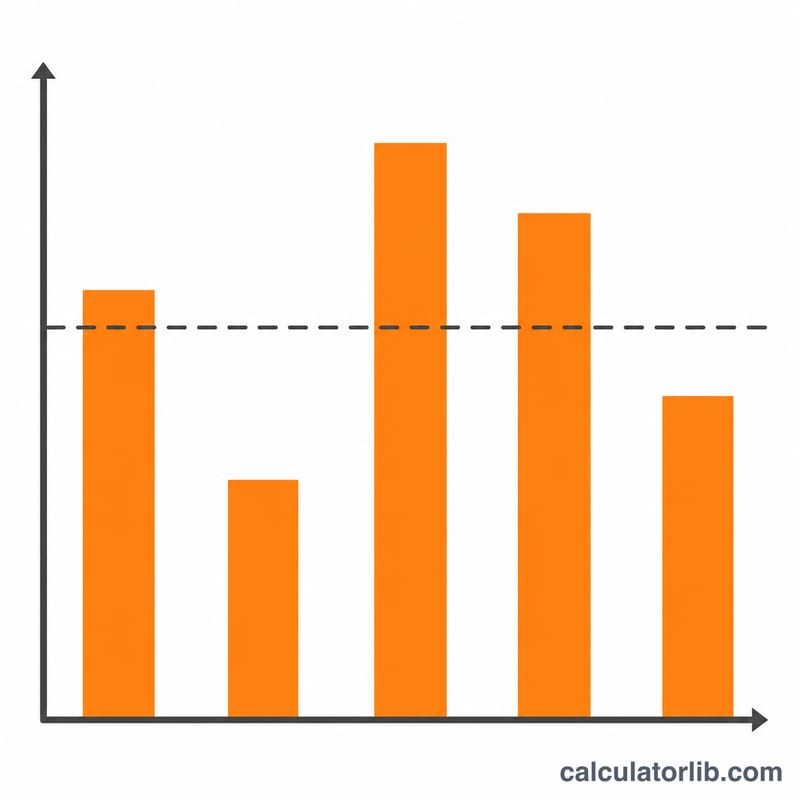
Points per game (PPG) is the most widely cited measure of a basketball player's scoring output. The tiers below reflect common context at the NBA level, where roughly 30 players per season average 20 or more points. These ranges are general guidelines — context such as position, role, and minutes played matters.
| Tier | PPG Range | What It Signifies |
|---|---|---|
| Elite scorer | 25.0+ | Franchise-caliber offensive engine; typically league scoring leaders and MVP candidates. |
| All-Star level | 20.0 – 24.9 | Primary scoring option, frequent All-Star selections, high offensive usage. |
| Solid starter | 15.0 – 19.9 | Reliable second or third scoring option in a starting lineup. |
| Role player | 8.0 – 14.9 | Complementary contributor, situational scorer, or specialist. |
| Bench / limited | Below 8.0 | Deep rotation, defensive specialist, or limited offensive role. |
For reference, an 82-game starter averaging 22.6 points lands squarely in the All-Star tier.
Interpreting Your PPG
PPG measures scoring volume, not scoring efficiency. A player who takes 25 shots to score 20 points is far less efficient than one who scores 20 on 12 shots, yet both post the same PPG. For that reason, PPG should never be read in isolation.
Sample size matters. An average drawn from a single game or a handful of games is highly volatile — one big or cold night swings it dramatically. A 40-point outburst in one game produces a 40.0 PPG that says little about true ability. Full-season averages (roughly 60–82 NBA games) are far more reliable indicators of a player's typical output.
Pair it with context stats. To understand the quality behind the volume, combine PPG with:
- Minutes per game — more minutes naturally inflate raw PPG; per-36-minute scoring normalizes for playing time.
- Usage rate — how often a player ends possessions; high PPG on high usage is expected.
- True Shooting % (TS%) — accounts for field goals, three-pointers, and free throws to show scoring efficiency, the natural complement to raw PPG.
In short, PPG answers "how much does this player score?" — pair it with efficiency metrics to answer "how well does this player score?"
FAQ
Does PPG include playoff games? Only if you include those points and games in your totals. Regular-season and playoff averages are usually reported separately.
Should I count games where a player didn't score? Yes. Every game the player appeared in counts toward games played, even a scoreless one, because it lowers the average accurately.
Is a higher PPG always better? Not necessarily. PPG measures volume scoring, not efficiency. A player with a high PPG may take many shots; efficiency stats like true shooting percentage tell the rest of the story.