
What is the Battery C-Rate Calculator?
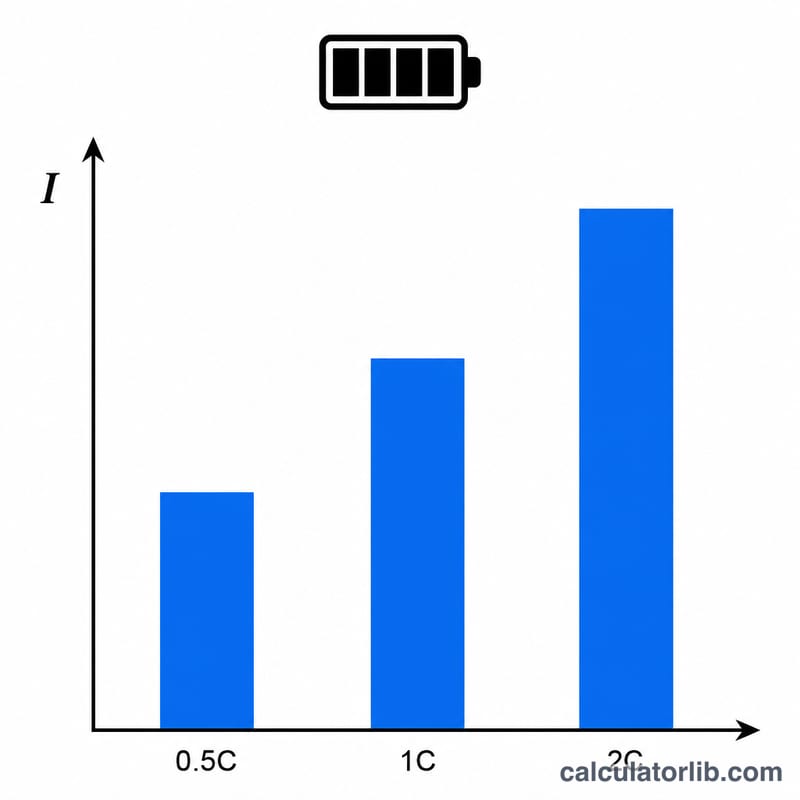
The C-rate describes how fast a battery is charged or discharged relative to its rated capacity. A C-rate of 1C means the full capacity is delivered in one hour; 2C means in half an hour; 0.5C means in two hours. This calculator converts a chosen C-rate and a battery capacity in amp-hours (Ah) into the resulting current in amperes (A), and tells you the theoretical time to fully charge or discharge.
How to use it
Enter the battery capacity in amp-hours and the desired C-rate. The tool multiplies them to give the current and computes the inverse of the C-rate to estimate the full charge/discharge time. Use it to size chargers, pick safe discharge limits, or estimate runtime.
The formula explained
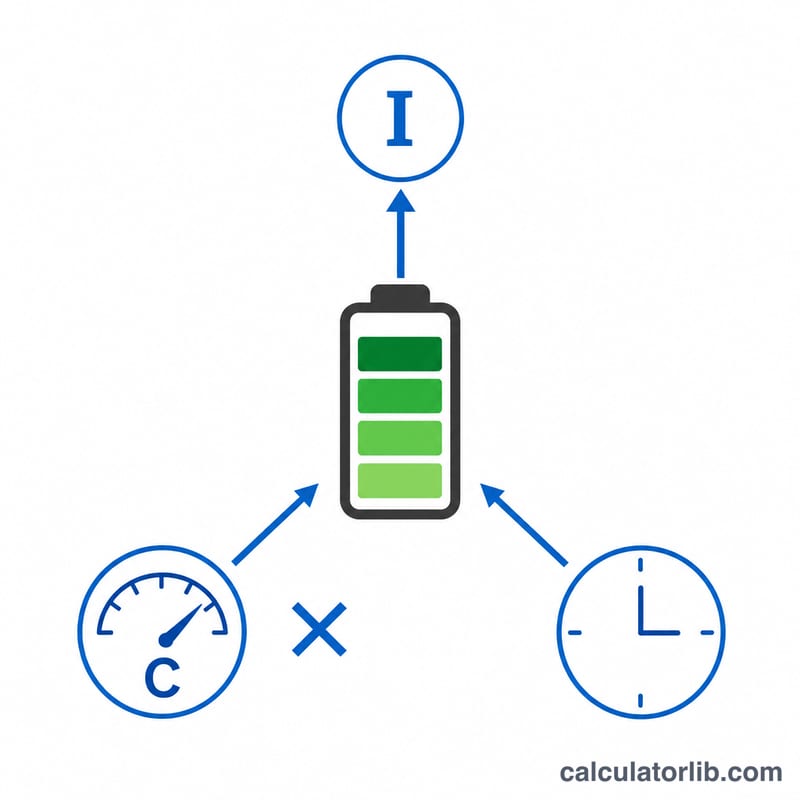
The core relationship is $$I = \text{C-rate} \times \text{Capacity}$$. Current scales linearly with both the C-rate and the capacity. The theoretical fill or empty time is $$t = \frac{1}{\text{C-rate}}$$ hours, independent of capacity, because higher capacity raises the current proportionally.
Worked example
Suppose you have a 2 Ah cell discharged at 2C. The current is $$2\text{C} \times 2\ \text{Ah} = 4\ \text{A}.$$ The theoretical discharge time is $$\frac{1}{2} = 0.5 \text{ hours, or } 30 \text{ minutes}.$$ If instead you used 0.5C on the same cell, the current would be \(1\ \text{A}\) and the time would be \(2\) hours.
Typical C-Rate Ranges by Battery Chemistry
The C-rate expresses charge or discharge current relative to a cell's rated capacity, where a current equal to \(1\,C\) fully charges or discharges the rated capacity in one hour. The ranges below are general guidelines for healthy operation at moderate temperatures; always verify the manufacturer's datasheet, since safe limits vary widely by cell construction, application (energy vs. power cells) and temperature.
| Chemistry | Typical charge C-rate | Typical continuous discharge C-rate | Notes |
|---|---|---|---|
| Li-ion (NMC/LCO, consumer) | 0.5C – 1C | 1C – 3C (power cells higher) | Charge to a fixed voltage with CC/CV; avoid charging below 0°C. |
| LiFePO4 (LFP) | 0.5C – 1C | 1C – 3C | Tolerant of higher rates; many cells rated for continuous 1C charge. |
| NiMH | 0.1C (standard) – 1C (fast) | 0.2C – 1C typical | Standard overnight charge ~0.1C for 14–16 h. |
| Lead-acid (flooded/AGM) | 0.1C – 0.3C | 0.05C – 0.2C for full rated capacity | High discharge rates sharply reduce usable capacity (Peukert effect). |
As a worked check, a 100 Ah LiFePO4 battery charged at 0.5C draws 50 A. These figures are general guidance, not a substitute for the cell datasheet.
C-Rate Scenario Comparison
Current is found with \(I = \text{C-Rate} \times \text{Capacity}\), and the theoretical time to move the full rated capacity is \(t = 1 / \text{C-Rate}\) hours (independent of capacity). Real charge/discharge times differ because of efficiency losses, CV tapering and depth-of-discharge limits.
| Capacity | C-rate | Current (A) | Theoretical time |
|---|---|---|---|
| 2 Ah | 0.2C | 0.4 A | 5 h |
| 2 Ah | 1C | 2 A | 1 h |
| 2 Ah | 2C | 4 A | 30 min |
| 10 Ah | 0.5C | 5 A | 2 h |
| 10 Ah | 1C | 10 A | 1 h |
| 10 Ah | 2C | 20 A | 30 min |
| 100 Ah | 0.2C | 20 A | 5 h |
| 100 Ah | 0.5C | 50 A | 2 h |
| 100 Ah | 1C | 100 A | 1 h |
| 100 Ah | 2C | 200 A | 30 min |
For example, discharging a 100 Ah battery at the 20 A current above (a 0.2C load) gives a theoretical runtime of 5 hours before reaching full depth of discharge.
Key Terms
- C-rate
- A normalized measure of charge or discharge current relative to capacity. \(1\,C\) means the rated capacity is delivered in one hour; \(0.5\,C\) takes two hours, \(2\,C\) takes half an hour.
- Amp-hour capacity (Ah)
- The charge a battery can deliver, equal to current multiplied by time. A 10 Ah cell can supply 10 A for one hour (ideally). Milliamp-hours (mAh) are simply thousandths of an Ah.
- Current (A)
- The rate of charge flow, in amperes. In this calculator it is the output: \(I = \text{C-Rate} \times \text{Capacity}\).
- Charge current
- The current pushed into the battery while charging. Keeping it within the chemistry's recommended charge C-rate protects cell life and safety.
- Discharge current
- The current drawn from the battery by a load. Higher discharge C-rates can reduce usable capacity and increase heat.
- Ah vs. Wh
- Amp-hours measure charge and ignore voltage, while watt-hours measure energy: \(\text{Wh} = \text{Ah} \times V\). Two batteries with the same Ah store different energy if their voltages differ, so Wh is the better basis for comparing how much work a pack can do.
FAQ
Does C-rate depend on voltage? No. C-rate uses capacity in amp-hours and gives current in amps; voltage is not part of this calculation.
Is the time exact? It is a theoretical ideal. Real batteries lose capacity at high C-rates and to internal resistance, so actual usable time is usually shorter.
What C-rate is safe? It depends on chemistry and manufacturer specs. Many lithium cells charge at 0.5C–1C and discharge at 1C–3C; always check the datasheet.