
What is the Battery Life Runtime Calculator?
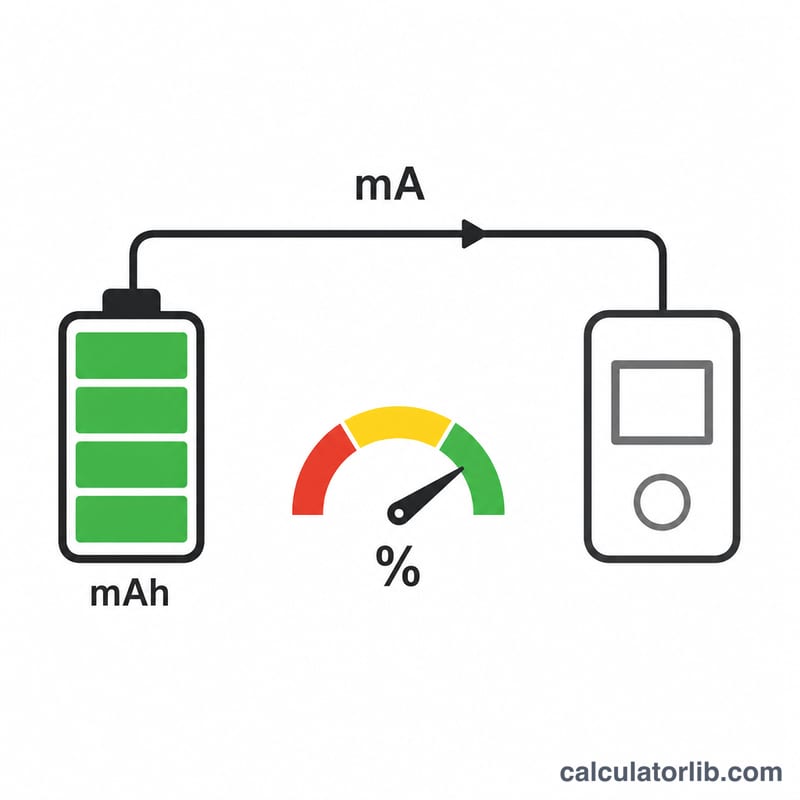
This tool estimates how long a battery will power a device before it is depleted. It uses the battery's rated capacity in milliamp-hours (mAh), the average current the device draws in milliamps (mA), and an efficiency factor that accounts for real-world losses such as voltage conversion, heat, and unusable capacity. The result is shown in hours, as well as a tidy hours-and-minutes breakdown.
How to use it
Enter the battery capacity printed on the cell or pack (e.g. 3000 mAh). Enter the load current your device draws on average — check the datasheet or measure it with a USB meter. Finally enter an efficiency percentage. Use 100% for an ideal estimate, or 70–90% to reflect typical real-world losses. Press calculate to see the projected runtime.
The formula explained
The core relationship is $$\text{Runtime (h)} = \frac{\text{Capacity (mAh)}}{\text{Load Current (mA)}} \times \frac{\text{Efficiency (\%)}}{100}$$. Capacity divided by current gives the theoretical run hours; multiplying by efficiency (as a decimal) derates that to a realistic figure. Both capacity and current must use the same time base — mAh and mA pair naturally, yielding hours.
Worked example
A 3000 mAh battery powers a device drawing 200 mA at 85% efficiency. Theoretical runtime is \(3000 \div 200 = 15\) hours. Applying efficiency: $$15 \times 0.85 = \textbf{12.75 hours}$$ or about 12 hours 45 minutes.
Typical Capacity and Current Draw Values
Battery runtime depends on two main numbers: how much charge the battery stores (capacity in mAh) and how fast your device draws it (load current in mA). The tables below list common, real-world values so you can plug realistic figures into the calculator.
Common Battery Capacities
| Battery type | Typical nominal voltage | Typical capacity (mAh) |
|---|---|---|
| AA alkaline | 1.5 V | 2000 – 3000 |
| AAA alkaline | 1.5 V | 800 – 1200 |
| AA NiMH rechargeable | 1.2 V | 1900 – 2700 |
| 18650 Li-ion | 3.7 V | 2500 – 3500 |
| 21700 Li-ion | 3.7 V | 4000 – 5000 |
| Smartphone battery | 3.7 – 3.85 V | 3000 – 5000 |
| Tablet battery | 3.7 – 3.85 V | 6000 – 10000 |
| USB power bank | 3.7 V (cells) | 10000 – 20000 |
Typical Device Load Currents
| Device / load | Typical current draw (mA) |
|---|---|
| Single indicator LED | 5 – 20 |
| Small microcontroller (active) | 10 – 50 |
| GPS tracker (periodic) | 30 – 120 |
| Bluetooth earbuds | 15 – 40 |
| Smartphone (idle / standby) | 10 – 50 |
| Smartphone (screen on, browsing) | 400 – 800 |
| Smartphone (gaming / video) | 800 – 1500 |
| Wi-Fi camera | 200 – 500 |
| Small DC motor / fan | 200 – 1000 |
Note that capacity is rated at the battery's own voltage. To compare batteries of different voltages, convert mAh to watt-hours; for example a 3000 mAh cell at 3.7 V stores roughly 11.1 Wh.
Runtime Across Different Scenarios
The runtime formula is:
$$\text{Runtime (h)} = \frac{\text{Capacity (mAh)}}{\text{Load (mA)}} \times \frac{\text{Efficiency (\%)}}{100}$$Real batteries never deliver 100% of their rated charge to the load, so an efficiency factor of 80–90% gives a realistic estimate. The table compares several common combinations.
| Scenario | Capacity (mAh) | Load (mA) | Efficiency | Runtime (h) | Runtime (h:min) |
|---|---|---|---|---|---|
| Phone, screen on | 3000 | 200 | 85% | 12.75 | 12 h 45 min |
| Power bank charging device | 5000 | 500 | 80% | 8.0 | 8 h 0 min |
| GPS tracker (low draw) | 10000 | 100 | 90% | 90.0 | 90 h 0 min |
| 18650 powering LED | 3000 | 20 | 90% | 135.0 | 135 h 0 min |
| Tablet video playback | 8000 | 900 | 85% | 7.56 | 7 h 33 min |
Worked example (first row): \( \frac{3000}{200} \times \frac{85}{100} = 15 \times 0.85 = 12.75 \) hours, which is 12 hours and 45 minutes (0.75 × 60 = 45 min). To express that 3000 mAh cell at 3.7 V as energy instead, it stores about 11.1 Wh.
Definitions & Glossary
- mAh (milliamp-hour) — capacity
- A measure of how much electric charge a battery stores. A 1000 mAh battery can theoretically supply 1000 mA for one hour, or 100 mA for ten hours.
- mA (milliamp) — load current
- The rate at which a device draws charge from the battery. Higher current empties the battery faster (1000 mA = 1 amp).
- Efficiency factor
- The fraction of rated capacity actually delivered to the load, accounting for voltage conversion losses, internal resistance, and the battery's inability to fully discharge. Typically 80–90% in practice.
- Wh (watt-hour)
- Energy capacity, found by multiplying amp-hours by voltage: Wh = (mAh ÷ 1000) × V. Useful for comparing batteries of different voltages and for airline carry-on limits.
- C-rate
- The charge or discharge current expressed relative to capacity. 1C drains the full capacity in one hour; 0.5C takes two hours. High C-rates reduce usable capacity and generate heat.
- Cutoff voltage
- The voltage at which a device stops drawing power to protect the cell. Because a battery is empty before reaching 0 V, usable capacity is always less than the theoretical rating.
- Self-discharge
- The gradual loss of charge while a battery sits unused. Alkaline and Li-ion lose only a few percent per month; older NiMH could lose much more.
Practical Tips to Extend Runtime
- Use a realistic efficiency. Enter 80–90% rather than 100%; this accounts for conversion losses and the charge you can't actually use before the cutoff voltage.
- Measure your real load. A cheap USB power meter or inline ammeter shows the device's actual current draw, which is far more accurate than a spec-sheet figure that may reflect peak rather than average use.
- Derate for cold and age. Cold temperatures and aged cells deliver less than rated capacity. Subtract 10–30% from estimated runtime for cold environments or batteries past a few hundred cycles.
- Add margin for peak loads. Devices with bursts (radio transmission, motors, screen wake) draw far more than their average. Size the battery for the average, but confirm the cell can supply the peak current without sagging below cutoff.
- Round down for safety. Treat the calculated runtime as an optimistic ceiling. For critical applications (alarms, trackers, medical devices), plan around 70–80% of the computed figure.
- Reduce the load itself. Lowering screen brightness, increasing sensor sleep intervals, and disabling idle radios cuts average current — often the most effective way to extend runtime.
This is general guidance for estimation and planning. Always follow the manufacturer's safety and discharge specifications for your specific battery and device.
FAQ
Why include an efficiency factor? Batteries rarely deliver 100% of their rated capacity due to voltage regulators, temperature, age, and cutoff voltages. An 80–90% factor gives more realistic results.
What efficiency should I use? For a quick best-case estimate use 100%. For phones, power banks, and DC-DC converters, 80–90% is common. For older or cold batteries, try 60–75%.
Can I use Wh and W instead? Yes — the same ratio works with watt-hours and watts. Just keep the units consistent; this calculator is set up for mAh and mA.