

What This Calculator Does
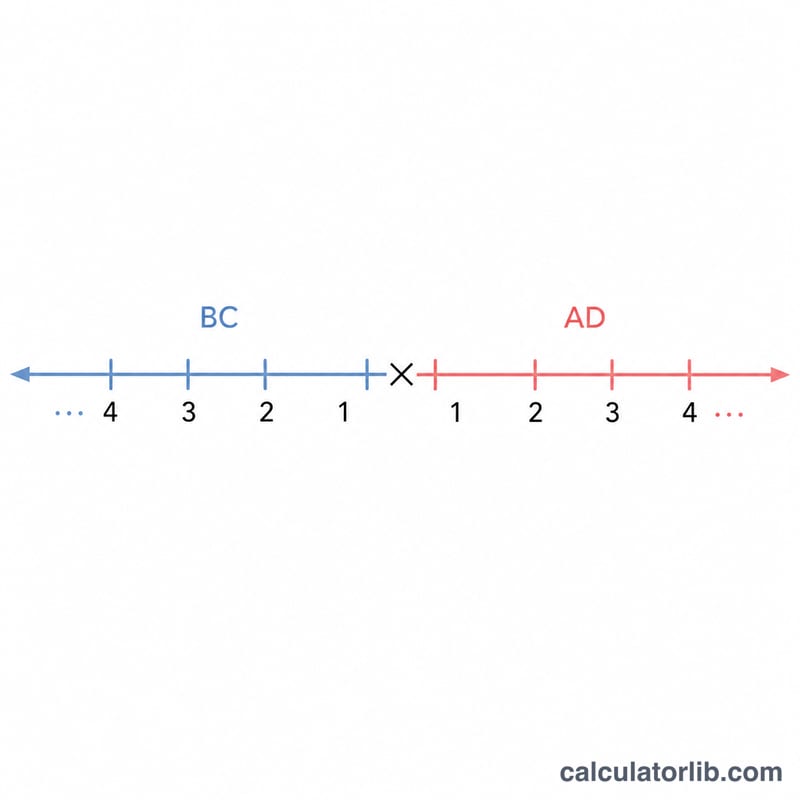
The BC to AD Year Calculator tells you how many years passed between a date in the BC era (Before Christ) and a date in the AD era (Anno Domini). Because the traditional Julian and Gregorian calendars have no "year zero" — 1 BC is immediately followed by 1 AD — a simple addition would over-count the span by one year. This tool corrects for that automatically.
How to Use It
Enter the BC year as a positive number (for example, 500 for 500 BC) and the AD year as a positive number (for example, 2024 for AD 2024). The calculator returns the total number of years elapsed between the two dates.
The Formula Explained
The elapsed span is calculated as:
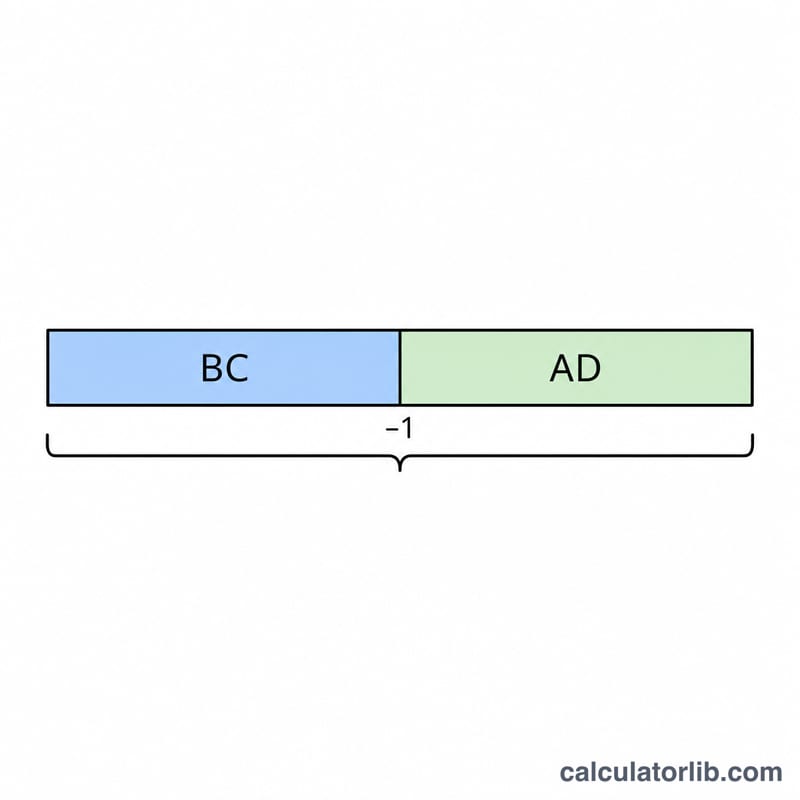
$$\text{Years} = \text{BC year} + \text{AD year} - 1$$The subtraction of 1 compensates for the absence of a year zero. Without it, you would be counting a non-existent year between 1 BC and AD 1.
Worked Example
How many years passed between 500 BC and AD 2024? Apply the formula:
$$500 + 2024 - 1 = 2523 \text{ years}$$So roughly 2,523 years separate those two points in time.
BC to AD Span Examples Across History
Because the Julian and Gregorian calendars have no year zero, the year immediately before AD 1 is 1 BC. To count the number of years between a BC year and an AD year, you add the two years together and subtract 1: \[\text{Years} = \text{BC Year} + \text{AD Year} - 1\] The subtraction corrects for the absent year zero. The examples below show the elapsed years for several notable historical dates measured to AD 2024.
| Event | BC Year | AD Year | Elapsed Years (BC + AD − 1) |
|---|---|---|---|
| Assassination of Julius Caesar | 44 BC | AD 2024 | 2067 |
| Traditional founding of Rome | 753 BC | AD 2024 | 2776 |
| First Olympic Games | 776 BC | AD 2024 | 2799 |
| Boundary of the eras | 1 BC | AD 1 | 1 |
| Battle of Marathon | 490 BC | AD 2000 | 2489 |
Note that the result counts the number of years spanned from the start of the BC year to the same point in the AD year. The single-year gap between 1 BC and AD 1 reflects that these are consecutive years with no intervening year zero.
Key Terms Explained
- BC (Before Christ) — A year-numbering label for dates before the traditional birth year of Jesus of Nazareth. BC years count backward: 2 BC is earlier than 1 BC, which is the last year before AD 1.
- AD (Anno Domini) — Latin for “in the year of the Lord.” AD years count forward from the start of the era. AD 1 is the first year of the Common Era, immediately following 1 BC.
- The missing year zero — The Julian and Gregorian calendars contain no year 0; the sequence runs … 2 BC, 1 BC, AD 1, AD 2 … Because of this, simply adding the BC and AD numbers overcounts the span by one year, which is why the formula subtracts 1. (Astronomical year numbering, used by astronomers, does include a year 0, where 1 BC = year 0 and 2 BC = year −1.)
- BCE / CE notation — “Before Common Era” (BCE) and “Common Era” (CE) are religiously neutral equivalents of BC and AD. They use exactly the same numbering, so 44 BC = 44 BCE and AD 2024 = 2024 CE, and the same year calculations apply.
FAQ
Why subtract one? Historical calendars skip directly from 1 BC to AD 1 — there is no year 0. Without subtracting 1, the result would be inflated by one year.
Can I enter the same era twice? This calculator is designed for one BC date and one AD date. For two AD dates or two BC dates you would simply subtract one from the other.
Is this exact to the day? No. It works in whole years only and does not account for the specific month or day within each year.