
What is the Beaufort Wind Scale?
The Beaufort wind scale is an empirical measure that relates wind speed to observed conditions on land and at sea. Devised by Sir Francis Beaufort in 1805, it runs from force 0 (calm) to force 12 (hurricane force). This calculator converts a measured wind speed into its Beaufort force number along with a plain-language description.
How to use it
Enter your wind speed, choose the unit (m/s, km/h, mph, or knots), and the calculator converts it to meters per second internally, then applies the Beaufort formula. You get the force number (0-12) and the standard description such as "Fresh breeze" or "Gale".
The formula explained
The modern relationship between wind speed in meters per second (\(v\)) and the Beaufort number (\(B\)) is:
$$B = \text{round}\left[\left(\frac{v}{0.836}\right)^{2/3}\right]$$The constant 0.836 and the 2/3 exponent reproduce the original observation-based scale closely. Results above 12 are capped at 12, since hurricane force is the top of the scale.
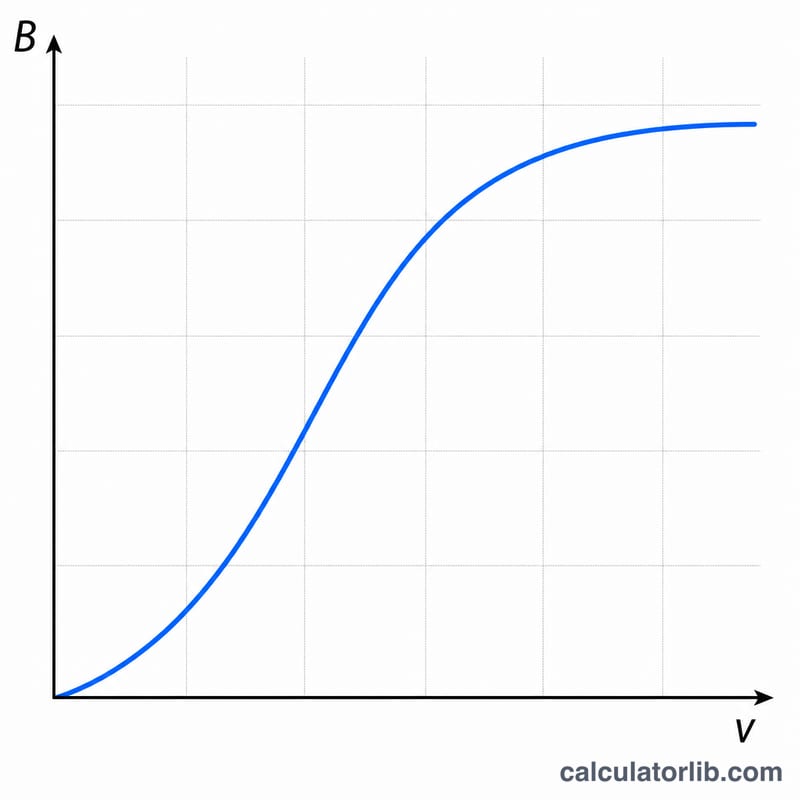
Worked example
Suppose the wind blows at 10 m/s. Then \((10 / 0.836) = 11.962\), and \(11.962^{2/3} = 5.27\), which rounds to 5 — a "Fresh breeze". A wind of 0.836 m/s gives \((1)^{2/3} = 1\), exactly force 1, "Light air".
Beaufort Scale Reference Table (Force 0-12)
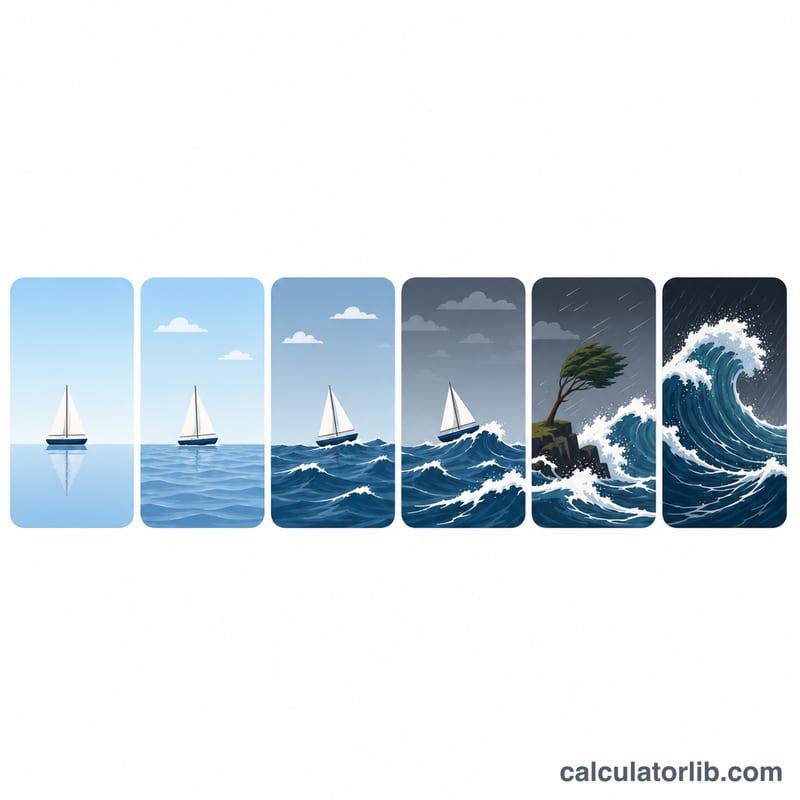
The Beaufort wind force scale relates wind speed to observed conditions on land and at sea. The force number \(B\) is estimated from the 10 m wind speed using \(B = \text{round}\left[\left(\frac{v}{0.836}\right)^{2/3}\right]\), where \(v\) is the wind speed in metres per second. The table below gives the standard speed ranges for each force together with typical observations.
| Force | Description | Knots | km/h | mph | m/s | Conditions on land / sea |
|---|---|---|---|---|---|---|
| 0 | Calm | <1 | <1 | <1 | 0–0.2 | Smoke rises vertically; sea like a mirror. |
| 1 | Light air | 1–3 | 1–5 | 1–3 | 0.3–1.5 | Smoke drifts, showing wind direction; ripples on water. |
| 2 | Light breeze | 4–6 | 6–11 | 4–7 | 1.6–3.3 | Wind felt on face, leaves rustle; small wavelets. |
| 3 | Gentle breeze | 7–10 | 12–19 | 8–12 | 3.4–5.4 | Leaves and twigs in motion; large wavelets, scattered whitecaps. |
| 4 | Moderate breeze | 11–16 | 20–28 | 13–18 | 5.5–7.9 | Dust and loose paper raised, small branches move; numerous whitecaps. |
| 5 | Fresh breeze | 17–21 | 29–38 | 19–24 | 8.0–10.7 | Small leafy trees sway; moderate waves, many whitecaps, some spray. |
| 6 | Strong breeze | 22–27 | 39–49 | 25–31 | 10.8–13.8 | Large branches move, umbrellas hard to use; large waves, white foam crests. |
| 7 | Near gale | 28–33 | 50–61 | 32–38 | 13.9–17.1 | Whole trees in motion, walking against wind is difficult; sea heaps up, foam blown in streaks. |
| 8 | Gale | 34–40 | 62–74 | 39–46 | 17.2–20.7 | Twigs broken from trees; moderately high waves, edges of crests break into spindrift. |
| 9 | Strong gale | 41–47 | 75–88 | 47–54 | 20.8–24.4 | Slight structural damage (chimney pots, slates); high waves, dense foam, spray reduces visibility. |
| 10 | Storm | 48–55 | 89–102 | 55–63 | 24.5–28.4 | Trees uprooted, considerable damage; very high waves with overhanging crests, surface white with foam. |
| 11 | Violent storm | 56–63 | 103–117 | 64–72 | 28.5–32.6 | Widespread damage (rare on land); exceptionally high waves, sea covered with foam patches. |
| 12 | Hurricane | ≥64 | ≥118 | ≥73 | ≥32.7 | Devastation; air filled with foam and spray, sea completely white, visibility severely reduced. |
Worked example: a steady wind of 12 m/s gives \(B = \text{round}\left[(12/0.836)^{2/3}\right] = \text{round}\left[14.35^{2/3}\right] = \text{round}[5.86] = \) 6, a strong breeze.
Wind Speed Unit Conversions
Wind speed is reported in several units. The base SI unit is the metre per second (m/s); meteorological reports often use km/h, while aviation and marine forecasts favour knots (nautical miles per hour). The exact relationships are:
- 1 m/s = 3.6 km/h = 2.23694 mph = 1.94384 knots
- 1 km/h = 0.27778 m/s = 0.62137 mph = 0.53996 knots
- 1 mph = 0.44704 m/s = 1.60934 km/h = 0.86898 knots
- 1 knot = 0.51444 m/s = 1.852 km/h = 1.15078 mph
| m/s | km/h | mph | knots |
|---|---|---|---|
| 1 | 3.60 | 2.24 | 1.94 |
| 5 | 18.00 | 11.18 | 9.72 |
| 10 | 36.00 | 22.37 | 19.44 |
| 15 | 54.00 | 33.55 | 29.16 |
| 20 | 72.00 | 44.74 | 38.88 |
| 25 | 90.00 | 55.92 | 48.60 |
| 30 | 108.00 | 67.11 | 58.32 |
Example conversion: a 20 kn marine wind equals 20 × 1.15078 = 23.02 mph, which is also 20 × 0.51444 ≈ 10.3 m/s — placing it at Force 6 (strong breeze) on the Beaufort scale.
FAQ
Is this scale international? Yes — the Beaufort scale is used worldwide in meteorology and marine forecasting, so no country adjustment is needed.
What unit should I use? Any of the four; the tool converts everything to m/s before computing. Aviation and marine reports often use knots, while weather apps use km/h or mph.
Why is the maximum 12? The classical Beaufort scale tops out at force 12 (hurricane force, ≥32.7 m/s). Some extended scales add forces 13-17 for tropical cyclones, but the standard scale stops at 12.