
What Is the Bench Press Percentage Calculator?
Most strength programs prescribe your training loads as a percentage of your one-rep max (1RM) — the heaviest weight you can lift once with good form. This calculator turns a percentage into an actual weight to load on the bar. It works for the bench press, squat, deadlift, overhead press or any barbell lift, and the units are agnostic (use pounds or kilograms — the answer comes out in whatever you entered).
How to Use It
Enter your one-rep max for the lift and the percentage your program calls for (for example 80%). The calculator returns the working weight. Round to the nearest plate increment you have available — typically the nearest 5 lb or 2.5 kg.
The Formula Explained
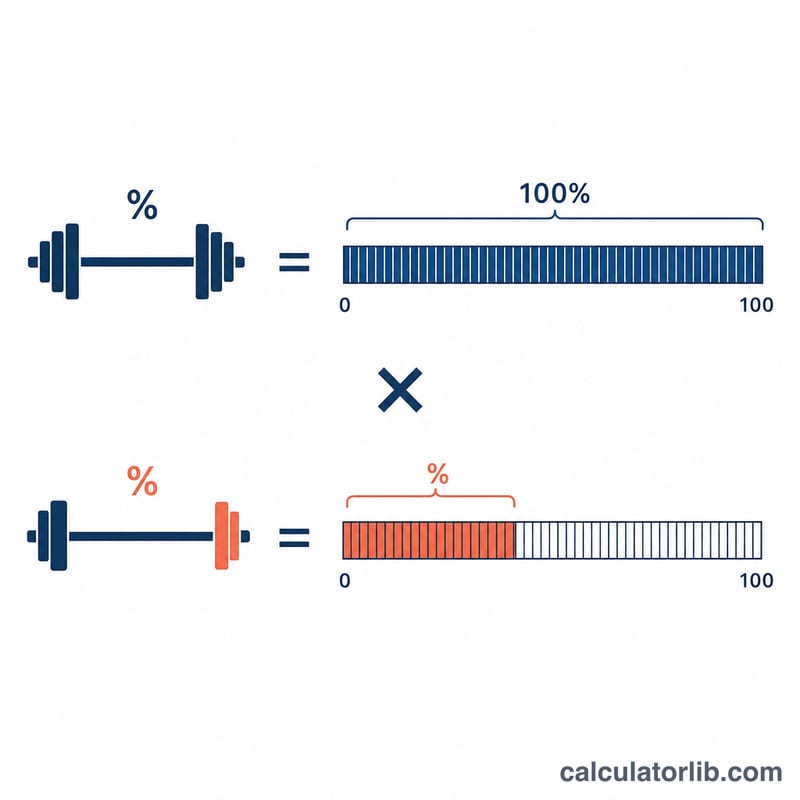
The math is simple proportionality:
$$\text{Working Weight} = \text{1RM} \times \frac{\text{Percentage}}{100}$$
If percentage is given as a decimal already (e.g. 0.8), multiply directly. Here we accept a whole-number percentage like 80, then divide by 100.
Worked Example
Suppose your bench press 1RM is 225 lb and today's session calls for 80%. $$\text{Working Weight} = 225 \times \frac{80}{100} = 225 \times 0.80 = \textbf{180 lb}$$ Load the bar to 180 lb (or the closest you can — 185 lb if your smallest plates are 5 lb).
Common Training Percentages and Their Purpose
Most strength programs prescribe working sets as a percentage of your one-rep max (1RM). Each band of intensity drives a different adaptation, from building muscular endurance at lighter loads to expressing maximal strength near 100%. Use the table below to match your goal to the right %1RM range.
| %1RM Band | Typical Reps per Set | Primary Adaptation | Notes |
|---|---|---|---|
| 50–60% | 15–20+ | Muscular endurance | Warm-ups, technique work, conditioning |
| 65–75% | 8–12 | Hypertrophy (muscle growth) | Classic bodybuilding rep range |
| 80–90% | 3–6 | Maximal strength | Lower reps, longer rest, heavier loads |
| 90–100% | 1–3 | Power / peaking | Neural strength, competition prep |
These ranges overlap and are guidelines rather than hard rules — individual rep capacity at a given percentage varies by lift, training age and fatigue.
Estimated Reps per Percentage (1RM Chart)
This widely used %1RM-to-reps chart estimates how many repetitions most trained lifters can complete at a given percentage of their one-rep max. Because lighter loads allow more reps, you can use the chart in reverse to estimate a 1RM from a set taken near failure.
| % of 1RM | Estimated Reps |
|---|---|
| 100% | 1 |
| 95% | 2 |
| 90% | 4 |
| 85% | 6 |
| 80% | 8 |
| 75% | 10 |
| 70% | 12 |
| 65% | 15 |
These figures are averages — actual reps at a given percentage depend on the exercise, your rate of fatigue and how close to true failure you train. If you only know a weight-for-reps set rather than a true max, estimate your max first with a one-rep max calculator, then apply the percentages above. This is general training information, not personalized coaching advice.
FAQ
What percentage should I train at? It depends on your goal: roughly 50–65% for technique/power, 70–85% for hypertrophy, and 85–100% for maximal strength. Follow your program.
How do I find my 1RM? Either test it directly under supervision or estimate it from a rep set using a 1RM formula (e.g. Epley or Brzycki).
Should I round the result? Yes — round to the nearest increment you can actually load. A few pounds either way will not change the training effect.