
What Is a Bill Rate Calculator?
A bill rate calculator converts the pay rate you give a worker into the bill rate you charge a client. The difference between the two — the markup — covers your overhead, taxes, benefits, recruiting costs, and profit margin. Staffing agencies, consultancies, IT contractors, and freelancers all rely on a consistent markup to price their services profitably.
How to Use It
Enter the worker's hourly pay rate and the markup percentage you want to apply. The calculator instantly shows the resulting bill rate per hour along with the dollar markup amount. Adjust the markup to see how your client price and margin change.
The Formula Explained
The core equation is simple:
$$\text{Bill Rate} = \text{Pay Rate} \times \left(1 + \frac{\text{Markup (\%)}}{100}\right)$$If you pay a contractor $25/hour and apply a 50% markup, you multiply $25 by 1.50, giving a bill rate of $37.50/hour. The extra $12.50 is your gross margin per hour before costs.
Worked Example
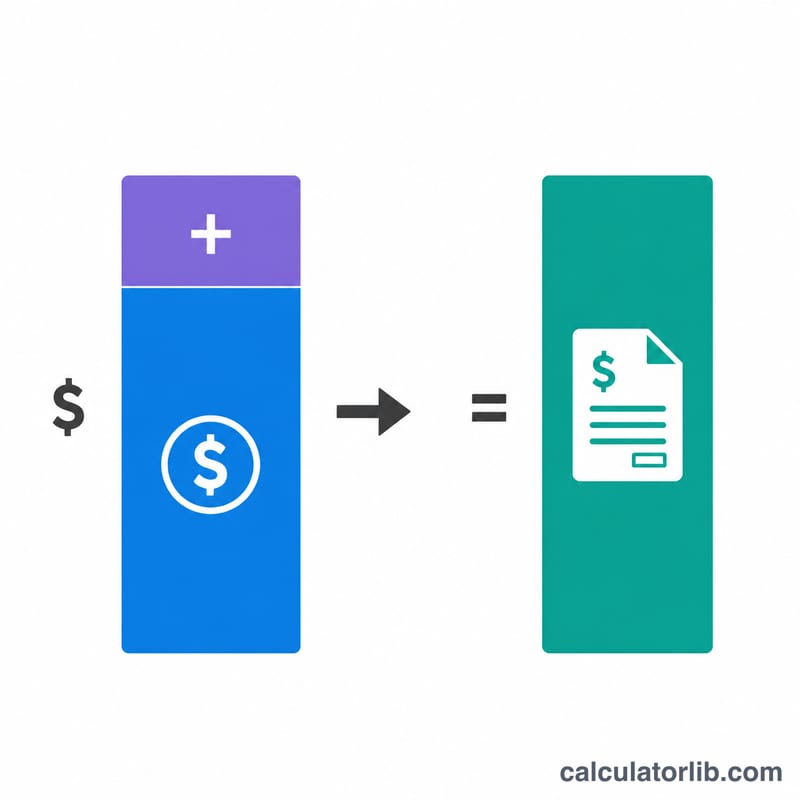
Suppose a developer is paid $80/hour and your agency uses a 65% markup.
$$\text{Bill Rate} = 80 \times (1 + 0.65) = 80 \times 1.65 = \$132/\text{hour}$$The markup amount is \(\$132 - \$80 = \$52/\text{hour}\), which the agency keeps to cover employer taxes, insurance, and profit.
Bill Rates Across Markup Scenarios
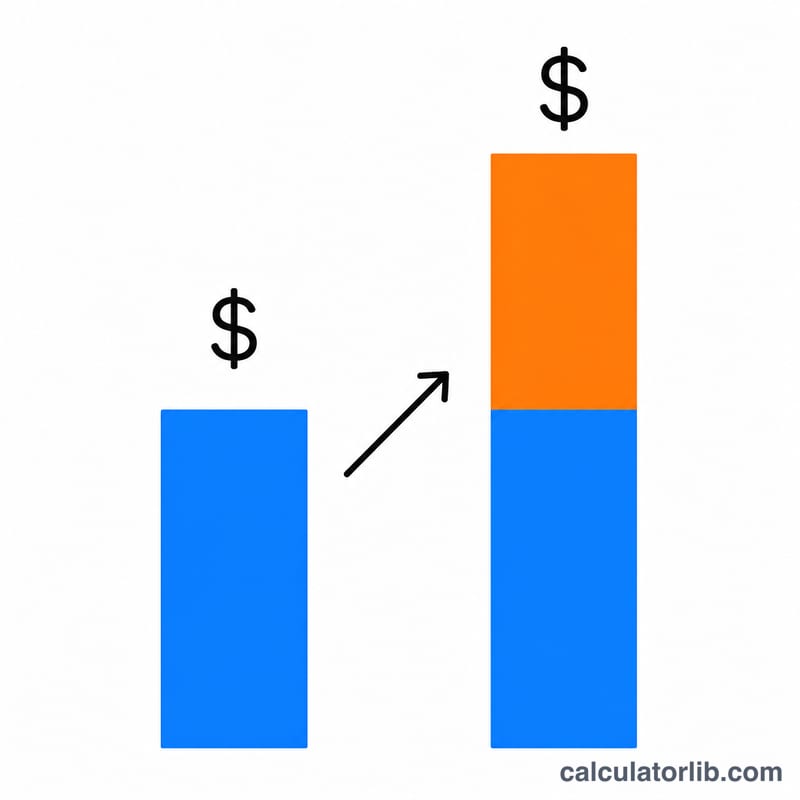
The table below holds a worker's pay rate fixed at $30.00/hr and applies a range of common staffing markups. The bill rate is found with \(\text{Bill Rate} = \text{Pay Rate} \times \left(1 + \frac{\text{Markup}}{100}\right)\). The dollar markup is the difference between the bill rate and the pay rate, and the equivalent gross margin shows what share of the bill rate is gross profit.
| Markup % | Bill Rate (on $30/hr) | Dollar Markup / hr | Equivalent Gross Margin % |
|---|---|---|---|
| 25% | $37.50 | $7.50 | 20.0% |
| 40% | $42.00 | $12.00 | 28.6% |
| 50% | $45.00 | $15.00 | 33.3% |
| 65% | $49.50 | $19.50 | 39.4% |
| 75% | $52.50 | $22.50 | 42.9% |
Note that markup and margin are not the same: a 50% markup corresponds to only a 33.3% margin because margin is measured against the higher bill rate rather than the pay rate.
Markup-to-Margin Reference Table
Markup is profit expressed as a percentage of the worker's pay (cost), while gross margin is profit expressed as a percentage of the bill rate (price). Convert between them with:
$$\text{Margin \%} = \frac{\text{Markup \%}}{100 + \text{Markup \%}} \times 100$$| Markup % | Equivalent Gross Margin % |
|---|---|
| 25% | 20.0% |
| 33% | 24.8% |
| 40% | 28.6% |
| 50% | 33.3% |
| 65% | 39.4% |
| 75% | 42.9% |
| 100% | 50.0% |
For example, a 40% markup gives \(\frac{40}{140} \times 100 = 28.6\%\) margin. As markup rises, the corresponding margin approaches but never reaches 100%.
Key Terms Defined
- Pay Rate
- The gross hourly wage paid to the worker before taxes and deductions. This is the cost base on which the markup is applied.
- Bill Rate
- The hourly rate the staffing firm or contractor charges the client. It equals the pay rate multiplied by one plus the markup percentage.
- Markup
- The amount added to the pay rate, expressed as a percentage of that pay rate. A 50% markup on a $30 pay rate adds $15, producing a $45 bill rate.
- Gross Margin
- Gross profit expressed as a percentage of the bill rate (revenue), not the pay rate. It is always lower than the equivalent markup percentage.
- Employer Burden / Overhead
- The employer-side costs layered on top of the pay rate — payroll taxes (Social Security, Medicare, unemployment), workers' compensation, benefits, and administrative overhead. The markup must cover this burden before any profit remains.
- Gross Profit per Hour
- The dollar difference between the bill rate and the pay rate for each hour worked. With a $42 bill rate and a $30 pay rate, gross profit is $12 per hour before subtracting employer burden.
FAQ
What is a typical markup percentage? Staffing markups commonly range from 25% to 75%, depending on the role, benefits offered, and competitive pressure. Specialized or hard-to-fill roles often command higher markups.
Is markup the same as margin? No. Markup is calculated on the pay rate (cost), while margin is the profit as a percentage of the bill rate. A 50% markup equals a 33.3% margin.
Does the bill rate include employer taxes? The markup is intended to cover employer-side payroll taxes, benefits, and overhead. Make sure your markup is high enough to absorb those costs and still leave profit.