
What This Calculator Does
Ever wondered what day of the week you were born — was it a lazy Sunday or a busy Monday? This Birthday Day of Week Calculator tells you the exact weekday of your date of birth, and as a bonus, it shows you what day your next birthday will land on. It works for any Gregorian calendar date.

How to Use It
Enter your birth year, pick your birth month from the dropdown, and type your birth day. Press calculate. The hero box shows the weekday you were born, and the table below shows the weekday of your upcoming birthday so you can start planning the party.
The Formula Explained
The tool uses Zeller's congruence, a classic algorithm for determining the day of the week for any date. January and February are treated as months 13 and 14 of the previous year. The formula computes h, where 0 = Saturday, 1 = Sunday, and so on. We remap this to the familiar Sunday–Saturday ordering for display. Because it uses pure integer arithmetic, it is exact and never drifts.
$$ h = \left( D + \left\lfloor \frac{13(m+1)}{5} \right\rfloor + K + \left\lfloor \frac{K}{4} \right\rfloor + \left\lfloor \frac{J}{4} \right\rfloor + 5J \right) \bmod 7 $$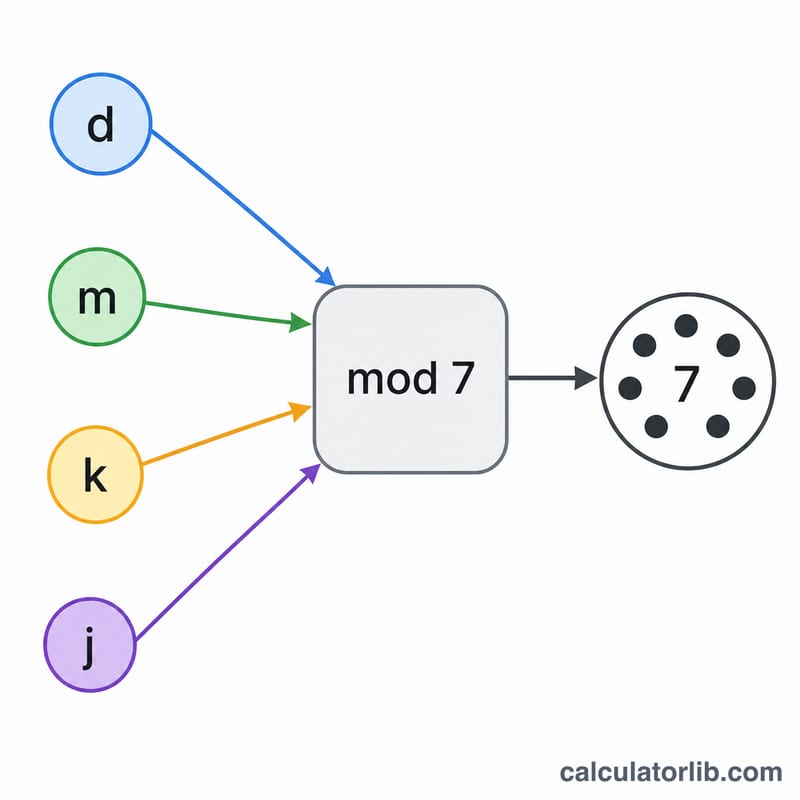
Worked Example
Take 15 July 1990. Here \(m = 7\), \(d = 15\), year = 1990 so \(k = 90\) and \(j = 19\). Then
$$ h = (15 + \lfloor 13\cdot 8/5 \rfloor + 90 + \lfloor 90/4 \rfloor + \lfloor 19/4 \rfloor + 5\cdot 19) \bmod 7 = (15 + 20 + 90 + 22 + 4 + 95) \bmod 7 = 246 \bmod 7 = 1 $$which is Sunday. So someone born on 15 July 1990 was born on a Sunday.
Variable Definitions
- \(D\) — Day of the month. The calendar day exactly as written, from 1 to 31. No adjustment is ever applied to \(D\).
- \(m\) — Adjusted month number. March = 3 through December = 12 are used as-is. January and February are special: they are treated as months 13 and 14 of the previous year. This is because Zeller's congruence treats March as the start of the year, which keeps the leap-day at the end of the cycle.
- \(Y\) — Adjusted year. If the date is in January or February, subtract 1 from the calendar year (since those months belong to the prior year in this scheme). All other months keep the original year.
- \(K\) — Year of the century. \(K = Y \bmod 100\), i.e. the last two digits of the adjusted year. For 2024 this is 24; for 1999 this is 99.
- \(J\) — Zero-based century. \(J = \lfloor Y / 100 \rfloor\), the century number without rounding up. For 2024 this is 20; for 1999 this is 19.
- \(h\) — Resulting day code. The remainder modulo 7 after combining all terms, giving a value 0–6 that maps to a weekday using the result-code table above.
More Worked Examples
Example 1 — A January date (showing the month and year shift)
Take 15 January 2000. Because the month is January, set \(m = 13\) and use the previous year, so the adjusted year is \(Y = 1999\). Then \(D = 15\), \(K = 1999 \bmod 100 = 99\), and \(J = \lfloor 1999/100 \rfloor = 19\).
$$h = \left(15 + \left\lfloor \tfrac{13(13+1)}{5} \right\rfloor + 99 + \left\lfloor \tfrac{99}{4} \right\rfloor + \left\lfloor \tfrac{19}{4} \right\rfloor + 5 \cdot 19 \right) \bmod 7$$
The floor terms are \(\lfloor 182/5 \rfloor = 36\), \(\lfloor 99/4 \rfloor = 24\), and \(\lfloor 19/4 \rfloor = 4\). Summing: \(15 + 36 + 99 + 24 + 4 + 95 = 273\). Then \(273 \bmod 7 = 0\), so \(h = 0\) → Saturday. January 15, 2000 was indeed a Saturday.
Example 2 — A leap-day birthday (29 February 2000)
For 29 February 2000, February is also shifted: \(m = 14\) and the adjusted year is \(Y = 1999\), giving \(K = 99\), \(J = 19\), and \(D = 29\).
$$h = \left(29 + \left\lfloor \tfrac{13(14+1)}{5} \right\rfloor + 99 + \left\lfloor \tfrac{99}{4} \right\rfloor + \left\lfloor \tfrac{19}{4} \right\rfloor + 5 \cdot 19 \right) \bmod 7$$
Here \(\lfloor 195/5 \rfloor = 39\), \(\lfloor 99/4 \rfloor = 24\), \(\lfloor 19/4 \rfloor = 4\). Summing: \(29 + 39 + 99 + 24 + 4 + 95 = 290\), and \(290 \bmod 7 = 3\), so \(h = 3\) → Tuesday. February 29, 2000 fell on a Tuesday. Note that 2000 is a leap year because it is divisible by 400.
Example 3 — A recent date (4 July 2023)
For 4 July 2023, July is a normal month, so \(m = 7\) with no year change: \(Y = 2023\), \(D = 4\), \(K = 23\), \(J = 20\).
$$h = \left(4 + \left\lfloor \tfrac{13(7+1)}{5} \right\rfloor + 23 + \left\lfloor \tfrac{23}{4} \right\rfloor + \left\lfloor \tfrac{20}{4} \right\rfloor + 5 \cdot 20 \right) \bmod 7$$
The floors are \(\lfloor 104/5 \rfloor = 20\), \(\lfloor 23/4 \rfloor = 5\), \(\lfloor 20/4 \rfloor = 5\). Summing: \(4 + 20 + 23 + 5 + 5 + 100 = 157\), and \(157 \bmod 7 = 3\), so \(h = 3\) → Tuesday. Independence Day 2023 was a Tuesday.
FAQ
Does it work for old dates? Yes, for any date on the proleptic Gregorian calendar. Dates before the 1582 calendar reform may differ from historical records that used the Julian calendar.
How is leap year handled? Zeller's congruence handles leap years automatically through its modular arithmetic, so February 29 dates are computed correctly.
What if my birthday already passed this year? The next-birthday result automatically rolls forward to next year if your birthday has already occurred this year.