
What is the Bleach Dilution Calculator?
This tool tells you exactly how much liquid bleach (sodium hypochlorite) and water to combine to reach a target disinfectant strength measured in parts per million (ppm). It is useful for sanitizing surfaces, food-contact items, water, and equipment where a specific chlorine concentration is required.
How to use it
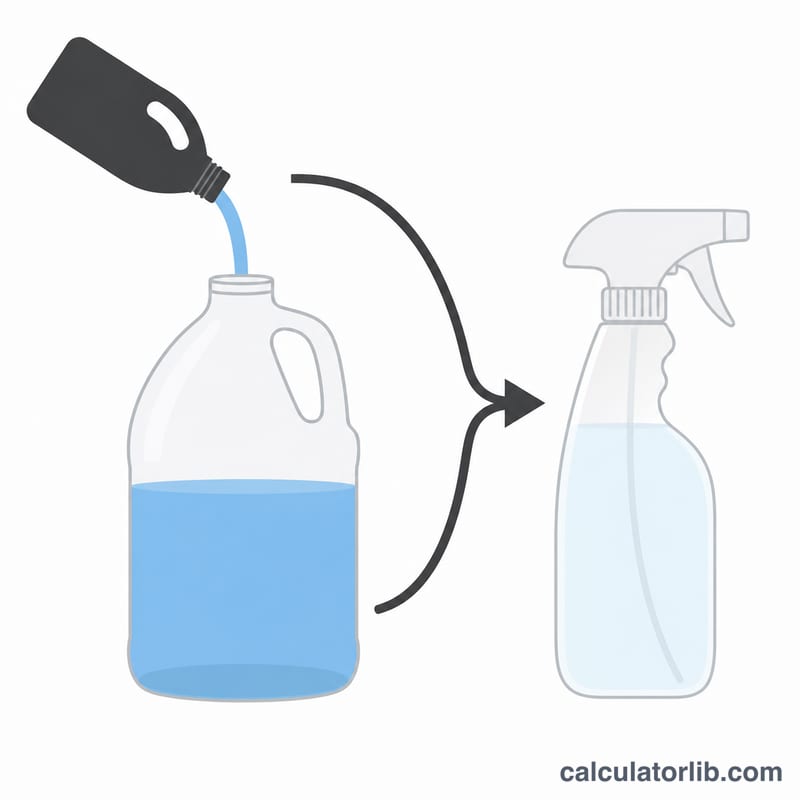
Enter three values: the target concentration you want in ppm, the total volume of solution you want to make in millilitres, and the stock concentration of your bleach as a percentage of sodium hypochlorite (household bleach is typically 5.25%–8.25%). The calculator returns how many millilitres of bleach to add and how much water to top up with.
The formula explained
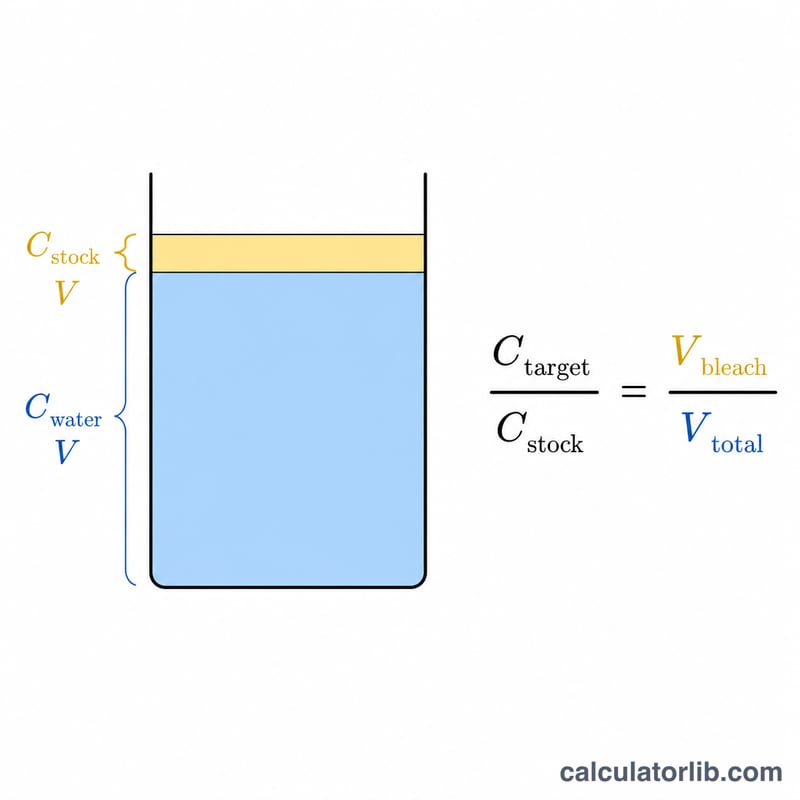
Because 1% sodium hypochlorite equals 10,000 ppm of available chlorine, the stock strength in ppm is simply the percentage multiplied by 10,000. The volume of bleach needed is then:
$$V_{bleach} = \frac{C_{target} \times V_{total}}{C_{stock}}$$
The water volume is the total volume minus the bleach volume.
$$V_{water} = V_{total} - V_{bleach}$$
Worked example
You want 1,000 mL of a 1,000 ppm sanitizing solution from 5.25% bleach. Stock ppm = \(5.25 \times 10{,}000 = 52{,}500\) ppm. Bleach volume = \(\frac{1{,}000 \times 1{,}000}{52{,}500} \approx 19.05\) mL. Water = \(1{,}000 - 19.05 \approx 980.95\) mL.
Recommended Bleach Concentrations by Use
Different disinfection tasks call for very different chlorine concentrations. The table below lists widely referenced target levels (as available chlorine in parts per million) and the standard or agency that publishes guidance for each use. Always confirm requirements with the current version of the applicable standard, as local rules and product labels may differ.
| Use | Typical target (ppm) | Source / standard |
|---|---|---|
| Emergency drinking water disinfection | ~50–100 ppm (contact, then aerate) | EPA / CDC emergency disinfection guidance |
| Food-contact surface sanitizing (no rinse) | ~200 ppm (max ~200 ppm without rinse) | FDA Food Code |
| General hard-surface disinfection | ~600–800 ppm | CDC environmental cleaning guidance |
| Blood / biohazard spill cleanup | ~1,000–5,000 ppm (1:100 to 1:10 dilution of household bleach) | CDC / OSHA bloodborne pathogens guidance |
Note: 5,000 ppm corresponds to roughly a 1:10 dilution of standard 5.25% household bleach, and 500 ppm to roughly a 1:100 dilution. These are general references, not a substitute for the directions on your specific disinfectant label.
Bleach Needed for Common Mixes
The volume of bleach to add is found with \(V_{\text{bleach}} = \dfrac{\text{Target (ppm)} \times \text{Total Volume (mL)}}{\text{Stock (\%)} \times 10000}\), then the water is the remainder. The scenarios below assume 5.25% (standard) and 8.25% (concentrated) household bleach, mixing into 1 L (1000 mL) and 4 L (4000 mL) total volumes.
| Target ppm | Total volume | Stock % | Bleach (mL) | Water (mL) |
|---|---|---|---|---|
| 200 | 1 L (1000 mL) | 5.25% | 3.81 | 996.19 |
| 200 | 4 L (4000 mL) | 5.25% | 15.24 | 3984.76 |
| 200 | 4 L (4000 mL) | 8.25% | 9.70 | 3990.30 |
| 1000 | 1 L (1000 mL) | 5.25% | 19.05 | 980.95 |
| 1000 | 4 L (4000 mL) | 8.25% | 48.48 | 3951.52 |
| 5000 | 1 L (1000 mL) | 5.25% | 95.24 | 904.76 |
| 5000 | 4 L (4000 mL) | 8.25% | 242.42 | 3757.58 |
For example, to reach 5,000 ppm in 1 L of 5.25% bleach: \(V_{\text{bleach}} = \dfrac{5000 \times 1000}{5.25 \times 10000} = 95.24\) mL, which is close to the familiar 1:10 dilution. If you already know the concentration in percent, you can convert it to ppm with a percent-to-ppm converter.
Practical Mixing Tips
- Add bleach to water, not water to bleach. Pouring concentrate into a partly filled container reduces splashing and limits concentrated fumes.
- Use fresh bleach. Sodium hypochlorite loses strength over time; bottles more than 6–12 months old (or stored hot) may be well below their labeled percent. If you suspect it has degraded, increase the volume added or replace the bottle.
- Measure small volumes precisely. A few milliliters makes a large difference at low ppm — use an oral syringe or graduated dropper for amounts under ~10 mL rather than eyeballing.
- Mix only what you need and use it promptly. Diluted chlorine solutions lose effectiveness within about 24 hours; label the container with the concentration and date, and remake daily.
- Respect required contact time. Surfaces generally must stay visibly wet for the time stated on the product label (often several minutes) for disinfection to be effective.
- Ventilate and never mix with ammonia or acids. Combining bleach with ammonia, acidic cleaners, or vinegar releases toxic gases. Use in a ventilated area and wear gloves and eye protection.
This is general information for safe mixing and is not professional, medical, or regulatory advice. For food service, healthcare, or biohazard work, follow the specific concentrations and procedures required by your applicable standards and product label.
FAQ
What ppm should I use? Common guidance: ~200 ppm for food-contact surfaces and ~1,000–5,000 ppm for heavy disinfection. Follow the guidance for your specific use.
What if I don't know my bleach percent? Check the label; household bleach is usually 5.25% to 8.25% sodium hypochlorite.
Why does the bleach lose strength? Sodium hypochlorite degrades over time and with heat and light, so old bleach is weaker than its labeled percentage.