
What is body frame size?
Body frame size describes the relative size of your skeleton — small, medium, or large. Two people of the same height can carry very different amounts of bone and structure, which affects their healthy weight range. Because the wrist contains little fat and muscle, its circumference is a convenient proxy for skeletal size. This calculator uses the classic height-to-wrist ratio method to classify your frame.
How to use this calculator
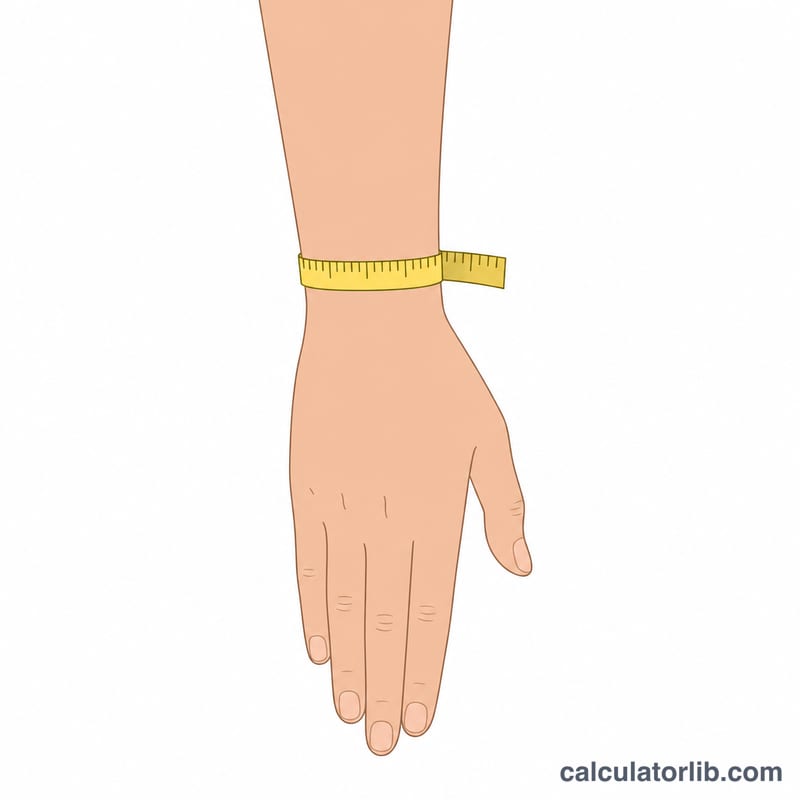
Select your gender, enter your height in centimetres, and measure the circumference of your smaller wrist (just above the wrist bone, where you would wear a watch) in centimetres. The calculator divides height by wrist circumference and compares the result to established thresholds to report a small, medium, or large frame.
The formula explained
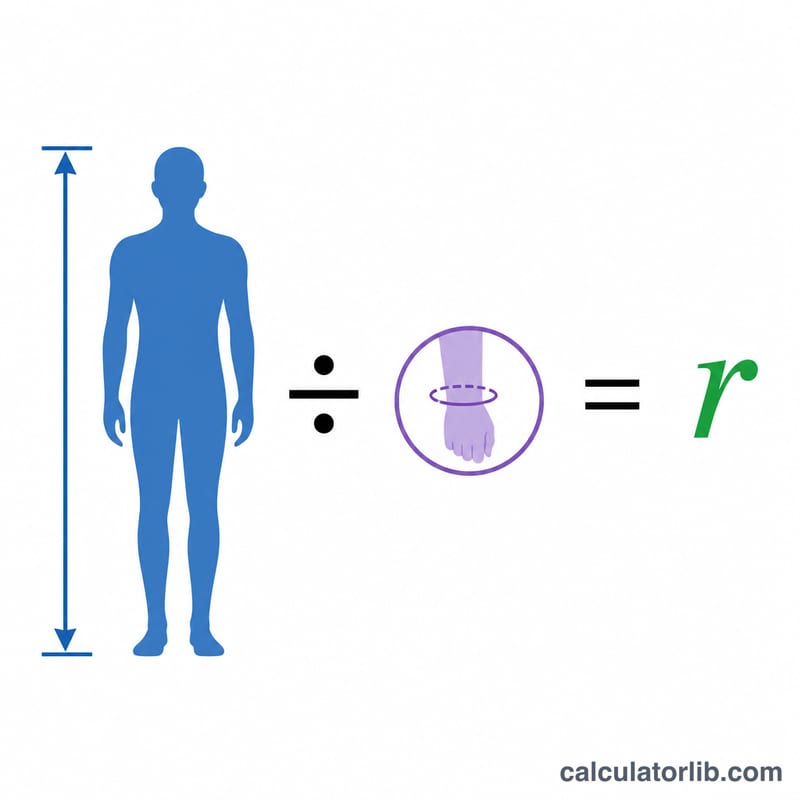
First compute the ratio r = height ÷ wrist circumference.
$$r = \dfrac{\text{height}_{cm}}{\text{wrist}_{cm}}$$A larger ratio means a thinner wrist relative to height, indicating a smaller frame. For men, \(r\) above 10.4 is small, below 9.6 is large, and in between is medium. For women, \(r\) above 11.0 is small, below 10.1 is large, and in between is medium.
Worked example
A man who is 180 cm tall with a 17 cm wrist has
$$r = \frac{180}{17} \approx 10.59$$Since 10.59 is greater than the male small threshold of 10.4, his frame is classified as small.
Frame Size Threshold Reference
This method classifies your skeletal frame from the ratio of your height to your wrist circumference, both measured in the same unit (centimeters):
$$r = \frac{\text{height}_{cm}}{\text{wrist}_{cm}}$$A larger ratio means your wrist is relatively small for your height (a smaller frame), while a smaller ratio means your wrist is relatively large for your height (a larger frame). The thresholds differ by sex because of differences in average skeletal proportions.
| Sex | Height-to-wrist ratio (r) | Frame size |
|---|---|---|
| Men | r > 10.4 | Small |
| 9.6 ≤ r ≤ 10.4 | Medium | |
| r < 9.6 | Large | |
| Women | r > 11.0 | Small |
| 10.1 ≤ r ≤ 11.0 | Medium | |
| r < 10.1 | Large |
Worked example: a man who is 178 cm tall with a 17.5 cm wrist has a ratio of 10.2, which falls in the 9.6–10.4 band and indicates a medium frame. Measure the wrist just past the wrist bone (distal to the styloid process), on the hand you write with, pulling the tape snug but not tight.
Interpreting Your Frame Size
Frame size is an estimate of your skeletal structure — the relative thickness of your bones and width of your joints — not a measure of body fat, muscle or overall health. Two people of identical height and weight can have different frame sizes simply because one has heavier, broader bones.
- Small frame: relatively slender bones and narrow joints for your height. Small-framed people tend to sit toward the lower end of healthy-weight ranges.
- Medium frame: average skeletal proportions, matching the midpoint of standard height–weight tables.
- Large frame: relatively broad, heavy bones and wide joints. Large-framed people often carry more weight at the same height while remaining lean.
The classic use of frame size is to refine ideal-weight estimates. Traditional height–weight tables (such as the Metropolitan Life tables) and formulas like the Devine equation give a single target for a given height and sex; frame size adjusts that target so a large-framed person aims a little higher and a small-framed person a little lower. For example, you can compare your weight against a standard ideal body weight and shade it up or down according to your frame.
The same logic applies when reading a BMI result: BMI treats all people of a given height the same, so a large-framed individual may sit at the upper end of the healthy BMI range yet still have a low body-fat percentage, while a small-framed person may be perfectly healthy lower in the range. Frame size therefore adds useful context, but it does not replace direct measures of body composition or a clinician's assessment.
This is general educational information, not medical advice. The wrist-ratio method is a quick approximation derived from population averages; for individualized weight or health goals, consult a qualified healthcare professional.
FAQ
Which wrist should I measure? Measure your dominant (usually slightly larger) wrist at its narrowest point for consistency.
Is frame size the same as being overweight? No. Frame size reflects bone structure, not body fat. Use it alongside BMI for a healthy-weight target, not as a fitness measure on its own.
How accurate is this method? It is a quick estimate. Elbow breadth measurement is considered more precise but requires calipers; the wrist-ratio method is easy to do at home.