
What Is the Boost Horsepower Calculator?
The Boost Horsepower Calculator estimates how much power an engine can make when you add forced induction — a turbocharger or supercharger. By compressing the intake air, boost forces more air (and therefore more fuel) into each cylinder, raising the engine's power output roughly in proportion to the total absolute pressure entering the engine.
How to Use It
Enter your engine's current naturally aspirated horsepower and the boost pressure you plan to run, measured in pounds per square inch (PSI). The calculator returns an estimated boosted horsepower figure, the raw horsepower gain, and the percentage increase. Use it for quick "what-if" planning before committing to a turbo or blower setup.
The Formula Explained
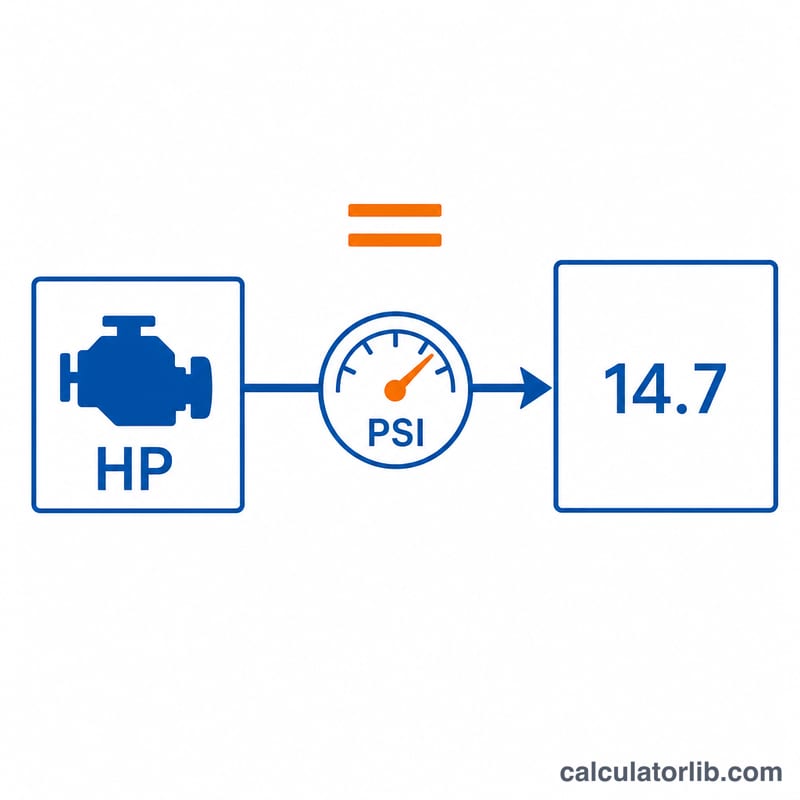
At sea level the atmosphere already pushes about 14.7 PSI of pressure into your engine. Adding boost increases the total absolute pressure to (boost PSI + 14.7). Power scales with the pressure ratio, so:
$$\text{HP}_{\text{boosted}} = \text{HP}_{\text{NA}} \times \frac{\text{Boost (PSI)} + 14.7}{14.7}$$
This is a first-order estimate. It assumes the engine can ingest and burn the extra air efficiently and ignores real-world losses like heat (which is why intercoolers matter), volumetric efficiency changes, and fueling limits.
Worked Example
Suppose a naturally aspirated engine makes 200 HP and you add 7 PSI of boost:
$$\text{HP}_{\text{boost}} = 200 \times \frac{7 + 14.7}{14.7} = 200 \times \frac{21.7}{14.7} \approx \textbf{295.24 HP}$$, a gain of about 95.24 HP, or roughly a 47.6% increase.
Boost HP Across Common Boost Levels
The basic forced-induction estimate assumes power scales with the ratio of absolute manifold pressure to standard atmospheric pressure (14.7 PSI at sea level):
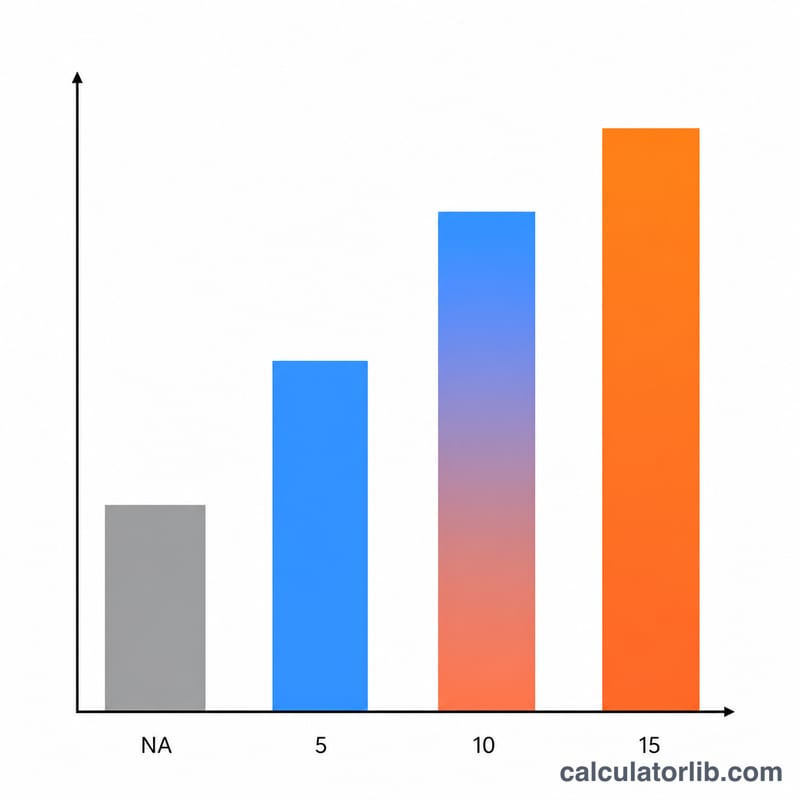
$$\text{HP}_{\text{boosted}} = \text{HP}_{\text{NA}} \times \frac{\text{Boost} + 14.7}{14.7}$$The table below uses a fixed naturally aspirated baseline of 200 HP and shows the estimated boosted output, the absolute power gain, and the percentage increase at common boost levels.
| Boost (PSI) | Boosted HP (from 200 HP) | HP Gain | % Increase |
|---|---|---|---|
| 5 | 268 | 68 | 34.0% |
| 7 | 295 | 95 | 47.6% |
| 10 | 336 | 136 | 68.0% |
| 14 | 390 | 190 | 95.2% |
| 20 | 472 | 272 | 136.1% |
Note on ranges: Street-driven cars on stock or lightly modified internals typically run 5–10 PSI, while race or heavily built engines may run 15–25+ PSI with upgraded pistons, rods, fuel systems, and tuning. This formula is an idealized estimate — real-world gains are usually lower because of intercooler efficiency losses, intake-air heating, less-than-perfect volumetric efficiency, and fueling or tuning limits.
Typical Boost Pressure Ranges
Boost is the pressure your turbocharger or supercharger forces into the intake above atmospheric pressure (gauge pressure). The practical limit depends far more on the strength of the engine internals and the quality of the tune than on the compressor itself.
| Range | Boost (PSI) | Typical Use | Internals |
|---|---|---|---|
| Mild / street | 5–8 | Daily drivers, factory-boosted cars, conservative upgrades | Usually safe on stock internals |
| Moderate | 8–14 | Performance street builds, stage 1–2 kits | Stock internals often near their limit; tuning critical |
| High / built | 15–25+ | Track, drag, and competition engines | Forged pistons/rods, upgraded fuel system, intercooling required |
Turbo vs. supercharger: A turbocharger is driven by exhaust gases and tends to build boost progressively with RPM, often allowing higher peak boost but with some lag. A supercharger is belt-driven off the crankshaft and delivers boost almost immediately and more linearly, though it consumes engine power to spin and is commonly run at more modest boost levels (typically 5–12 PSI on street setups).
Stock-internal limits: Many factory engines tolerate roughly 6–9 PSI safely, but this varies widely by engine. Heat, knock, and fuel quality matter more than the raw number — always rely on proper tuning, adequate fueling, and knock monitoring rather than chasing PSI alone.
Key Terms Explained
- Boost pressure
- The amount of intake pressure produced by a forced-induction system above atmospheric pressure, measured in PSI (gauge). 0 PSI of boost equals normal atmospheric pressure.
- Naturally aspirated (NA)
- An engine that draws air using only atmospheric pressure and piston vacuum, with no turbocharger or supercharger. Its rated power is the baseline (\(\text{HP}_{\text{NA}}\)) used in the boost formula.
- Absolute vs. gauge pressure
- Gauge pressure is measured relative to the surrounding atmosphere (what a boost gauge reads). Absolute pressure adds atmospheric pressure (\(\approx 14.7\) PSI at sea level): \(P_{\text{abs}} = P_{\text{gauge}} + 14.7\). The formula uses absolute pressure because power scales with the total air mass entering the cylinder.
- Pressure ratio
- The ratio of absolute outlet pressure to absolute inlet pressure, \(\frac{\text{Boost} + 14.7}{14.7}\). This multiplier is what scales NA horsepower up to estimated boosted horsepower.
- Intercooler
- A heat exchanger that cools the compressed (and therefore heated) intake charge before it enters the engine. Cooler, denser air improves power and reduces the risk of knock, helping real output approach the idealized estimate.
- Volumetric efficiency (VE)
- How completely a cylinder fills with air relative to its theoretical capacity on each intake stroke. Forced induction can push VE above 100%. Because the simple boost formula assumes ideal filling, real gains are typically a bit lower.
- Turbocharger vs. supercharger
- Both compress intake air to make boost. A turbocharger uses exhaust energy to spin its compressor (efficient but with some lag), while a supercharger is mechanically driven by the engine's crankshaft (instant response but consumes some engine power).
FAQ
Is this an exact power figure? No. It is a theoretical estimate. Real gains depend on intercooling, fuel delivery, engine internals, tuning, and altitude.
Why 14.7 PSI? That is the approximate atmospheric pressure at sea level. At higher elevations the value is lower, so boosted gains over a baseline can differ.
Can my engine handle the boost? Always confirm your engine's safe limits. High boost without supporting modifications and proper tuning can cause engine damage.